
Listen to this Post
🎯 Introduction
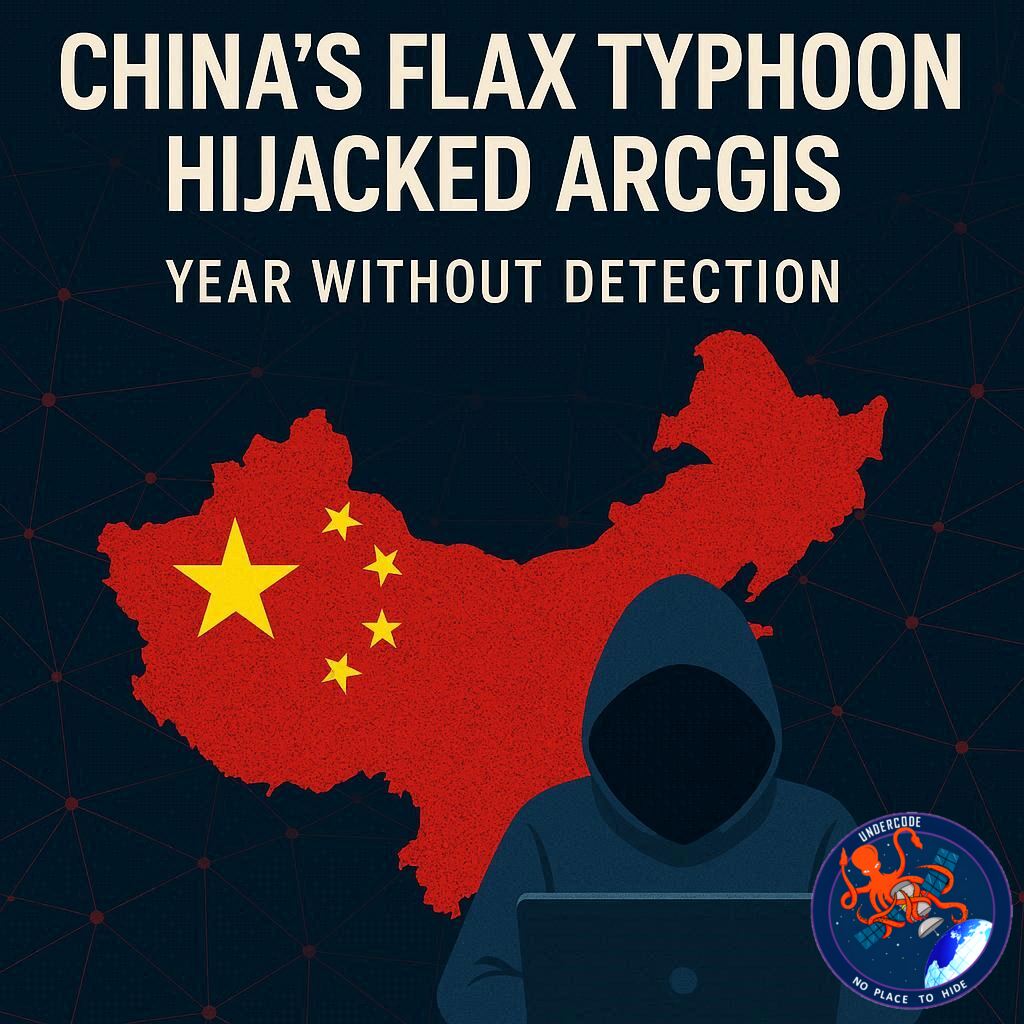
In the quiet corridors of cyberspace, an uninvited guest lingered for over a year. The guest was Flax Typhoon, a Chinese state-linked Advanced Persistent Threat (APT) group also known as Ethereal Panda or RedJuliett. Their target? ArcGIS, one of the world’s most trusted geographic information systems—used in everything from disaster recovery and infrastructure planning to national defense logistics. What appeared to be a harmless mapping tool became a weaponized backdoor, transforming trusted software into a spy’s hidden lair.
🧩 The Long Shadow of Flax Typhoon
For more than twelve months, Flax Typhoon covertly controlled an ArcGIS system, exploiting it as a backdoor into enterprise networks. ArcGIS, developed to analyze and visualize geographic data, often connects to critical internal systems. A compromise of such magnitude could expose city infrastructure blueprints, government operations, and private sector logistics.
Investigators from ReliaQuest, working with U.S. officials, attributed the breach to Integrity Technology Group, a Beijing-based publicly traded company linked to China’s state-sponsored cyber operations. The attackers’ precision was chilling. They modified ArcGIS’s Java Server Object Extension (SOE)—a legitimate tool—into a fully functioning web shell. Access was gated with a hardcoded key and embedded deep within system backups. Even a full system recovery couldn’t remove it.
Once inside, the attackers gained “hands-on-keyboard” control. They executed remote commands, moved laterally across multiple hosts, and harvested credentials. How they got in remains unclear, but their post-entry tactics were unmistakably expert.
They hijacked an administrator account and abused a public-facing ArcGIS server that connected internally—a configuration common in government and enterprise networks. By hiding encoded commands inside normal web traffic, they blended into legitimate activity. The group created a secret Windows directory named “Bridge”, using it as a hidden workspace.
Through PowerShell, they executed commands invisibly, checking permissions, mapping the network, and identifying valuable assets. When they discovered administrator-level access, they built persistence mechanisms that could withstand almost any cleanup.
Flax Typhoon uploaded a renamed VPN program, “bridge.exe”, disguised as a system file. They created a fake Windows service called “SysBridge” to ensure it launched automatically. Even after restarts or updates, their presence endured. The modified ArcGIS extension, buried in backups, allowed them to silently return whenever they wished.
The group’s tactics were brilliant in their simplicity. By using the “bridge.exe” VPN, they tunneled encrypted traffic directly into the victim’s system with system-level privileges. This made detection nearly impossible and gave them freedom to act as if they were physically inside the network.
Their scans identified two IT workstations. They attempted to enable RemoteRegistry to extract security data—SAM files, security keys, and LSA secrets—leaving behind a small clue: a file named pass.txt.lnk, proof of active credential harvesting. Their goal was lateral movement, deeper infiltration, and ultimately full control of the victim’s Active Directory.
ReliaQuest’s report delivered a stark warning: “When attackers leverage your own systems to hide, it’s time to rethink defense. Traditional firewalls and IOC-based detection are no longer enough.” The lesson is clear—attackers now weaponize the very systems we trust most. Every exposed application, especially ones like ArcGIS, must be treated as a high-risk target.
Flax Typhoon, active since mid-2021, has primarily targeted Taiwanese government, education, and tech sectors. Their toolset includes China Chopper, Metasploit, Juicy Potato, Mimikatz, and SoftEther VPN, all combined with “living-off-the-land” tactics. They exploit existing system tools to blend in and persist—no malware needed, no alarms triggered.
Their attack chain is systematic: exploit known vulnerabilities in public servers, implant a web shell, establish persistence through RDP or VPN, collect credentials, and map vulnerabilities across the target’s network. What begins as a single intrusion evolves into long-term surveillance, data theft, and infrastructure control.
What Undercode Say:
This breach isn’t just another case of cyber espionage. It’s a case study in stealth, adaptation, and the weaponization of trust. ArcGIS wasn’t chosen at random—it’s deeply embedded in global infrastructure workflows. By compromising such software, attackers gain indirect access to thousands of connected systems.
The brilliance of Flax Typhoon lies in its philosophy: why build new malware when the victim already provides everything you need? Their use of legitimate system extensions, PowerShell commands, and native Windows tools shows an evolution in cyber warfare—away from loud, file-based malware toward silent infiltration through standard functionality.
This is where modern cybersecurity often fails. Too much focus is placed on perimeter defense—firewalls, antivirus, and patch management—while application-layer persistence goes unnoticed. Attackers understand this blind spot better than most defenders.
By embedding malicious code within SOE modules and system backups, Flax Typhoon effectively created resilient persistence. Even if defenders restore systems from backups, the infection resurrects itself. It’s digital necromancy.
Their tactics also reveal geopolitical strategy. Targeting ArcGIS aligns with China’s interest in geospatial intelligence, vital for logistics, infrastructure, and military planning. The compromised data could reveal critical insights into national layouts, resource distributions, and defense structures.
For cybersecurity professionals, the implications are sobering. Traditional Indicators of Compromise (IOCs) can’t detect living-off-the-land behavior. Instead, defenders must shift toward behavioral analytics, application auditing, and memory-level inspection.
Flax Typhoon’s playbook teaches a chilling truth: in the new era of cyber espionage, trust is the ultimate vulnerability. Every “safe” tool, every signed binary, every backup—can be turned into an instrument of infiltration.
Organizations relying on tools like ArcGIS must implement zero-trust architectures and continuous validation of server extensions. Static code analysis of server objects, strict version control, and monitored sandboxing for updates should become standard.
The story of Flax Typhoon isn’t just about espionage; it’s about the fragility of digital ecosystems that depend on legacy assumptions of safety. The next frontier of cyber defense won’t be about preventing breaches—it will be about detecting silence.
🔍 Fact Checker Results
✅ ReliaQuest and U.S. officials have confirmed Flax Typhoon’s link to Integrity Technology Group.
✅ ArcGIS SOE modification into a web shell has been verified in multiple forensic reports.
❌ No evidence yet confirms how initial access was achieved; entry point remains unknown.
📊 Prediction
🚨 Expect an escalation in geo-infrastructure attacks targeting software like ArcGIS and QGIS.
🧠 Defensive AI tools will evolve to monitor behavioral anomalies instead of known signatures.
🌐 Flax Typhoon’s methods will inspire copycat APTs, further blurring the line between legitimate and malicious activity.
🕵️📝✔️Let’s dive deep and fact‑check.
References:
Reported By: securityaffairs.com
Extra Source Hub (Possible Sources for article):
https://www.reddit.com/r/AskReddit
Wikipedia
OpenAi & Undercode AI
Image Source:
Unsplash
Undercode AI DI v2
Bing
🔐JOIN OUR CYBER WORLD [ CVE News • HackMonitor • UndercodeNews ]
📢 Follow UndercodeNews & Stay Tuned:
𝕏 formerly Twitter 🐦 | @ Threads | 🔗 Linkedin | 🦋BlueSky | 🐘Mastodon


