
Listen to this Post
🔹 Introduction
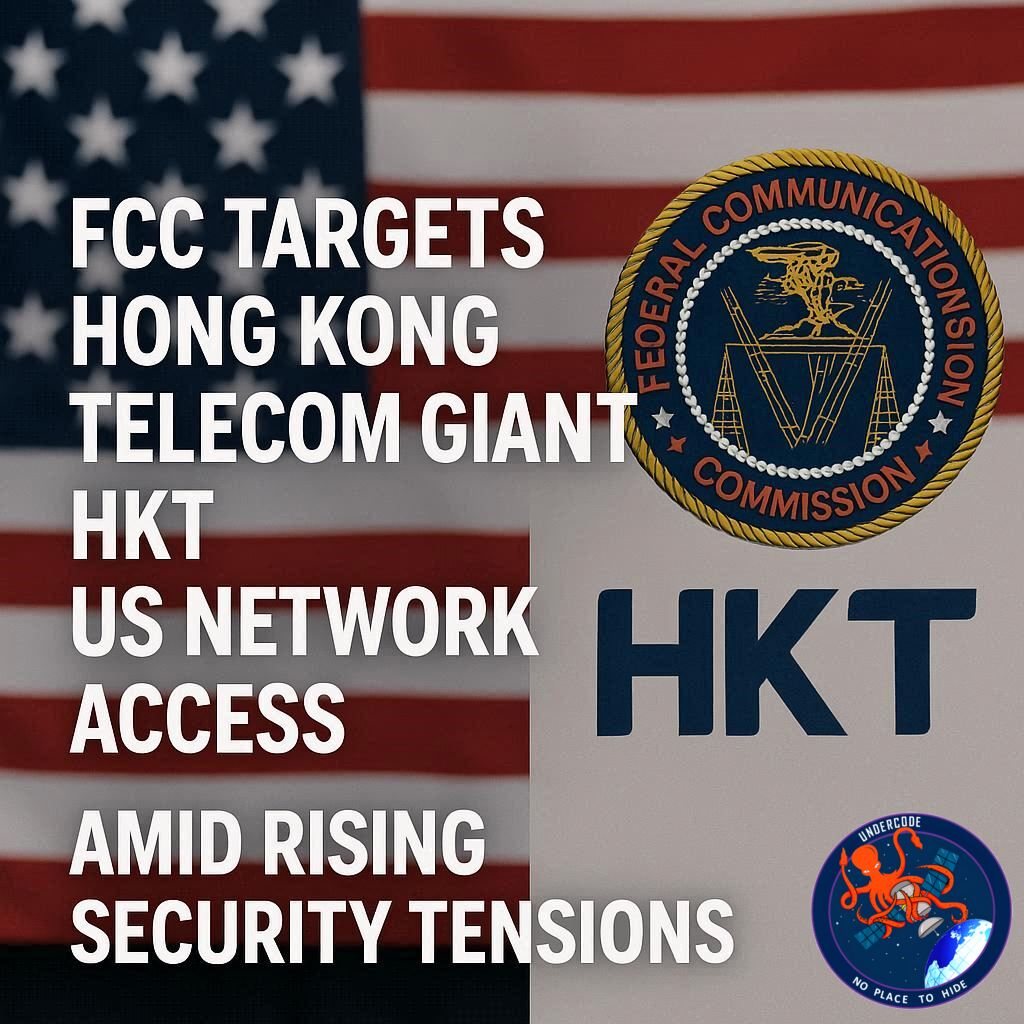
In a move that signals tightening scrutiny over Chinese-linked telecommunications firms, the U.S. Federal Communications Commission (FCC) is preparing to possibly revoke the American network access of HKT (International) Ltd., a Hong Kong-based telecom company owned by PCCW Ltd. The decision underscores Washington’s growing anxiety over foreign influence in its communications infrastructure, particularly from China. As global trade tensions evolve into a technology cold war, this case adds yet another chapter to the escalating rivalry between the world’s two largest economies.
The FCC’s Warning: National Security on the Line
The FCC formally requested HKT and its subsidiaries to justify why their authorization to connect with U.S. networks should not be revoked. These permissions currently allow HKT to interlink directly with American telecom systems, facilitating voice and data exchanges between the two countries.
The agency’s concern stems from HKT’s corporate ties—most notably its affiliation with China Unicom Hong Kong Ltd., which lost its U.S. operating rights in 2022 due to national security risks. China Unicom maintains an 18.4% stake in PCCW, creating what regulators describe as an indirect pipeline of influence between a Chinese state-affiliated entity and the U.S. network ecosystem.
FCC Chairman Brendan Carr emphasized the gravity of the situation, stating that the move represents a “necessary step to preserve the safety and integrity of America’s communications infrastructure.” He added that the FCC remains determined to defend national networks “against penetration from foreign adversaries, like China.”
The Business Behind the Headlines
HKT’s parent company, PCCW Ltd., is chaired by Richard Li, the son of Hong Kong billionaire Li Ka-shing. According to PCCW’s 2024 annual report, roughly 13.7% of its revenue originates outside Greater China and Singapore, though the company has not specified where those earnings come from.
The timing of the FCC’s decision is striking. It places Li’s business empire squarely in the crosshairs of intensifying U.S.-China rivalry. Complicating matters further, CK Hutchison Holdings Ltd., Li Ka-shing’s conglomerate, is entangled in a controversial global ports sale to a consortium backed by BlackRock Inc. The deal has faced criticism in Washington due to the participation of a Chinese investor, sparking renewed debate over foreign access to strategic infrastructure.
Meanwhile, Bloomberg reports that FWD Group Holdings Ltd., another of Richard Li’s ventures, has faced difficulties securing approval to expand into mainland China. These obstacles, combined with heightened geopolitical friction, have created a challenging business climate for Hong Kong-based companies seeking to navigate both Western markets and Chinese interests.
A Pattern of Crackdowns
The FCC’s action against HKT mirrors similar measures taken against other Chinese state-linked telecommunications firms, including China Telecom (Americas) Corp. and China Unicom (Americas). These decisions have consistently been justified by national security agencies, citing fears that foreign entities could exploit U.S. telecom infrastructure for espionage or data interception.
This trend reflects a broader national strategy that began during Donald Trump’s presidency, when the administration declared the U.S. to be engaged in a “trade war” with China. The move against HKT thus represents continuity in policy rather than an isolated case. As the global digital landscape becomes increasingly weaponized, telecommunications access has become a matter of state security, not just commercial regulation.
What Undercode Say:
The FCC’s action against HKT is more than a bureaucratic maneuver—it is a clear message that the digital battleground between Washington and Beijing is expanding beyond trade tariffs into technological sovereignty.
At its core, this is about control over data flow and communications infrastructure. In an era where digital information underpins everything from financial transactions to defense logistics, whoever controls the networks controls the narrative. The U.S. has grown wary of China’s growing global telecom footprint through companies like Huawei, ZTE, and China Unicom, and HKT’s links through PCCW make it part of the same web of suspicion.
For the FCC, the threat is not hypothetical. Allowing network interconnection with entities influenced by Beijing could, in theory, open backdoors for surveillance, cyber infiltration, or strategic disruptions. This explains why the commission has progressively dismantled Chinese telecom access in the U.S.—each revocation tightening the firewall between American and Chinese communication channels.
Economically, this decision will likely strain Hong Kong’s already delicate position as a semi-autonomous bridge between East and West. Since the 2020 imposition of China’s National Security Law in Hong Kong, Western governments have become more skeptical of the city’s independence, treating its companies as potential proxies for Beijing.
For Richard Li, this move is personal and strategic. His business empire—spanning telecommunications, insurance, and media—has long sought a delicate balance between Western investment and Chinese market access. But as geopolitical divisions deepen, neutrality is becoming nearly impossible. Companies like PCCW are being forced to pick a side, even if doing so means losing lucrative cross-border partnerships.
The broader takeaway is that digital infrastructure has become a frontline of 21st-century geopolitics. The question is no longer whether foreign ownership matters, but how deeply national security should penetrate corporate regulation.
From a strategic viewpoint, the FCC’s crackdown represents a preemptive strike to secure informational sovereignty—ensuring that U.S. communications remain insulated from entities that could, directly or indirectly, fall under foreign state influence. Yet, critics argue this approach risks fragmenting the global internet, leading to a future where networks become increasingly divided along political lines.
In short, the U.S. and China are no longer just fighting over tariffs or chips; they’re battling over trust, access, and data control. HKT has simply become the latest symbol of that struggle.
🔍 Fact Checker Results
✅ FCC’s notice to HKT was confirmed by Bloomberg and official FCC statements.
✅ China Unicom holds an 18.4% stake in PCCW, linking HKT indirectly to Beijing interests.
✅ The FCC previously revoked licenses for China Telecom and China Unicom (Americas) on similar security grounds.
📊 Prediction
📡 Expect further U.S. crackdowns on Chinese-linked tech and telecom firms operating domestically.
💼 Hong Kong-based corporations like PCCW may shift strategic focus to Southeast Asia or the Middle East to offset losses.
🌐 The digital divide between China and the West will likely deepen, fragmenting the global communications landscape into competing spheres of influence.
🕵️📝✔️Let’s dive deep and fact‑check.
References:
Reported By: timesofindia.indiatimes.com
Extra Source Hub (Possible Sources for article):
https://stackoverflow.com
Wikipedia
OpenAi & Undercode AI
Image Source:
Unsplash
Undercode AI DI v2
Bing
🔐JOIN OUR CYBER WORLD [ CVE News • HackMonitor • UndercodeNews ]
📢 Follow UndercodeNews & Stay Tuned:
𝕏 formerly Twitter 🐦 | @ Threads | 🔗 Linkedin | 🦋BlueSky | 🐘Mastodon


