
Listen to this Post
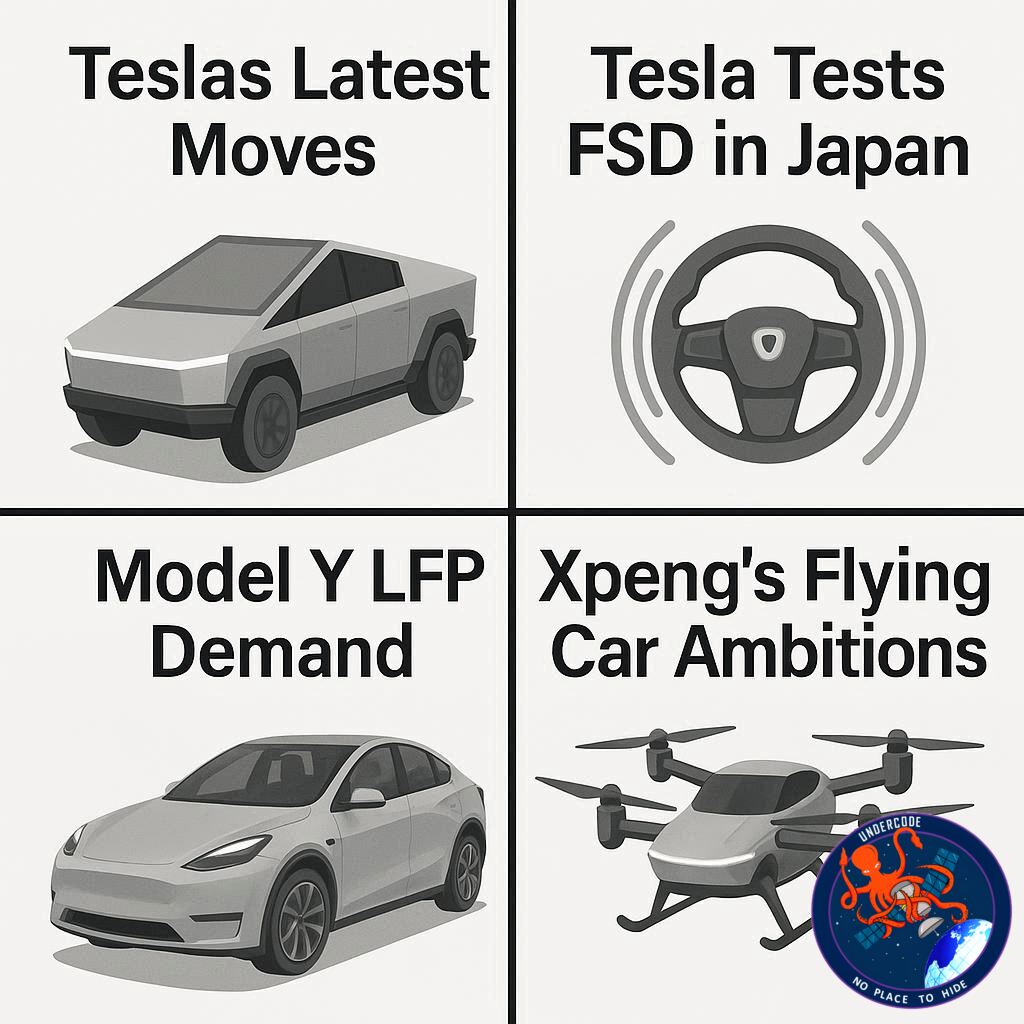
Tesla and its rivals are shaking up the automotive and tech world with rapid innovations, record demand, and futuristic concepts. From Elon Musk’s ambitious Cybercab to Tesla Full Self-Driving (FSD) making waves in Japan, and the Model Y L’s booming success in China, the EV landscape is evolving faster than ever. Meanwhile, competitors like Xpeng are pushing boundaries with flying cars aimed for 2027. This roundup explores the latest developments shaping the future of electric mobility.
Cybercab Testing Accelerates
Tesla seems to be ramping up testing for its futuristic two-seater, the Cybercab. Recent drone footage from both the Fremont Factory and Gigafactory Texas has reignited discussions about its development. Observers like longtime drone operator Joe Tegtmeyer spotted a Cybercab on Giga Texas’ South River Road, marking the first time in months he’s seen the vehicle undergo road tests.
Similarly, at Fremont, another Cybercab was observed moving around the facility’s test area, appearing to be manually driven. This has fueled speculation that Tesla’s current test units retain manual controls, in contrast to the production version, which aims to operate fully autonomously without a steering wheel or pedals.
The increased visibility of these prototypes coincides with Tesla’s preparation for production. Drone footage indicates stockpiling of Cybercab castings and production equipment being set up at Giga Texas. Elon Musk has ambitious expectations: a production run rate of 2 million Cybercabs annually, leveraging Tesla’s Unboxed manufacturing process, which promises high-speed assembly akin to consumer electronics rather than traditional automotive lines.
Full Self-Driving Gains Praise in Japan
While Tesla’s FSD continues to face skepticism in the U.S., it has received glowing reviews from Japanese media. Nikkei, one of Japan’s leading publications, tested FSD in Tokyo and highlighted its remarkable situational awareness and smooth driving. The system successfully reacted to sudden hazards, including a cyclist unexpectedly entering a crosswalk and a car reversing on a narrow street, all without requiring human intervention during a 30-minute drive.
Japan’s regulatory environment is also adapting. The Ministry of Land, Infrastructure, Transport, and Tourism recently allowed AI-powered vehicles to receive software updates enabling autonomous driving. Tesla board member Hiro Mizuno emphasized that this move paves the way for smoother FSD adoption, potentially benefiting all manufacturers pursuing autonomous solutions in Japan.
Model Y L Demand Surges in China
Tesla’s extended-wheelbase Model Y L has gained rapid traction in the Chinese market. Current delivery estimates have been pushed to December 2025, indicating the vehicle is fully sold out for October and November.
Launched in August and first delivered in September, the six-seat crossover addresses the growing demand for spacious family EVs. Reports show that registrations have been rising steadily, helping boost Tesla China’s wholesale numbers in September. With a price starting at RMB 339,000 ($47,180), the Model Y L combines comfort, performance, and practicality, reinforcing Tesla’s dominance in one of the world’s most competitive EV markets.
Xpeng’s Flying Car Vision
Tesla rivals are not standing still. Xpeng’s flying car division, now branded as Aridge, showcased its High-Speed Long-Range Full Tilt-Rotor Flying Car concept in Dubai. The vehicle offers a 500-kilometer (310-mile) range and can reach speeds up to 360 kilometers per hour (224 MPH).
The event also revealed the Land Aircraft Carrier, a modular flying car system, alongside the long-range hybrid A868 model. Production is planned at a new Guangzhou facility capable of building 10,000 units annually, with full-scale delivery set for 2026. Early demand is already strong, with 7,000 cumulative orders from the Middle East. These innovations indicate a future where low-altitude, personal air mobility becomes a viable commercial reality.
What Undercode Say:
Tesla’s recent moves reflect a strategic blend of ambition and practical scalability. The Cybercab represents a radical departure from conventional vehicles, both in form and manufacturing. Its reliance on Tesla’s Unboxed process suggests the company is attempting to redefine mass EV production—shifting from traditional assembly lines to modular, electronics-style rapid production. Achieving Musk’s target of 2 million units annually would require near-perfect coordination between factories, suppliers, and logistics, marking one of the boldest production targets in automotive history.
The FSD developments in Japan indicate that Tesla is targeting global markets with a nuanced approach. By aligning with Japanese regulatory allowances, Tesla is effectively securing a first-mover advantage in autonomous software adoption in Asia. The positive media coverage also boosts public trust in regions where skepticism toward AI vehicles remains high.
The Model Y L’s surging demand in China underscores Tesla’s ability to adapt products for specific markets. The larger, six-seat configuration addresses an unfulfilled niche in family EVs, offering both luxury and utility. This localized strategy could serve as a blueprint for Tesla’s expansion into other regions where larger EVs are gaining popularity.
Meanwhile, Xpeng’s flying car ventures highlight how competition is driving innovation beyond traditional EV boundaries. Their focus on long-range, high-speed, and modular design positions them to compete in emerging personal air mobility markets. This could create a future where urban transport is multi-dimensional—ground and air-based, interconnected with autonomous systems.
Tesla’s aggressive expansion in autonomous technology, mass-market EVs, and high-volume production contrasts with Xpeng’s futuristic aerial vision, but both illustrate a shared industry trend: mobility is no longer just about cars; it’s about systems, software, and scalable innovation. Companies that balance technological ambition with production pragmatism are likely to dominate the next decade of mobility evolution.
By investing heavily in both autonomous systems and market-specific EV configurations, Tesla demonstrates a dual strategy: leading in both volume production and intelligent mobility. Success in Japan, China, and the U.S. could cement its global dominance, while rivals like Xpeng push boundaries that may redefine what “transportation” even means.
Fact Checker Results:
✅ Cybercab production target: 2 million annually, confirmed by Elon Musk.
✅ FSD praised in Japan; Nikkei reports highlight superior safety response.
❌ Model Y L currently only available in China; no official global rollout yet.
Prediction
Tesla is likely to accelerate Cybercab production by late 2026, with partial automation still in testing. FSD’s favorable reception in Japan could encourage faster adoption across Asia. The Model Y L may serve as a blueprint for larger EV launches globally. Meanwhile, Xpeng’s flying cars are positioned to emerge as niche, high-demand transport by 2027, potentially shaping urban mobility ecosystems with a mix of autonomous ground and low-altitude air vehicles. 🌐✈️
🕵️📝✔️Let’s dive deep and fact‑check.
References:
Reported By: www.teslarati.com
Extra Source Hub (Possible Sources for article):
https://www.github.com
Wikipedia
OpenAi & Undercode AI
Image Source:
Unsplash
Undercode AI DI v2
Bing
🔐JOIN OUR CYBER WORLD [ CVE News • HackMonitor • UndercodeNews ]
📢 Follow UndercodeNews & Stay Tuned:
𝕏 formerly Twitter 🐦 | @ Threads | 🔗 Linkedin | 🦋BlueSky | 🐘Mastodon


