
Listen to this Post
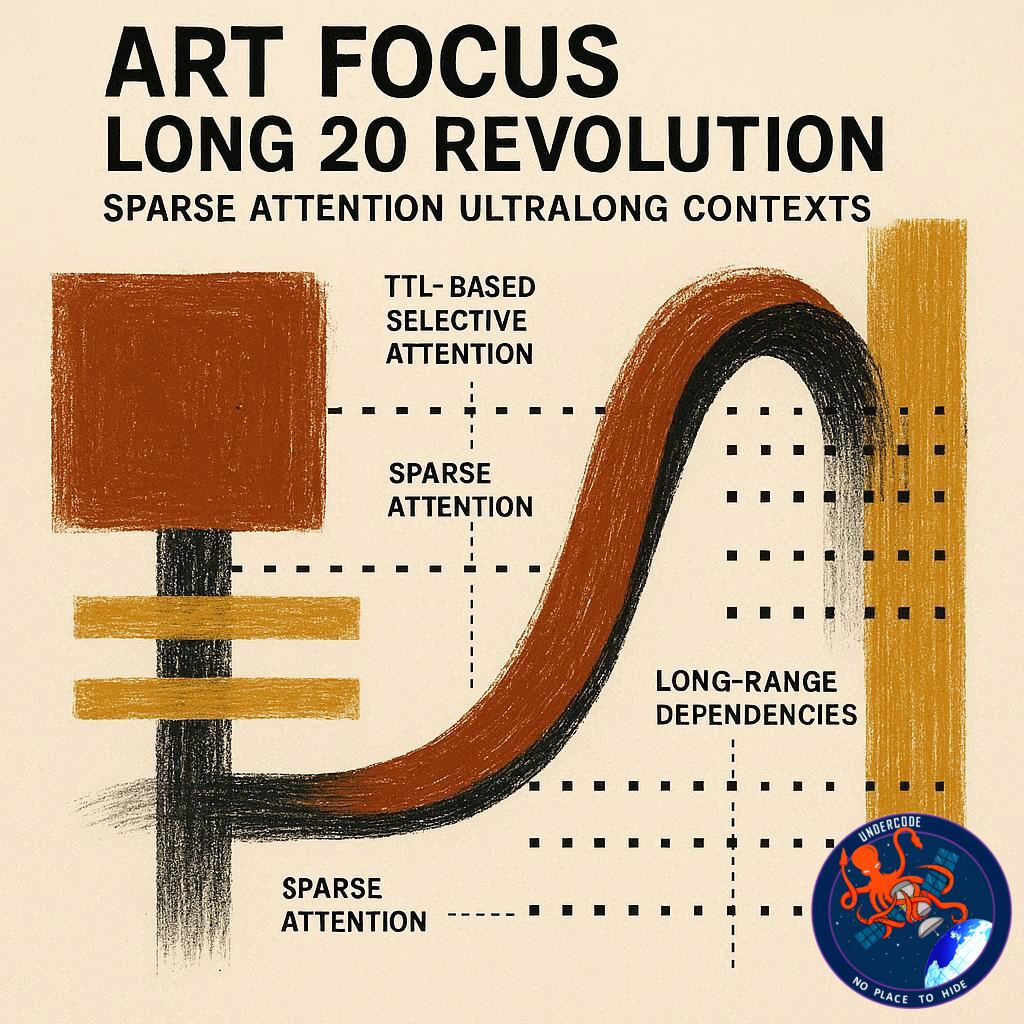
As large language models (LLMs) scale, handling ultra-long sequences efficiently has become a critical challenge. Standard attention mechanisms face exponential growth in computation and memory requirements, creating bottlenecks during inference. Ling 2.0, with its innovative sparse attention architecture, addresses this head-on. By combining high-sparsity Mixture of Expert (MoE) structures with block-wise sparse attention, Ling 2.0 aims to make long-sequence decoding faster, more efficient, and more accessible to the open-source community. Its latest iteration, Ring-mini-sparse-2.0-exp, demonstrates remarkable speed and efficiency improvements while maintaining state-of-the-art reasoning performance.
Summarizing the Breakthrough
Ling 2.0 Sparse introduces a high-efficiency sparse attention mechanism designed for two pressing trends in LLM development: context length scaling and test-time scaling. Inspired by the Mixture of Block Attention (MoBA) approach, the system partitions input keys and values into blocks, allowing queries to selectively attend only to the top-k relevant blocks. This block-wise attention dramatically reduces computational overhead.
Further refinement comes from Grouped Query Attention (GQA), enabling multiple query heads within a group to share block selection results, cutting down I/O load even further. While MoBA accelerated pre-fill stages, it struggled during decode due to the lack of cached block token representations. Traditional KV caches couldn’t store these intermediate block representations, causing redundant memory reads and slowing down decoding.
Ling 2.0 addresses this with a page-aware block cache. During pre-fill, token sequences are aggregated into block representations and stored in the cache. During decode, only the top-k relevant blocks are retrieved, eliminating unnecessary I/O. Unified memory management ensures block and KV caches share the same indexing system, maintaining consistency without extra metadata overhead.
The result? Ring-mini-sparse-2.0-exp achieves nearly 3x faster inference in ultra-long sequences compared to its predecessor, while still maintaining high accuracy across challenging reasoning benchmarks. The model is fully open-source, available on Hugging Face, ModelScope, and GitHub, inviting developers to experiment and implement these advances.
What Undercode Say:
Ling 2.0 represents more than a technical tweak; it’s a philosophical shift in how LLMs handle scale. Traditional full-attention models treat every token equally, leading to massive overhead in long sequences. Sparse attention mechanisms like MoBA, when combined with intelligent memory management, demonstrate that selective attention—not brute-force computation—is the key to efficient scaling.
The integration of block-wise attention and GQA shows a nuanced understanding of both computational and memory constraints. By sharing top-k selections across query heads, the system achieves efficiency gains without sacrificing model fidelity. This reflects a broader trend in AI: architectural innovations are increasingly paired with inference-optimized software to achieve real-world applicability.
The page-aware block cache is particularly elegant. It solves a persistent problem in sparse attention decoding—redundant data access—through a cache design that mirrors the physical memory page concept. This not only reduces I/O overhead but also ensures that memory usage scales linearly with sequence length rather than exponentially, which is crucial as models attempt to process documents with tens of thousands of tokens.
From a strategic perspective, open-sourcing Ring-mini-sparse-2.0-exp is a savvy move. By lowering barriers for high-efficiency inference, the community can experiment with longer-context LLMs without prohibitive hardware costs. Researchers can now focus on fine-tuning for reasoning and creativity rather than struggling with infrastructure limitations.
Ling 2.0’s approach also provides a roadmap for future models. As LLMs grow in size and context capacity, hybrid methods combining MoE, sparse attention, and intelligent caching will likely become the norm. This represents a shift away from raw parameter scaling toward smarter attention distribution and memory-aware computation, a trend likely to dominate the next generation of transformer models.
Another critical point is the alignment between software frameworks (SGLang, vLLM) and hardware-efficient design. Many sparse attention methods fail to deliver in real-world use because frameworks are not optimized for unconventional caching or routing patterns. Ling 2.0 explicitly addresses this gap, showing that efficient architecture requires both hardware-conscious design and software-level innovation.
Furthermore, the implications for AI applications are vast. Any task involving long-form text—legal documents, scientific papers, or multi-turn dialogues—stands to benefit from 3x faster inference. In applied settings, this efficiency gain translates directly into cost savings, reduced energy consumption, and the ability to deploy larger models in production environments without sacrificing latency.
The adoption of page-aware sparse attention may also influence multimodal LLMs. Visual and audio data sequences can be treated similarly to textual tokens, suggesting that Ring-mini-sparse-2.0-exp principles could extend beyond NLP to cross-modal reasoning and generation tasks.
Finally, Ling 2.0 demonstrates the importance of balancing theoretical innovation with practical accessibility. By open-sourcing the model and providing detailed framework integration, the developers ensure that these advancements are not just academic curiosities but tools that the broader AI community can use and build upon. This combination of cutting-edge research, practical optimization, and open collaboration sets a benchmark for future LLM innovations.
Fact Checker Results:
✅ Ring-mini-sparse-2.0-exp achieves 3x faster inference in ultra-long sequences compared to Ring-mini-2.0.
✅ Page-aware block caching significantly reduces I/O overhead during the decode stage.
❌ Current mainstream frameworks without block caching cannot fully accelerate MoBA-based sparse attention decoding.
Prediction:
🌟 As LLMs continue to grow in context length, architectures like Ling 2.0 Sparse will become standard. We can expect next-gen models to combine sparse attention, MoE, and intelligent caching to achieve both ultra-long context handling and real-time efficiency. By 2026, models processing 50k+ token sequences efficiently on consumer-grade hardware may no longer be aspirational but achievable.
🕵️📝✔️Let’s dive deep and fact‑check.
References:
Reported By: huggingface.co
Extra Source Hub (Possible Sources for article):
https://www.github.com
Wikipedia
OpenAi & Undercode AI
Image Source:
Unsplash
Undercode AI DI v2
Bing
🔐JOIN OUR CYBER WORLD [ CVE News • HackMonitor • UndercodeNews ]
📢 Follow UndercodeNews & Stay Tuned:
𝕏 formerly Twitter 🐦 | @ Threads | 🔗 Linkedin | 🦋BlueSky | 🐘Mastodon


