
Listen to this Post
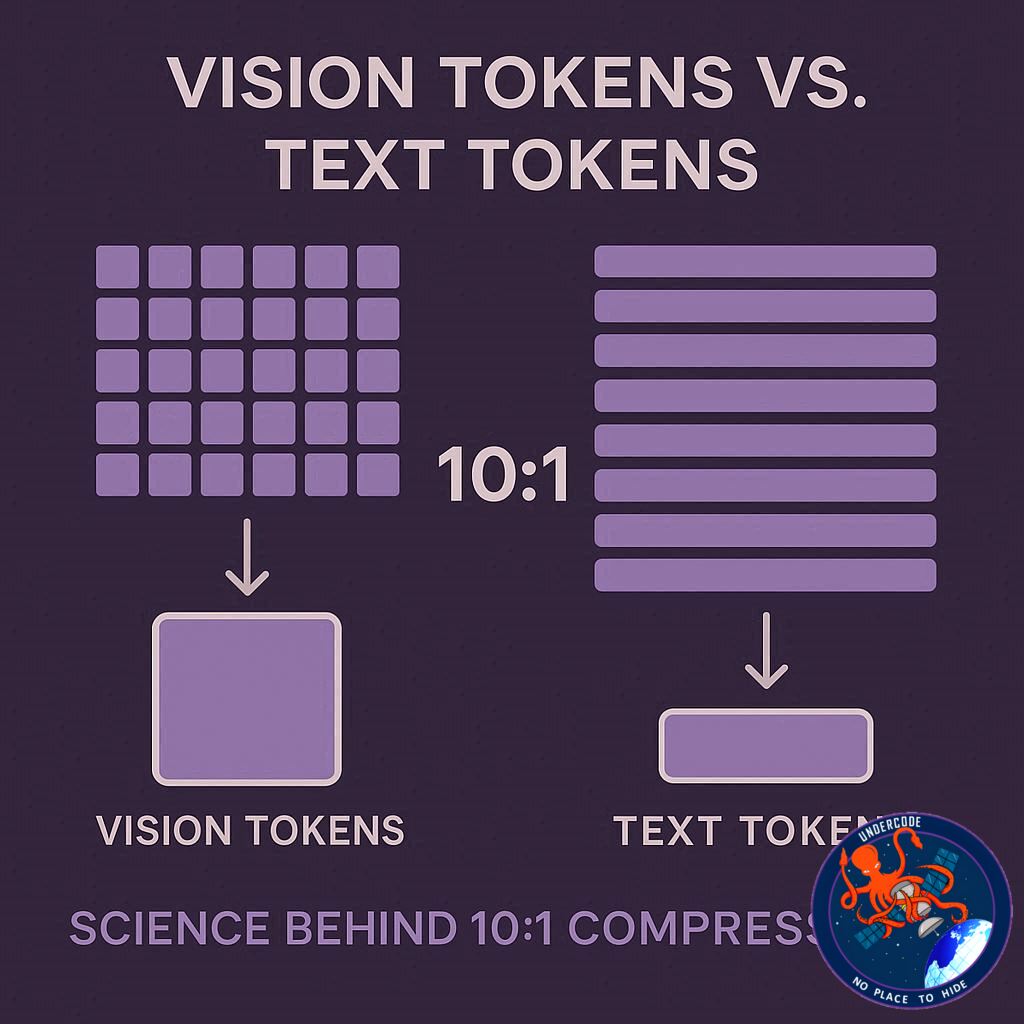
In the fast-evolving world of AI, one claim has drawn remarkable attention: DeepSeek-OCR demonstrates that just 100 vision tokens can represent roughly 1,000 text tokens—with more than 97% accuracy. This isn’t just a technical milestone—it’s a profound shift in how machines understand information. What seems like a simple 10× compression ratio actually reveals how differently text and vision tokens encode meaning. To grasp this fully, we must look under the hood of how these two systems work, and why the comparison is not as straightforward as it appears.
The Compression Mystery Explained
DeepSeek-OCR’s results show that each vision token holds an astonishing amount of data. When an image—say, a 1024×1024-pixel document—is broken into smaller 16×16 patches, it produces 4,096 small sections. These are then compressed into just 256 vision tokens. Each of these tokens encapsulates around a 64×64-pixel region, representing not only text but also layout, font, color, and formatting.
Let’s imagine a single vision token extracted from a document section:
yaml
Copy code
Annual Revenue Growth
Q4 2024: $2.1M
Increase: 15.3%
In that tiny block of pixels, one vision token captures about 10 to 12 words—plus all the visual context that makes the document readable and aesthetically coherent. By contrast, in text-based tokenization, those same words would require over a dozen separate tokens such as “Annual,” “Revenue,” “Growth,” and so on.
This means each vision token packs the same semantic load as multiple text tokens, resulting in a 5–10× information density increase. In effect, 100 vision tokens can store what would normally require about 1,000 text tokens.
Why Both End Up in 4096 Dimensions
Here’s the twist: despite the huge difference in informational density, both text and vision tokens are ultimately represented as 4096-dimensional vectors. The key difference lies in how they get there.
Text tokens pass through a vocabulary-based lookup system. Each word or subword has a corresponding ID in a massive dictionary—often containing 100K+ entries. The system maps this ID to a dense 4096-dimensional vector, which the model then processes to predict the next token.
Vision tokens, however, take a completely different route. They start as raw pixel values (64×64×3 = 12,288 numbers), which are compressed through a vision encoder directly into a 4096-dimensional latent space. There’s no vocabulary lookup, no symbolic representation—just direct visual encoding.
This difference is monumental. Text tokens are symbolic abstractions; vision tokens are continuous compressions. Both end up in the same latent space, but their journeys could not be more distinct.
Information Density and Efficiency
This 10× compression isn’t about squeezing text—it’s about representation efficiency. A vision token carries multiple layers of meaning: not only text, but also context, visual hierarchy, and relationships between words and design elements.
In essence:
Type Coverage Information Content
Text Token ~1 word Literal meaning only
Vision Token 64×64 pixels 5–8 words + layout + style
This is what makes multimodal models so powerful. They don’t just read words—they see information. When a large language model processes vision tokens, it’s dealing with dense, context-rich embeddings that unlock a new level of understanding, especially for documents, tables, and complex visuals.
The Deep Architecture of Understanding
Behind DeepSeek-OCR’s compression is an architectural philosophy: merge perception with comprehension. Traditional OCR systems translate images into text through multiple disjointed steps—image recognition, segmentation, text decoding, and post-processing. DeepSeek-OCR skips this fragmentation. It learns to represent entire document regions as semantic embeddings directly usable by a large language model.
By training on enormous datasets of scanned text and layouts, it learns that “Annual Revenue Growth” isn’t just text—it’s a conceptual unit often followed by numerical values or financial figures. This context-driven encoding allows for semantic compression, not just pixel reduction.
This means the model doesn’t just “read” text—it understands what it means in context.
What Undercode Say:
The DeepSeek-OCR breakthrough is more than a technical curiosity—it’s a sign of where AI representation learning is heading. The traditional boundary between text and image is dissolving, giving birth to a unified multimodal intelligence.
When we say “100 vision tokens equal 1,000 text tokens,” what we’re really acknowledging is a new way of encoding the world. Text tokens are discrete and linear, optimized for language. Vision tokens are spatial and dense, optimized for pattern recognition. The magic lies in how they converge into the same latent space—where attention mechanisms can process them interchangeably.
The implications are massive. For one, efficiency: multimodal models could process more complex documents faster and with less computational cost. Second, contextual comprehension: visual cues such as tables, graphs, and design hierarchies become part of the reasoning process, not discarded noise.
DeepSeek-OCR is quietly rewriting the future of document intelligence. Imagine an AI system that can understand an invoice, a research paper, or a financial report not by converting it into plain text, but by perceiving its structure and semantics in one pass. That’s what vision tokenization makes possible.
Moreover, this convergence hints at something deeper: the future of cognition in machines may not be linguistic—it may be representational. A model that sees, reads, and reasons in the same internal language is no longer bound by the limits of text-based thought. It moves toward a holistic intelligence that mirrors human perception more closely than ever before.
For researchers, this is both exciting and challenging. Compressing information without losing meaning requires incredibly precise encoders. A single vision token might contain ten words, but if even one nuance—like the bolding of a financial number—is lost, the semantic value shifts. Thus, the next frontier will not just be compression, but faithful semantic retention.
In short, DeepSeek-OCR’s claim isn’t just about a “10× ratio.” It’s a doorway into a new paradigm of multimodal reasoning, where seeing and understanding become indistinguishable processes.
Fact Checker Results
✅ DeepSeek-OCR paper confirms the 10× effective compression rate (100 vision tokens ≈ 1000 text tokens).
✅ Embedding dimensions (4096) match between vision and text modalities.
❌ “10× compression” is not literal data compression—it refers to representational density, not file size.
Prediction
📈 In the next generation of multimodal models, we’ll see direct integration of visual tokens into large-scale reasoning pipelines. Models will interpret PDFs, slides, and charts seamlessly—without needing text conversion. As compression improves, AI systems will think in vision units as naturally as they now think in words, paving the way for a unified intelligence capable of perceiving and reasoning simultaneously.
🕵️📝✔️Let’s dive deep and fact‑check.
References:
Reported By: huggingface.co
Extra Source Hub (Possible Sources for article):
https://www.linkedin.com
Wikipedia
OpenAi & Undercode AI
Image Source:
Unsplash
Undercode AI DI v2
Bing
🔐JOIN OUR CYBER WORLD [ CVE News • HackMonitor • UndercodeNews ]
📢 Follow UndercodeNews & Stay Tuned:
𝕏 formerly Twitter 🐦 | @ Threads | 🔗 Linkedin | 🦋BlueSky | 🐘Mastodon


