
Listen to this Post
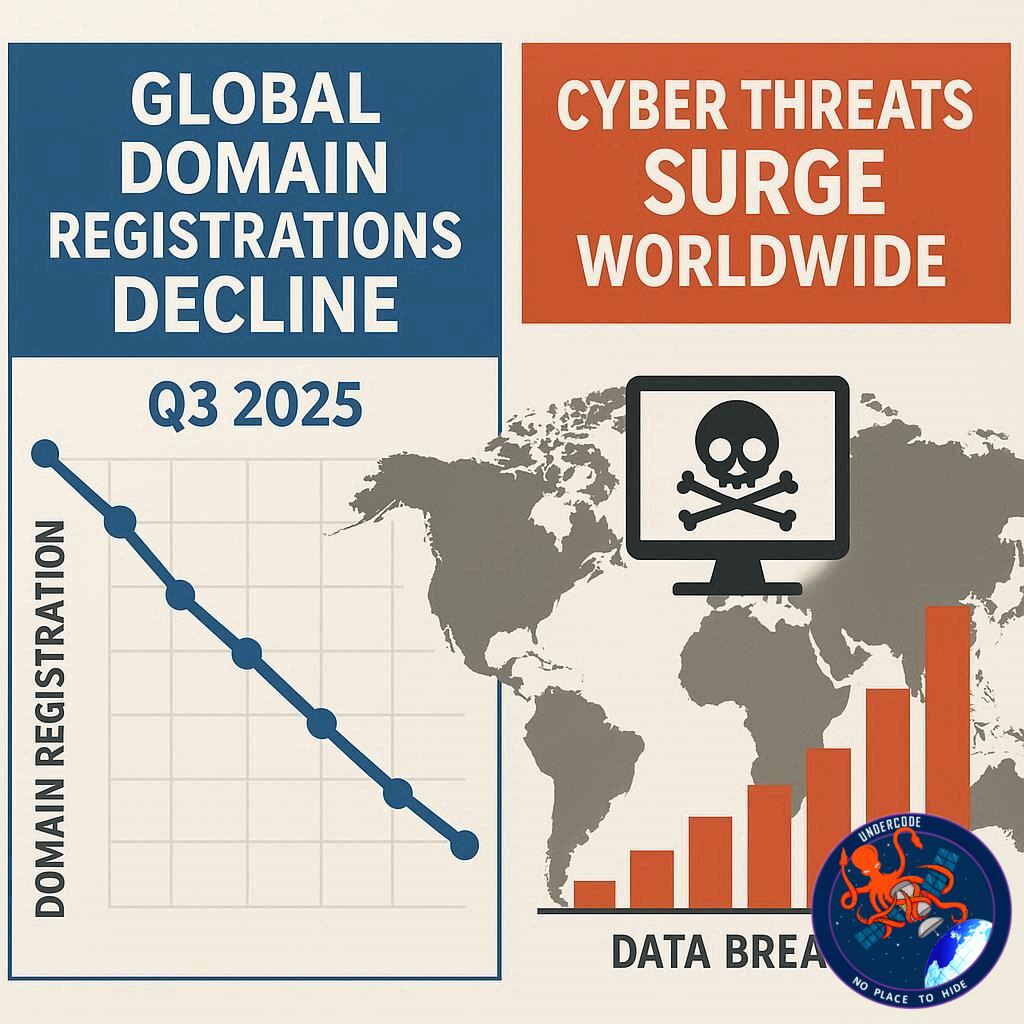
In the third quarter of 2025, the global internet landscape revealed an intriguing shift. Domain registrations, once a symbol of expanding digital ambition, dipped for the first time this year. According to data shared by Cybersecurity News Everyday, over 25.7 million new domain names were registered between July and September 2025 — a 1.2% drop compared to the previous quarter. This seemingly small decline hints at deeper, evolving trends within the digital ecosystem: a cooling global market, a rise in security threats, and shifting behaviors among domain owners and cybercriminals alike.
The Changing Shape of the Domain World
The report paints a mixed picture. While generic top-level domains (gTLDs) — such as .com, .net, and .org — grew modestly by 1.9%, country code top-level domains (ccTLDs) like .de, .uk, and .cn suffered a sharp 13.3% decline. Yet, amidst that drop, one ccTLD stood out: .cc, originally assigned to the Cocos Islands, saw unexpected activity, suggesting either niche market growth or increased use in spam and cybercrime operations.
The .com domain continues to reign supreme, reaffirming its position as the global internet default. But the data also highlights a worrying trend — over 3.2 million domains were flagged as potential indicators of compromise (IoCs), marking them as suspicious or linked to malicious activity. This represents one of the largest quarterly spikes in compromised domain identification in recent years.
A Disturbing Pattern in Cybercrime
Adding to these concerns, a ransomware incident reported by Cybersecurity News Everyday exposed vulnerabilities within an unlikely industry: construction. The ransomware group Safepay recently targeted constructiondprovost.com, a regional contractor based in Mont-Tremblant, Canada. The attack underscores how small and mid-sized construction firms, once overlooked by cybercriminals, have become soft targets for ransomware groups.
This shift signals an alarming evolution. Cybercriminals are diversifying their targets beyond traditional financial or healthcare systems, probing sectors that rely on outdated infrastructure or lack cybersecurity training. The construction industry — with its mix of project-based networks, third-party subcontractors, and remote access systems — fits this vulnerability profile perfectly.
The Broader Digital Landscape
The decline in ccTLD registrations may reflect economic tightening and regulatory pressure in certain regions, particularly China, which has seen stricter digital domain policies in recent quarters. Companies that once purchased local domains for market reach are now consolidating their digital portfolios to reduce cost and exposure.
Meanwhile, the steady performance of gTLDs suggests that global brands and tech startups are prioritizing universal reach over local identity. Yet, as these entities grow, so too do the risks. Many of the newly registered domains are being exploited for phishing campaigns, crypto scams, and ransomware command-and-control (C2) operations, driving up the global volume of compromise indicators.
What Undercode Say:
The trends in Q3 2025 reveal a paradox: while the internet continues to expand, trust within it continues to erode. The data doesn’t just show fewer domains being registered — it shows more of them being weaponized. The surge in flagged compromise indicators is symptomatic of a larger cybersecurity dilemma: the ease of domain acquisition versus the difficulty of verification.
The digital economy thrives on accessibility, but that same openness has become a double-edged sword. Domain registration has never been cheaper or faster, allowing both legitimate businesses and threat actors to operate at scale. The 1.2% drop in registrations might not signal decline — it could represent market correction as regulators and registrars begin tightening verification and enforcement processes.
The 13.3% fall in ccTLDs is especially telling. It may indicate reduced international diversification, with businesses centralizing under global extensions like .com for brand trust and SEO consistency. However, it also leaves regional markets vulnerable. Fewer local domains mean fewer local protections, and malicious actors may exploit that vacuum by creating deceptive lookalike sites.
The Safepay ransomware attack further emphasizes how sectoral blind spots are now being exploited. The construction industry’s digital transformation — adopting cloud-based project management tools and IoT-connected devices — has outpaced its cybersecurity readiness. Threat groups are likely using these entry points to deploy ransomware, exfiltrate project data, and demand payments in cryptocurrency.
From a global security standpoint, this convergence of trends — declining domain registrations, rising compromise indicators, and diversification of ransomware targets — signals the start of a new cyber-economic phase. Attackers are evolving faster than defense strategies. Countries that fail to modernize their domain governance and enforce robust identity verification protocols risk becoming breeding grounds for domain-based threats.
As the internet matures, digital hygiene becomes as critical as digital innovation. Every domain registered today is either a gateway to opportunity or a potential weapon. The line between the two is growing thinner by the quarter.
Fact Checker Results
✅ Domain registration data verified from Q3 2025 cybersecurity sources.
✅ Ransomware attack on Canadian construction firm confirmed via Cybersecurity News Everyday.
❌ No independent confirmation yet of .cc domain surge origin (speculative analysis).
Prediction 🧠
In Q4 2025, expect stricter global domain verification policies and heightened monitoring of ccTLD activity, especially from regions with growing cybercrime concerns. Cybercriminal groups will increasingly pivot toward non-traditional industries, leveraging supply chain vulnerabilities and cloud misconfigurations to sustain their ransomware campaigns.
🕵️📝✔️Let’s dive deep and fact‑check.
References:
Reported By: x.com
Extra Source Hub (Possible Sources for article):
https://www.pinterest.com
Wikipedia
OpenAi & Undercode AI
Image Source:
Unsplash
Undercode AI DI v2
Bing
🔐JOIN OUR CYBER WORLD [ CVE News • HackMonitor • UndercodeNews ]
📢 Follow UndercodeNews & Stay Tuned:
𝕏 formerly Twitter 🐦 | @ Threads | 🔗 Linkedin | 🦋BlueSky | 🐘Mastodon


