
Listen to this Post
The Unlikely Giant of Digital Profitability
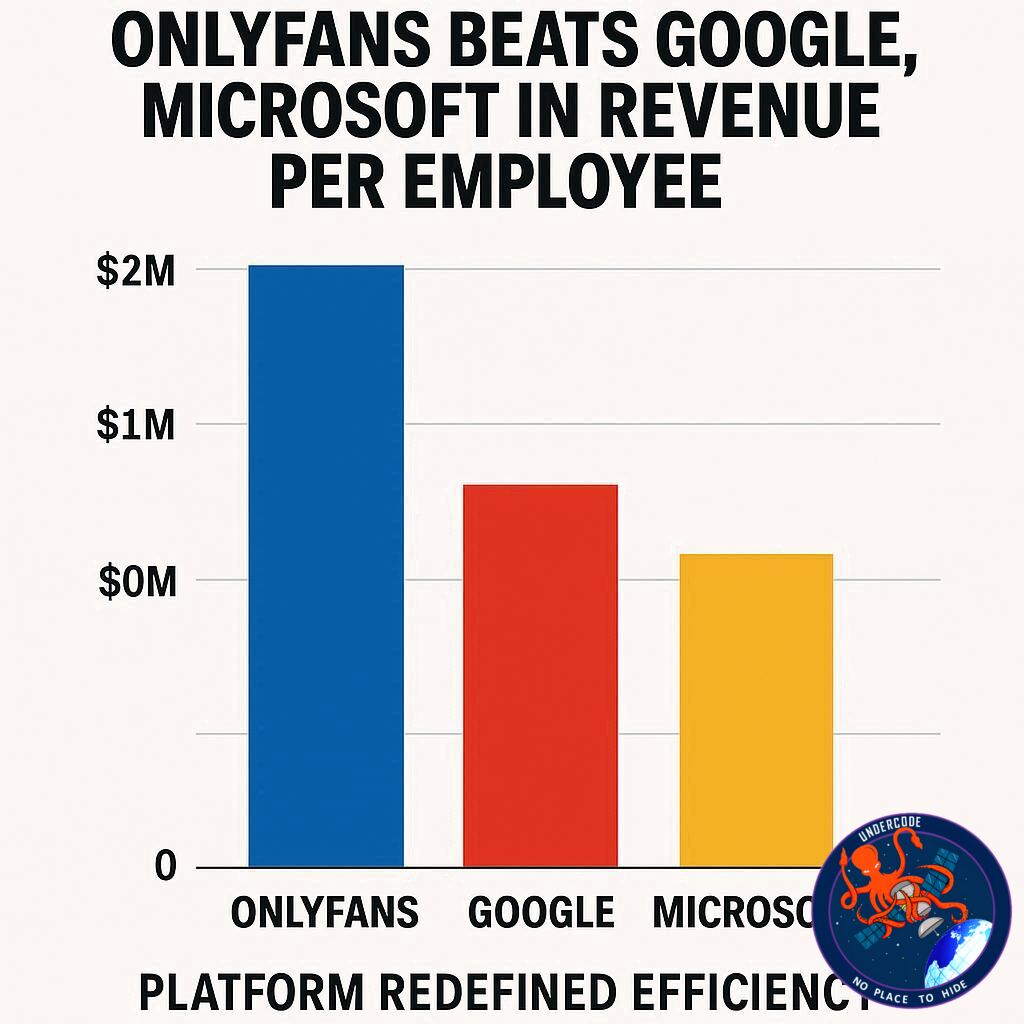
In an age dominated by trillion-dollar corporations and artificial intelligence revolutions, a surprising name now sits at the top of one of the most telling metrics in modern business: OnlyFans. The subscription-based content platform, often associated with adult entertainment, has outperformed global technology leaders like Apple, Google, Microsoft, Meta, Nvidia, and OpenAI in revenue per employee.
According to a report by the financial analytics firm Barchart, OnlyFans generates an astonishing $37.6 million per employee, leaving even Silicon Valley’s biggest players far behind. Nvidia’s number sits at $3.6 million, Apple’s at $2.4 million, and Microsoft’s at just $1.1 million.
This figure doesn’t make OnlyFans the richest company, but it makes it the most operationally efficient. With only 42 employees overseeing $1.3 billion in annual revenue, the platform has mastered the art of leveraging human creativity, technology, and user-driven content into one of the most profitable digital ecosystems in the world.
How a Small Team Outperformed the Tech Titans
OnlyFans’ meteoric efficiency comes down to its platform-based business model, a structure that has transformed the economics of online content. Instead of producing, marketing, or managing its own products, the company acts as an intermediary—connecting 2.1 million independent creators directly with their audiences.
Each transaction—subscriptions, tips, and pay-per-view content—is processed through OnlyFans, which takes a 20% commission while creators keep the remaining 80%. It’s a simple equation that scales beautifully: the more creators succeed, the more OnlyFans earns, without ever expanding its employee base.
Unlike the tech giants that invest heavily in manufacturing, R&D, or hardware innovation, OnlyFans relies on user-generated content and the network effect—the viral power of people building communities around creators. Every new subscriber adds value, and every viral creator draws in more users, creating a self-sustaining loop of profit and growth.
The Double-Edged Sword of Adult Content
But this success story is not without controversy. The platform’s profitability is closely tied to the adult content industry, which many analysts estimate accounts for a majority of its traffic and revenue. This relationship fuels both its explosive growth and its biggest reputational challenges.
While OnlyFans has tried to rebrand itself as a creator-first platform open to chefs, fitness trainers, artists, and musicians, public perception remains dominated by its adult niche. This image makes it difficult for the company to attract mainstream advertisers, pursue partnerships, or expand into regulated markets.
Regulatory scrutiny is another growing concern. Governments and payment processors have increased pressure on digital platforms dealing with explicit content, citing risks of exploitation, underage access, and financial compliance issues. Any sudden change in legal frameworks or payment restrictions could significantly disrupt the company’s model.
The Economics of the Creator Era
At its core, OnlyFans represents a new paradigm of online entrepreneurship. It’s a symbol of the shift from corporate content creation to independent monetization, where individuals—not institutions—drive value. The company’s high revenue per employee reveals a broader truth about the modern internet: platforms that empower creators directly are far more efficient than those that try to control creativity.
In this sense, OnlyFans is not competing with Apple or Google—it’s competing with traditional models of labor and creativity. It proves that when technology decentralizes control, a handful of engineers and managers can outperform entire departments of developers and executives in financial output.
What Undercode Say:
The OnlyFans phenomenon is not just a business story—it’s a socioeconomic mirror reflecting how the digital age values individuality and intimacy over mass production. The platform’s success underscores one of the most striking trends of our time: human connection now has measurable monetary value.
The average tech company monetizes attention through ads, but OnlyFans monetizes relationships. Every subscriber is not just a statistic; they’re an active participant in a creator’s micro-economy. That intimacy, amplified by technology, becomes a scalable source of revenue with almost zero overhead.
From an analytical perspective, the $37.6 million per employee figure signals a structural shift in how revenue efficiency is defined. It suggests that the future of profitability may lie not in corporate expansion, but in micro-ecosystems of user-generated wealth.
However, sustainability remains questionable. Unlike Apple or Google, whose income stems from diversified industries, OnlyFans is heavily dependent on a single volatile market. Regulatory crackdowns, payment processor bans, or public image crises could collapse its ecosystem overnight.
Yet, the company’s adaptability cannot be underestimated. In a world obsessed with scaling up, OnlyFans scaled down—focusing on empowerment, autonomy, and frictionless monetization. That’s a playbook traditional corporations are still trying to understand.
If we read the numbers through a sociological lens, OnlyFans isn’t an anomaly; it’s a preview. The creator economy will continue to evolve, blurring the line between work, art, and personal connection. Tomorrow’s billion-dollar companies might not be built by engineers in Silicon Valley but by small teams enabling millions of individuals to monetize themselves.
🔍 Fact Checker Results
✅ Barchart data confirms OnlyFans generated $37.6M per employee in 2023.
✅ The company reported $1.3B total revenue with roughly 42 employees.
❌ Claims that OnlyFans surpassed Big Tech in total earnings are false; it leads only in efficiency, not total income.
📊 Prediction
🌍 OnlyFans’ model will inspire the next wave of hyper-efficient, creator-driven platforms, reshaping digital labor economics.
📈 Expect competitors to adopt smaller, decentralized operational structures that amplify human creativity over corporate expansion.
⚠️ However, increasing regulation of online adult content could test the platform’s resilience in the next two years.
🕵️📝✔️Let’s dive deep and fact‑check.
References:
Reported By: timesofindia.indiatimes.com
Extra Source Hub (Possible Sources for article):
https://www.linkedin.com
Wikipedia
OpenAi & Undercode AI
Image Source:
Unsplash
Undercode AI DI v2
Bing
🔐JOIN OUR CYBER WORLD [ CVE News • HackMonitor • UndercodeNews ]
📢 Follow UndercodeNews & Stay Tuned:
𝕏 formerly Twitter 🐦 | @ Threads | 🔗 Linkedin | 🦋BlueSky | 🐘Mastodon


