
Listen to this Post
 The World’s First Submerged Data Centre Signals a Global Shift
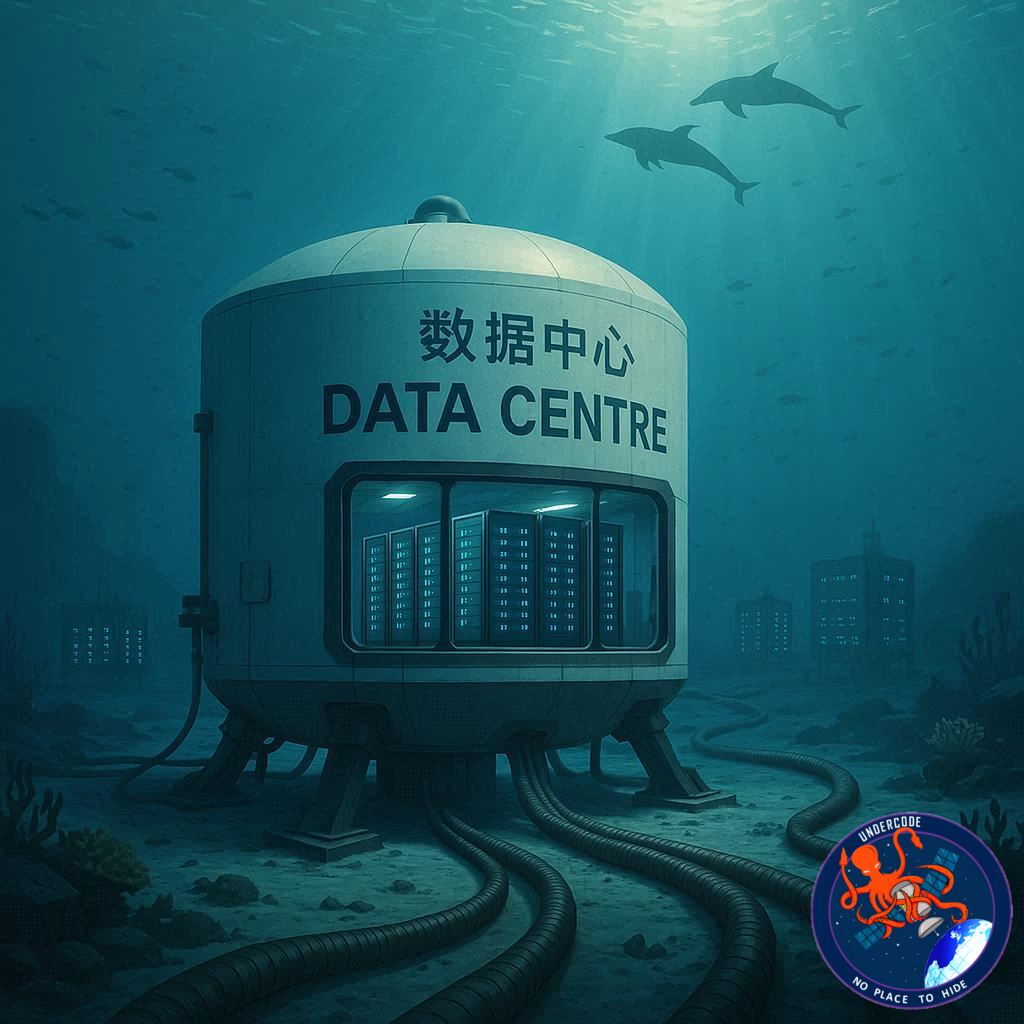
In a move that blends innovation, sustainability, and national ambition, China has reportedly completed the first phase of construction on the world’s first large-scale Underwater Data Centre (UDC), located in Shanghai’s Lin-gang Special Area. Estimated at $226 million, the project marks a historic leap in energy-efficient computing infrastructure, signaling China’s determination to lead the next era of green technology and digital dominance.
The concept is as futuristic as it sounds—servers placed beneath the ocean, silently processing the world’s data while being cooled naturally by seawater. According to a Wired report, the initiative was designed to combat one of the biggest challenges facing modern computing: the massive energy demand of data centres that power cloud services, AI, and global communications.
Traditional land-based facilities consume up to half their energy on air conditioning alone. In contrast, the Lin-gang Underwater Data Centre reduces that cooling requirement to less than 10%, as confirmed by Su Yang, general manager of Shanghai Hicloud Technology. Seawater acts as a stable cooling agent, while the structure is powered largely by offshore wind energy, creating a near self-sustaining ecosystem.
This underwater structure not only revolutionizes how data is stored and cooled but also underscores a broader geopolitical undercurrent. While China dives deep—literally—into futuristic infrastructure, OpenAI in the United States is sounding alarms over America’s lagging energy capabilities. Just one day after the UDC announcement, OpenAI submitted an 11-page proposal to the White House Office of Science and Technology Policy, warning that the U.S. risks ceding its technological edge to China unless it dramatically increases its domestic energy investment.
OpenAI’s argument is clear: advanced AI models like ChatGPT require massive power, far more than current grids can handle. The company urged the U.S. to build 100 gigawatts (GW) of new energy capacity each year—nearly double what it currently adds—to keep up with competitors. In stark contrast, China added 429 GW of power capacity last year, while the U.S. managed just 51 GW.
The symbolism is hard to miss: while China builds under the sea, the U.S. struggles to power its future. The Lin-gang project thus becomes more than a feat of engineering; it is a statement of intent—one that merges technological prowess with strategic foresight.
What Undercode Say:
China’s underwater data centre is more than a technical milestone; it’s a geopolitical message written in steel, saltwater, and silicon. By completing the first phase of this aquatic marvel, Beijing is showcasing its ability to blend sustainability with long-term digital strategy.
The cooling challenge has long haunted the data industry. Every byte of information processed in a server releases heat. Multiply that by billions of operations per second, and you get a planetary-scale heat problem. The Lin-gang UDC’s seawater-based cooling solution transforms that problem into an opportunity—tapping into nature’s endless thermal stability without burning more fossil fuel.
From an engineering perspective, this is a game changer. Cooling costs traditionally account for almost half of operational expenses in cloud infrastructure. If China can scale underwater centres safely, it could cut operating costs globally while drastically reducing carbon footprints. The implications ripple far beyond China’s borders.
But this isn’t just about green computing—it’s also about data sovereignty and control. By building infrastructure that doesn’t rely on foreign land, China strengthens its digital independence. Submerged data centres are difficult to access physically, offering enhanced security and resilience against natural disasters or sabotage.
Meanwhile, the timing of OpenAI’s plea to the U.S. government isn’t coincidental. The AI arms race is powered as much by energy as by intelligence. AI models need electricity to train, refine, and deploy. Without massive power grids, innovation stalls. OpenAI’s warning that America risks “handing global AI leadership to China” should be read as both a technical concern and a strategic alarm.
There’s also an environmental undertone here. China’s hybrid use of offshore wind and marine cooling suggests a dual push for carbon neutrality and technological leadership. The U.S., for all its innovation, still faces grid constraints, political division, and regulatory red tape that slow down such massive-scale energy projects.
In essence, the Lin-gang UDC represents the physical embodiment of China’s 21st-century vision—a future where sustainability, innovation, and national power intersect below the surface of the sea. It’s an audacious reminder that the next frontier of competition may not be in the cloud, but beneath the waves.
The irony is poetic: while Western companies perfect virtual realities, China is mastering the physical foundation of the digital world.
If successful, underwater data centres could reshape not only the energy landscape but also the geography of the internet itself. Imagine distributed clusters of deep-sea servers encircling the globe, powered by ocean currents and wind—cool, silent, and unstoppable.
🔍 Fact Checker Results:
✅ China has completed the first phase of its underwater data centre project in Shanghai’s Lin-gang Special Area.
✅ Cooling efficiency improvements claim to cut energy use by up to 80–90% compared to traditional data centres.
✅ OpenAI’s report to the U.S. government is real and highlights the need for 100 GW of annual new energy capacity to sustain AI growth.
📊 Prediction:
🌊 By 2030, China will likely expand its underwater data centre network to multiple coastal regions, positioning itself as the global leader in sustainable digital infrastructure.
⚡ The U.S. will intensify its investments in renewable energy and AI-focused grids, but China’s head start in green computing may give it a strategic advantage.
🤖 As AI workloads continue to surge, the world’s tech race will increasingly depend not on algorithms, but on who can generate and manage the power to sustain them.
🕵️📝✔️Let’s dive deep and fact‑check.
References:
Reported By: timesofindia.indiatimes.com
Extra Source Hub (Possible Sources for article):
https://www.stackexchange.com
Wikipedia
OpenAi & Undercode AI
Image Source:
Unsplash
Undercode AI DI v2
Bing
🔐JOIN OUR CYBER WORLD [ CVE News • HackMonitor • UndercodeNews ]
📢 Follow UndercodeNews & Stay Tuned:
𝕏 formerly Twitter 🐦 | @ Threads | 🔗 Linkedin | 🦋BlueSky | 🐘Mastodon


