
Listen to this Post
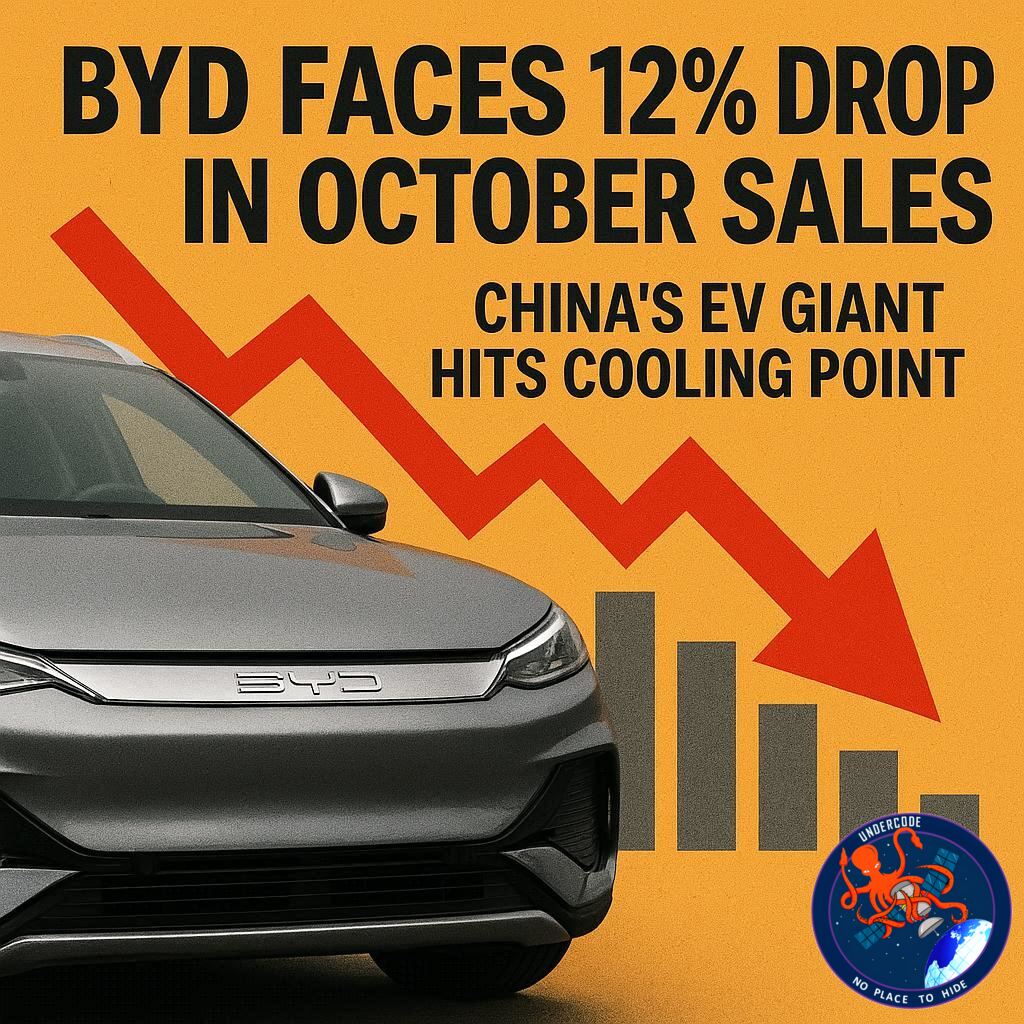
The Pressure Mounts on China’s Electric Titan
China’s EV powerhouse, BYD, is facing an unexpected slowdown. According to data released on November 1, the automaker sold 441,706 new vehicles in October, marking a 12% drop compared to the same month last year. This decline follows another dip in September, signaling a two-month streak of falling sales for one of the world’s most dominant electric vehicle makers.
The slowdown is most pronounced in BYD’s domestic passenger car market, where sales fell 13% to 436,856 units. Within that segment, its two core brands — Dynasty and Ocean — suffered a sharper 18% decline, falling to 395,015 units. Even the company’s luxury sub-brand DENZA, once considered a bright spot, saw stagnation amid growing competition and market fatigue.
BYD’s numbers reveal a deeper challenge: China’s EV market, once fueled by fierce demand and government incentives, is showing signs of saturation. As new rivals flood the market with aggressive pricing and advanced technologies, even BYD, the country’s largest electric automaker, is not immune to the slowdown.
Shifting Market Dynamics in China’s EV Landscape
Just a year ago, BYD was rewriting the global automotive script, surpassing Tesla in total electric vehicle sales in several quarters. The brand was celebrated for its vertical integration, battery innovation, and strong domestic footprint. But 2025 is proving to be a year of market correction rather than expansion.
Several factors are tightening BYD’s grip on growth:
Price wars triggered by Tesla and new Chinese EV startups have eroded profit margins.
Reduced subsidies and stricter environmental policies have made it harder for mid-tier buyers to commit.
Consumer fatigue has begun to surface as the flood of new models overwhelms the market.
BYD’s reliance on its home market is now being tested. While the company is expanding internationally — from Southeast Asia to Europe and Latin America — the slowdown at home poses strategic challenges. Domestic competition from Li Auto, Xpeng, and NIO has intensified, each brand targeting specific niches once dominated by BYD.
What Undercode Say:
BYD’s October slump is more than just a temporary sales dip. It’s a reflection of the growing pains of a maturing EV industry in China. The same forces that once powered BYD’s rise — aggressive scaling, price competitiveness, and government backing — are now becoming double-edged swords.
Let’s unpack why.
First, BYD’s scale has reached saturation in the domestic market. When a company sells nearly half a million cars per month, the law of large numbers kicks in. Sustaining double-digit growth becomes exponentially harder. The market that once craved electric vehicles now has too many options, and the differentiation between brands is thinning.
Second, the pricing war in China’s EV sector has turned brutal. Tesla’s frequent price cuts have cornered BYD into offering similar discounts, hurting profitability. Smaller EV startups, desperate to gain attention, are pushing prices even lower. This cycle benefits consumers in the short term but bleeds the industry of long-term sustainability.
Third, BYD’s international expansion is still in its early stage. While its models like the Seal and Atto 3 are gaining traction abroad, logistical hurdles, regulatory barriers, and brand recognition issues slow momentum. Global growth is not yet enough to offset domestic cooling.
Yet, despite these headwinds, BYD remains strategically well-positioned. Its battery division (BYD FinDreams) continues to supply not only its own cars but also other automakers. Its cost structure, supply chain control, and manufacturing efficiency remain unmatched. In the long run, these foundations could help BYD weather short-term volatility and regain momentum.
From a macroeconomic lens, BYD’s performance may also be a bellwether for China’s broader consumption slowdown. As economic uncertainty and youth unemployment weigh on middle-class spending, big-ticket items like cars are the first to feel the squeeze.
Still, investors and analysts should not mistake this dip for decline. Instead, it might be a strategic cooling phase before the next wave of global expansion. BYD is already setting its sights on the European mid-range EV market, a segment currently underserved by both Tesla and local automakers.
In essence, BYD’s October figures are a reminder: even giants stumble when the ground beneath them shifts. But in an industry defined by cycles of innovation and adaptation, the real question isn’t whether BYD can recover — it’s how fast and how boldly it will redefine its next phase of growth.
🔍 Fact Checker Results
✅ BYD reported 441,706 vehicle sales in October 2025, down 12% year-on-year.
✅ Dynasty and Ocean brands saw an 18% drop in combined sales.
❌ DENZA sales data not fully disclosed, only referenced as stagnant.
📊 Prediction
🚗 Short-Term: BYD may face continued pressure through Q4 as domestic competition intensifies.
🌏 Mid-Term: International markets, especially in Europe and Southeast Asia, will gradually offset domestic softness.
⚡ Long-Term: With its vertical integration and advanced battery tech, BYD could reclaim double-digit growth by mid-2026.
🕵️📝✔️Let’s dive deep and fact‑check.
References:
Reported By: xtechnikkeicom_1763eaf8b65e86fb45841471
Extra Source Hub (Possible Sources for article):
https://www.reddit.com/r/AskReddit
Wikipedia
OpenAi & Undercode AI
Image Source:
Unsplash
Undercode AI DI v2
Bing
🔐JOIN OUR CYBER WORLD [ CVE News • HackMonitor • UndercodeNews ]
📢 Follow UndercodeNews & Stay Tuned:
𝕏 formerly Twitter 🐦 | @ Threads | 🔗 Linkedin | 🦋BlueSky | 🐘Mastodon


