
Listen to this Post
Introduction
In a groundbreaking step for infrastructure maintenance, NTT Group has successfully demonstrated drone-based inspections of public sewer pipelines in Kanagawa Prefecture, Japan. Leveraging artificial intelligence (AI) for precise damage detection and innovative drone technology, the project aims to transform how municipalities monitor and maintain underground infrastructure. By overcoming traditional challenges such as narrow spaces, dark environments, and complex pipe angles, this initiative represents a major leap forward in automated, efficient, and safe sewer inspections.
the Demonstration
NTT e-Drone Technology, the NTT Group company specializing in drone services, conducted test flights in Kanagawa Prefecture’s public sewer pipelines. These flights, carried out on October 20 and 31 in collaboration with NTT-ME and NTT East Japan, focused on two stormwater retention pipes and one wastewater main. The team deployed the indoor-specific drone “ELIOS 3” and the versatile “Skydio X10” to navigate the challenging underground environment.
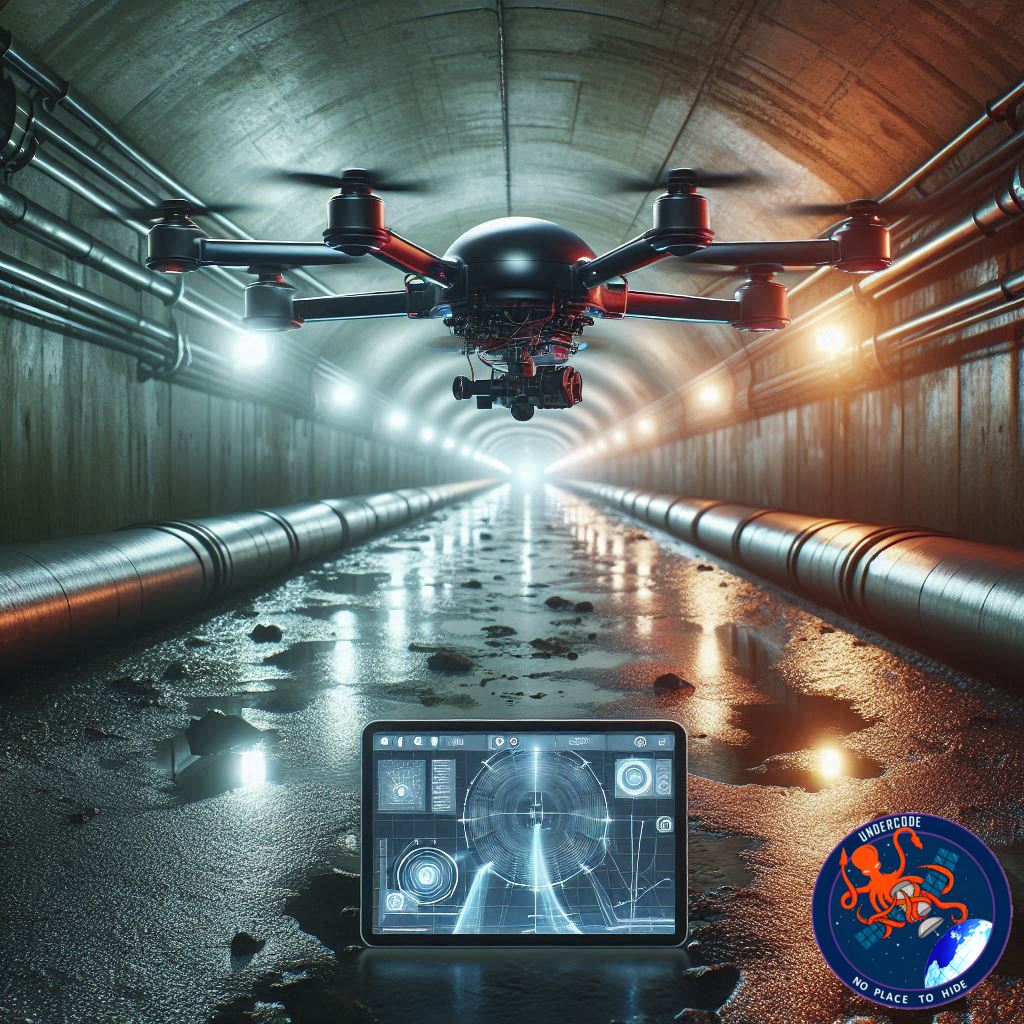
During the tests, drones achieved stable flights over approximately 150 meters, successfully traversing tight bends and confined spaces that were previously difficult for conventional inspection methods. Equipped with high-intensity LED lights and high-resolution cameras, the drones captured sharp images of the pipe interiors. Unique signal amplification technology enabled stable communication, even in pipes with 90-degree bends.
AI-driven damage analysis using NTT e-Drone Technology’s proprietary “e-Drone AI” successfully identified cracks extending along both axial and circumferential directions. Comparison with past inspection records confirmed that the AI’s detection accuracy matched human visual inspections. Based on these results, NTT and its partners are set to expand support for drone-based inspections in Kanagawa Prefecture and nationwide, leveraging AI and other emerging technologies to address long-standing challenges in sewer and underground infrastructure monitoring.
What Undercode Say:
The NTT initiative highlights several transformative trends in infrastructure inspection. First, drones combined with AI are not merely tools for automation—they represent a paradigm shift in how municipalities can manage aging sewer systems. The ability to navigate narrow, dark, and curved pipes addresses a critical limitation of traditional inspection methods, which often require manual labor, confined-space equipment, and significant time investment. By achieving stable flights in environments previously considered inaccessible, drones can reduce inspection costs, minimize human risk, and accelerate maintenance schedules.
Second, AI-based damage detection ensures a level of accuracy and consistency unattainable through purely human inspection. Cracks and other structural defects are often subtle, and reliance on visual checks can lead to missed issues. The integration of AI allows for continuous, objective, and high-precision assessment, potentially predicting maintenance needs before critical failures occur. This data-driven approach also enables better prioritization of repair works and resource allocation for municipal authorities.
Third, the demonstration illustrates the importance of tailored drone technology. Using a combination of indoor-specific and general-purpose drones maximizes flexibility while addressing the unique challenges of subterranean inspections. The amplification of communication signals further ensures operational reliability—a crucial factor in complex urban infrastructures.
Moreover, this development is indicative of a broader trend: the convergence of robotics, AI, and urban management. Cities worldwide face aging infrastructure, and proactive maintenance powered by technology will become an essential element of urban planning. Japan’s approach, through rigorous testing and gradual implementation, could serve as a blueprint for other nations with similar infrastructure challenges.
Finally, NTT’s strategy to expand adoption across municipalities emphasizes scalability. Successful pilot programs like this pave the way for wider deployment, fostering public-private partnerships that leverage technological innovation for societal benefit. The initiative also underlines the growing market for AI-driven industrial inspection solutions, combining hardware and software in a seamless ecosystem.
From a long-term perspective, the integration of drone inspections and AI analytics is likely to influence policy, insurance, and risk assessment frameworks. Data collected from these inspections can inform structural health monitoring systems, support regulatory compliance, and contribute to disaster preparedness planning. With AI continuously learning from inspection data, predictive maintenance can evolve from reactive repairs to proactive, condition-based interventions—significantly improving urban resilience.
Additionally, there is potential for cross-application: similar drone and AI systems could be adapted for bridge inspections, tunnel monitoring, and water treatment facilities. As technology matures, cost reductions and operational efficiency will encourage broader adoption, creating a new standard for civil infrastructure management. The NTT demonstration in Kanagawa thus represents not just a technological achievement, but a strategic investment in the future of urban infrastructure oversight.
Fact Checker Results
✅ AI successfully detected structural cracks in sewer pipelines.
✅ Drones maintained stable flight in tight and dark sewer conditions.
❌ No information suggests full-scale municipal deployment has occurred yet.
Prediction
📊 Drone and AI technology for sewer inspections will likely expand rapidly across Japan and globally within the next five years. Municipalities will adopt automated inspection as a standard, reducing maintenance costs and risks. Predictive analytics from AI will also drive more proactive infrastructure management, potentially preventing major pipe failures and improving urban resilience.
🕵️📝✔️Let’s dive deep and fact‑check.
References:
Reported By: xtechnikkeicom_3f6c5529cb3bda5b14dc6d70
Extra Source Hub (Possible Sources for article):
https://www.github.com
Wikipedia
OpenAi & Undercode AI
Image Source:
Unsplash
Undercode AI DI v2
Bing
🔐JOIN OUR CYBER WORLD [ CVE News • HackMonitor • UndercodeNews ]
📢 Follow UndercodeNews & Stay Tuned:
𝕏 formerly Twitter 🐦 | @ Threads | 🔗 Linkedin | 🦋BlueSky | 🐘Mastodon


