
Listen to this Post
Introduction
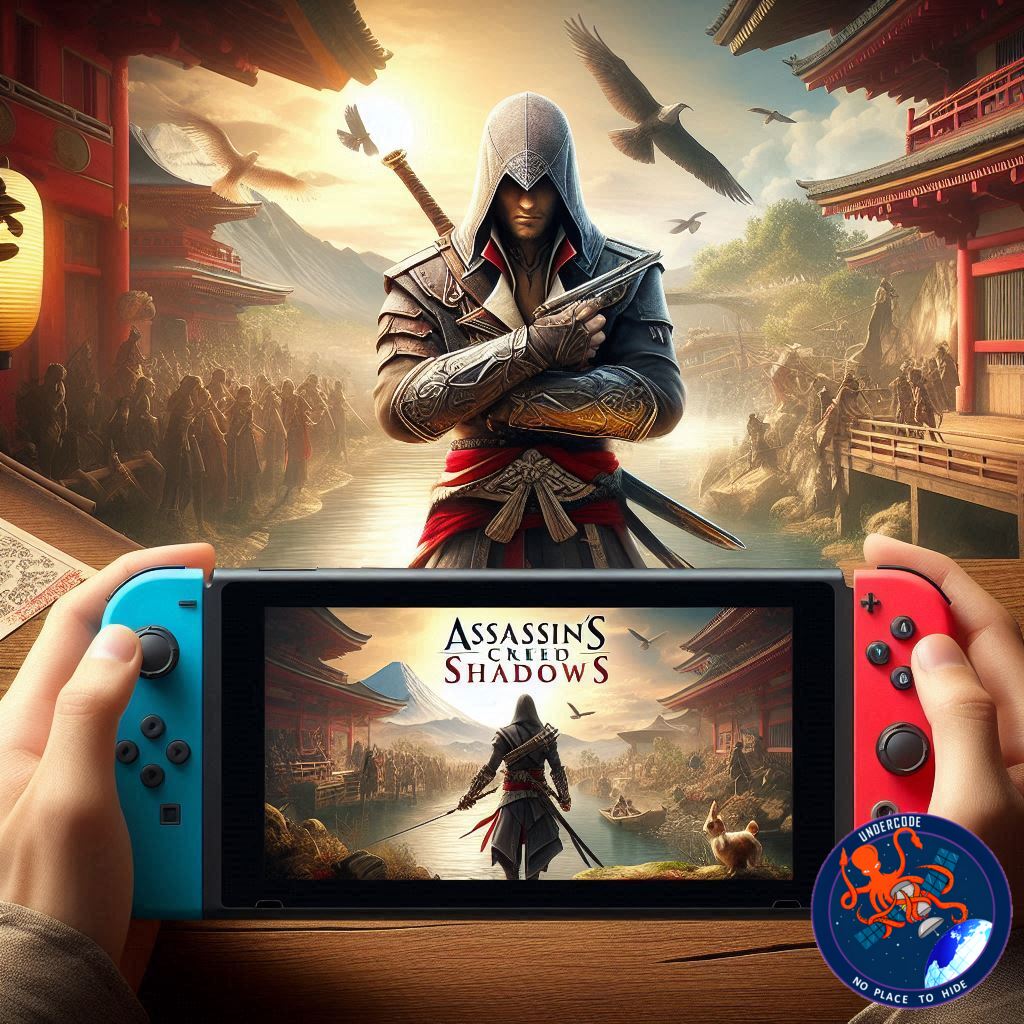
Ubisoft’s decision to bring Assassin’s Creed Shadows to the Nintendo Switch 2 marks one of the most ambitious technical undertakings in the franchise’s history. For years, the series has been synonymous with sprawling cities, dense crowd systems, and complex simulation layers that push hardware to its limits. Translating this vision to a hybrid console with portable constraints required a complete rethinking of rendering pipelines, performance budgets, and world-building strategies. What emerged is not just a port, but a reconstruction of feudal Japan designed specifically to survive the realities of mobile hardware while preserving the soul of the original adventure.
Assassin’s Creed Shadows Comes to Nintendo Switch 2
Ubisoft has confirmed that
Rebuilding Shadows for a Hybrid Console
Bringing a game designed for PC, Xbox Series consoles and PS5 to the far less powerful Switch 2 required a technical overhaul. Ubisoft revealed that this port was one of the studio’s toughest engineering challenges to date. Still, the final product maintains smooth gameplay and high visual fidelity whether played in handheld or docked mode.
How Developer Expertise Shaped the Port
In a detailed technical breakdown, Ubisoft’s graphic director, Yannick, and project lead programmer, Bruno, outlined how the team reshaped the world of Shadows to function efficiently on Nintendo’s new device. Shadows’ open world was rebuilt through months of optimisation that touched nearly every system.
The Challenge of Rendering Feudal Japan on Switch 2
Bruno described the port as one of the most demanding yet rewarding projects of his career. The team had to rebuild rendering systems, restructure code, and optimise performance targets without compromising the artistic integrity and atmosphere of feudal Japan. Their main objective was clear: preserve visual impact while maintaining 30 FPS in handheld and docked modes.
Deep Optimisation Across the Engine
Shadows’ systems originally developed for high-end hardware required extensive rewrites. Assets were re-authored, cloud simulations and cloth physics were retooled for ARM architecture, and GPU-heavy data was selectively reduced without damaging visual quality. Although Switch 2 supports ray-traced Global Illumination, the developers opted for baked GI to safeguard memory resources, ensuring that lighting remained dynamic and convincing without overwhelming system RAM.
Smart Technical Reductions
Performance stability was protected through controlled adjustments to LOD distances, texture resolution and loading behaviour. In densely populated regions, NPC counts were dialed back slightly to maintain fluidity. DLSS played a key role by using AI-driven upscaling to enhance clarity, colour depth and overall performance.
Designed for Both Modes
A smooth 30 FPS was the goal across handheld and docked, though handheld required scaled-back assets. Docked mode leverages the full suite of Switch 2’s capabilities, including HDR and VRR. Since VRR typically requires 40 FPS or more, Ubisoft developed a custom VRR algorithm that operates at 30 FPS, ensuring visual smoothness without altering gameplay.
Enhanced Features on Switch 2
This version brings touch controls, nearly all post-launch updates and future patches will maintain parity with other platforms. Keyboard and mouse support will arrive later for docked mode.
Multi-Platform Availability
Assassin’s Creed Shadows will also remain available across PS5, Xbox Series X|S, Amazon Luna, Apple silicon Macs, PC, Steam, the Epic Games Store, and Ubisoft+ Premium.
What Undercode Say:
The arrival of Assassin’s Creed Shadows on Nintendo Switch 2 represents more than a platform expansion, it is a stress test for the industry’s future relationship with hybrid hardware. Ubisoft did not simply shrink an open-world giant into a portable frame. Instead, they renegotiated how simulation, lighting, and world density can coexist within stricter limits without sacrificing identity.
The use of DLSS is especially telling.
The baked Global Illumination approach demonstrates a willingness to prioritize stability over spectacle. It signals a return to fundamentals, where developers must rethink assumptions about lighting that have gone unquestioned for years. In many ways, this port forces a philosophical shift; it challenges the belief that modern visuals require fully dynamic lighting to feel alive.
Crowd density adjustments, LOD tuning, and memory-conscious asset trimming are reminders that optimization is an art form. Ubisoft’s custom VRR algorithm is particularly clever, bending a feature typically bound by frame-rate requirements and making it functional for a 30 FPS target. This type of engineering reveals a deeper technical creativity, one that often goes unnoticed behind the flashier marketing claims.
What stands out most is how Shadows becomes a proving ground for scalable open-world design. If Ubisoft can produce a faithful rendition of feudal Japan on a portable console, it opens the door for more AAA studios to rethink how their future titles might expand across hardware tiers. It hints at a gaming ecosystem where scale no longer equals exclusivity, where technical elegance can overcome hardware disparity.
Ultimately, the Switch 2 version of Assassin’s Creed Shadows is a quiet statement. It says that fidelity is not dependent on platform, but on the ingenuity of the people who build within its constraints. It underscores how innovation thrives when limitations are embraced, not feared. And it positions Ubisoft as one of the few major studios willing to rebuild their technologies from the ground up to meet players wherever they choose to play.
Fact Checker Results
✅ Ubisoft officially confirmed the December 2 release date for Switch 2.
❌ The Claws of Awaji expansion is not included at launch, despite other updates being present.
✅ DLSS, touch controls and cross-progression were verified through developer statements.
Prediction
The success of Assassin’s Creed Shadows on Switch 2 may encourage more AAA studios to adopt scalable engines and AI-driven rendering. 🎮
If reception is strong, Nintendo’s hybrid platform could see a wave of high-end ports previously considered impossible. 📈
Ubisoft’s technical gains might shape future entries, pushing the franchise toward broader multi-device parity and deeper optimisation strategies. 🚀
🕵️📝✔️Let’s dive deep and fact‑check.
References:
Reported By: timesofindia.indiatimes.com
Extra Source Hub (Possible Sources for article):
https://www.reddit.com/r/AskReddit
Wikipedia
OpenAi & Undercode AI
Image Source:
Unsplash
Undercode AI DI v2
Bing
🔐JOIN OUR CYBER WORLD [ CVE News • HackMonitor • UndercodeNews ]
📢 Follow UndercodeNews & Stay Tuned:
𝕏 formerly Twitter 🐦 | @ Threads | 🔗 Linkedin | 🦋BlueSky | 🐘Mastodon


