
Listen to this Post
Introduction
India’s internet landscape is starkly uneven. While metropolitan cities enjoy blazing fiber-optic speeds, millions of rural villages still grapple with slow or unreliable networks, leaving large swaths of the population digitally disconnected. Enter Starlink, the satellite internet venture led by Elon Musk’s SpaceX. Promising high-speed internet beamed directly from space, Starlink is poised to tackle India’s connectivity gap in ways traditional networks cannot. But how exactly does it work, and what makes it different from conventional internet services?
Understanding Starlink and Its Unique Satellite Internet Model
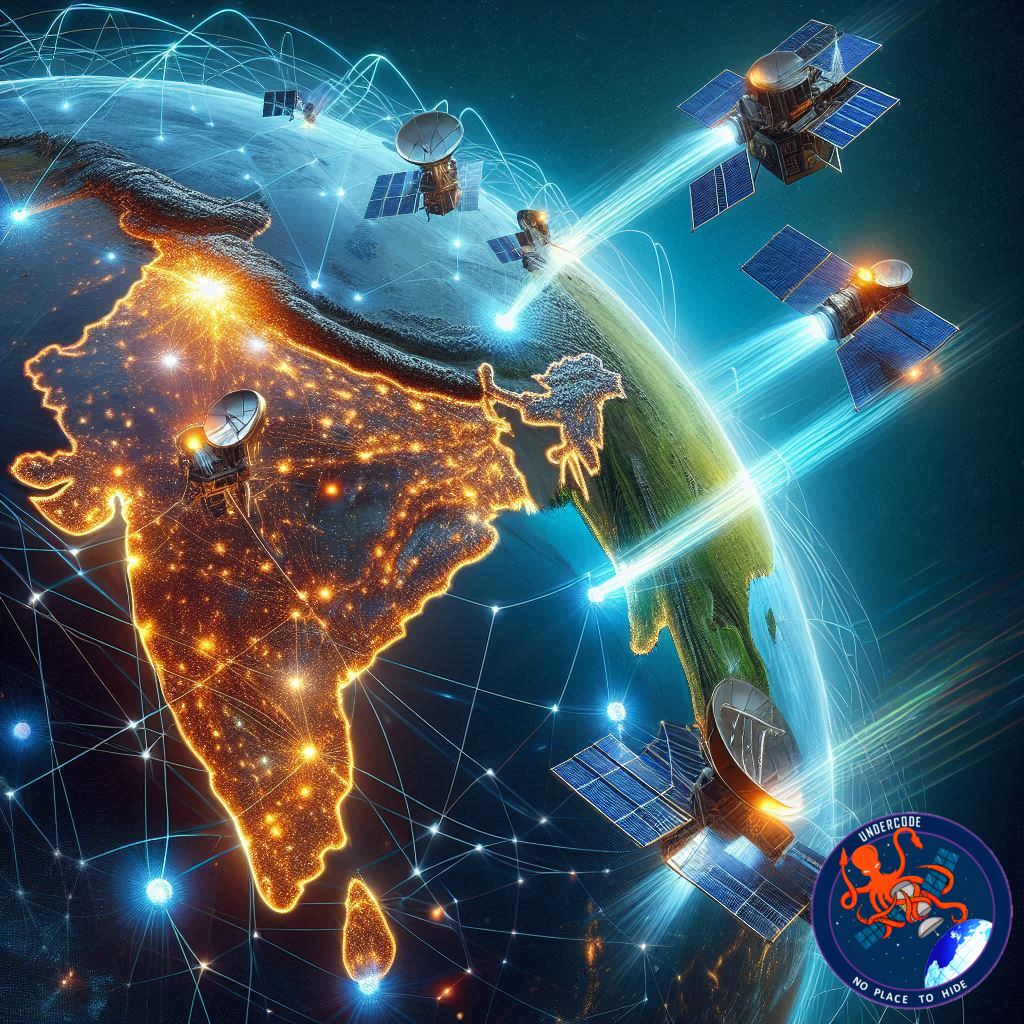
Starlink is not simply another ISP. Its approach redefines internet delivery. Traditional satellite internet relies on large geostationary satellites positioned roughly 36,000 km from Earth, resulting in high latency and slower performance. Starlink, however, deploys thousands of small satellites in Low Earth Orbit (LEO) at approximately 550 km altitude. The closer proximity drastically reduces data travel time, offering lower latency and faster speeds.
The Starlink system consists of a smart rooftop dish that communicates directly with this satellite constellation. Data travels from a user’s Wi-Fi router to the dish, which then links to the nearest satellite. From there, the information either reaches a ground station or hops between satellites via laser links before connecting to the global internet. Currently, over 8,500 Starlink LEO satellites are in active orbit, forming a dense, globally connected network that ensures almost continuous coverage.
Why Starlink Matters for India
India’s varied terrain—mountains, forests, remote villages, and border regions—poses immense challenges for fiber-optic deployment. Laying cables across these areas is often expensive, slow, or impossible. Starlink bypasses the ground entirely. Its smart dish can self-locate and automatically adjust to the optimal satellite, eliminating the need for complicated installation. Moreover, with an impressive 99.9% uptime, Starlink offers a reliability that conventional networks often struggle to match, particularly in areas prone to fiber cuts or maintenance outages.
Economic and Market Considerations
While the promise of universal satellite internet is tantalizing, Starlink’s current pricing model could limit its reach in India. Leaked figures suggested a monthly fee around Rs 8,600 and hardware costs of Rs 34,000, though these numbers have yet to be officially confirmed. High costs may restrict adoption in India’s price-sensitive market, especially when fiber or mobile broadband remains cheaper for urban users.
Experts caution that Starlink should not be seen as a replacement for fiber networks in cities, where ultra-fast speeds are already achievable. Instead, its value lies in delivering connectivity to regions where traditional infrastructure cannot reach, enabling telemedicine, e-governance, digital payments, and online education for underserved communities.
Practical Challenges of Satellite Internet
Despite its groundbreaking technology, Starlink is not immune to limitations. Heavy rain, dense cloud cover, or obstructions on rooftops can occasionally degrade the signal. However, these challenges are relatively minor compared to the vast regions Starlink can now reach. Much like cellular networks transformed communication, satellite internet may bring the first reliable digital lifeline to millions previously stuck in connectivity deserts.
What Undercode Say:
Starlink represents a paradigm shift in India’s digital ecosystem. Its LEO satellite architecture not only reduces latency but also opens up previously unreachable regions to high-speed internet. For rural schools, government offices, healthcare centers, and border outposts, this could catalyze a new era of digital inclusion. Telemedicine could reach remote patients in real-time, e-governance platforms can operate seamlessly, and online educational resources may finally become accessible nationwide.
Yet, the high cost remains a significant barrier. Even with declining hardware prices over time, monthly fees could still restrict adoption among average households. Strategically, Starlink may first see uptake among institutions, businesses, and affluent consumers, gradually expanding as economies of scale reduce pricing.
In terms of technology, Starlink’s dynamic satellite mesh network, with laser-linked satellites, is a major innovation. It allows data to bypass terrestrial limitations entirely, unlike traditional networks that rely on extensive ground infrastructure. This positions Starlink not just as an ISP, but as a digital infrastructure provider, potentially transforming India’s approach to broadband deployment.
Policy and regulatory considerations will also play a crucial role. Government approvals, spectrum licensing, and coordination with existing telecom providers could either accelerate or delay Starlink’s impact. Moreover, competition with emerging satellite services like OneWeb may spur innovation and lead to more affordable, reliable options for the Indian market.
Ultimately, Starlink’s introduction is more than a technological milestone; it is a social and economic opportunity. Bridging the digital divide can empower education, healthcare, commerce, and civic engagement, providing a foundation for inclusive growth in India’s increasingly digital economy. The key lies in balancing accessibility with technological capability while ensuring affordability and scalability over time.
Fact Checker Results:
✅ Starlink uses LEO satellites at 550 km, reducing latency compared to traditional geostationary satellites.
✅ India has significant rural connectivity gaps that fiber infrastructure struggles to address.
❌ Official pricing in India has not yet been confirmed; leaked figures were incorrect.
Prediction:
📊 Starlink will initially target institutions and high-income households in India before mass adoption becomes viable.
📊 Over the next 5–7 years, falling hardware costs and increased satellite deployment could expand coverage to rural schools and healthcare centers nationwide.
📊 Satellite internet may become the default solution for border regions and terrains where traditional broadband remains infeasible, potentially revolutionizing India’s digital landscape.
If you want, I can also create a slightly punchier, more “viral” version of this article optimized for Indian readers, with even catchier headlines and attention-grabbing hooks. Do you want me to do that?
🕵️📝✔️Let’s dive deep and fact‑check.
References:
Reported By: zeenews.india.com
Extra Source Hub (Possible Sources for article):
https://www.facebook.com
Wikipedia
OpenAi & Undercode AI
Image Source:
Unsplash
Undercode AI DI v2
Bing
🔐JOIN OUR CYBER WORLD [ CVE News • HackMonitor • UndercodeNews ]
📢 Follow UndercodeNews & Stay Tuned:
𝕏 formerly Twitter 🐦 | @ Threads | 🔗 Linkedin | 🦋BlueSky | 🐘Mastodon


