
Listen to this Post
Introduction: The Hidden Problem Behind “Fast” Wireless Charging
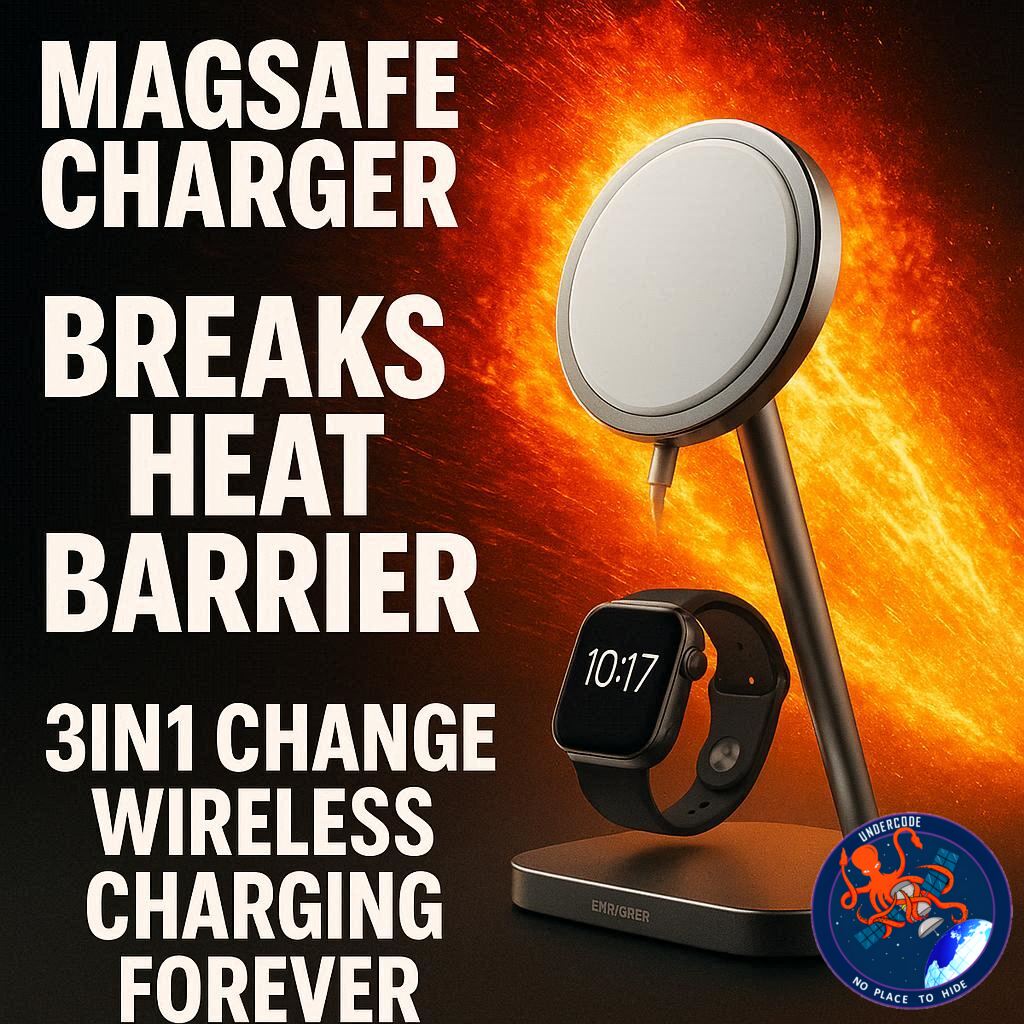
Wireless charging has always promised convenience, but speed has remained its biggest weakness. MagSafe chargers, in particular, face a fundamental enemy: heat. As power is transferred through induction coils, excess heat builds up, forcing iPhones to slow charging speeds to protect battery health. This problem becomes even more obvious during summer or in warm indoor environments. LISEN’s new 3-in-1 MagSafe charging station positions itself as a direct answer to this long-standing limitation, combining active cooling with the newer Qi2.2 standard to deliver sustained 25-watt wireless charging that rivals wired performance.
the Original A Faster, Cooler MagSafe Experience
LISEN’s 3-in-1 MagSafe charging station is designed around one key idea: defeating thermal throttling. Traditional MagSafe chargers often advertise higher speeds but fail to sustain them once heat builds up. By integrating an active cooling fan directly into the charging stand, LISEN claims its charger can maintain the full 25-watt output enabled by Qi2.2. According to the article, this allows an iPhone 17 Pro to reach 50% battery in roughly 22 minutes, a major leap compared to the common 15-watt ceiling seen on many MagSafe accessories.
A standout feature of the charger is its dual operating modes. “Cool Mode” activates the internal fan to actively dissipate heat, ensuring maximum charging speed during daytime or desk use. “Sleep Mode,” on the other hand, disables the fan for silent operation, making it suitable for bedside charging even if it sacrifices peak speed. This flexibility addresses one of the main concerns with active cooling on desktop chargers: noise during nighttime use.
The hardware design also receives praise. The charger features a weighted, chrome-plated base that stays firmly in place when removing an iPhone, avoiding the frustrating lift-and-drag effect seen on cheaper docks. The MagSafe puck supports both portrait and landscape orientations, making it ideal for Apple’s StandBy mode. LISEN includes a 45-watt power adapter in the box, ensuring users can actually reach the advertised charging speeds without purchasing additional accessories.
Beyond iPhone charging, the station includes dedicated spots for AirPods and Apple Watch, turning it into a true all-in-one solution for Apple users. While overnight charging in Sleep Mode won’t fully exploit the 25-watt capability, the article emphasizes that this trade-off is largely irrelevant for long charging sessions. Overall, the original piece frames the LISEN charger as a practical, speed-focused upgrade for users who frequently need fast top-ups during the workday.
What Undercode Say:
The real story here is not just faster wireless charging, but the quiet admission that MagSafe has been thermally constrained from the start. LISEN’s approach highlights a truth many accessory makers avoid: without active cooling, wireless charging will always hit a ceiling. By borrowing ideas previously seen in car mounts and adapting them for the desktop, LISEN is effectively redefining what “fast” wireless charging can realistically mean.
From a market perspective, this charger blurs the traditional line between wired and wireless performance. If a MagSafe dock can consistently deliver 25 watts without throttling, the psychological advantage of cables starts to fade. For office workers, creators, and anyone constantly moving between meetings, shaving 20–30 minutes off charging time has real productivity value. This is not about convenience alone; it is about reliability under pressure.
The inclusion of Qi2.2 is also strategically important. As Apple continues to influence wireless standards, accessories that fully embrace newer Qi revisions early tend to age better. If future iPhones continue pushing higher wireless wattage, chargers like LISEN’s may already be prepared, while older 15-watt docks quietly become obsolete.
However, active cooling introduces a new design philosophy that may divide users. Purists who value absolute silence and minimalism may resist the idea of a fan inside a desk accessory, even if it is optional. Yet LISEN’s decision to include a Sleep Mode shows an understanding of real-world usage rather than chasing benchmarks alone. This balance between performance and practicality is where many tech accessories fail.
There is also a broader implication for battery health. Sustained high-speed charging typically raises concerns about long-term degradation, but effective thermal management can actually reduce stress on lithium-ion cells. If LISEN’s cooling system genuinely keeps temperatures lower, it may extend battery longevity rather than harm it, challenging common assumptions about fast charging.
Ultimately, this charger feels less like a gimmick and more like a signal. Wireless charging is entering a phase where engineering choices, not just branding, will define winners. LISEN’s 3-in-1 station suggests that the next generation of MagSafe accessories will be judged on thermal design as much as wattage numbers. If competitors follow suit, the era of “slow but convenient” wireless charging may finally be ending.
🔍 Fact Checker Results
✅ Active cooling is a proven method to reduce thermal throttling in wireless charging systems.
✅ Qi2.2 supports higher sustained power delivery compared to earlier Qi standards.
❌ Not all environments will achieve identical charging speeds, as ambient temperature still plays a role.
📊 Prediction
Wireless charging accessories with active cooling will become mainstream within the next two product cycles, especially as iPhones push higher wattage limits. Chargers that remain capped at 15 watts without thermal innovation are likely to be phased out as users increasingly expect wired-level performance without cables.
🕵️📝✔️Let’s dive deep and fact‑check.
References:
Reported By: 9to5mac.com
Extra Source Hub (Possible Sources for article):
https://www.quora.com/topic/Technology
Wikipedia
OpenAi & Undercode AI
Image Source:
Unsplash
Undercode AI DI v2
Bing
🔐JOIN OUR CYBER WORLD [ CVE News • HackMonitor • UndercodeNews ]
📢 Follow UndercodeNews & Stay Tuned:
𝕏 formerly Twitter 🐦 | @ Threads | 🔗 Linkedin | 🦋BlueSky | 🐘Mastodon


