
Listen to this Post
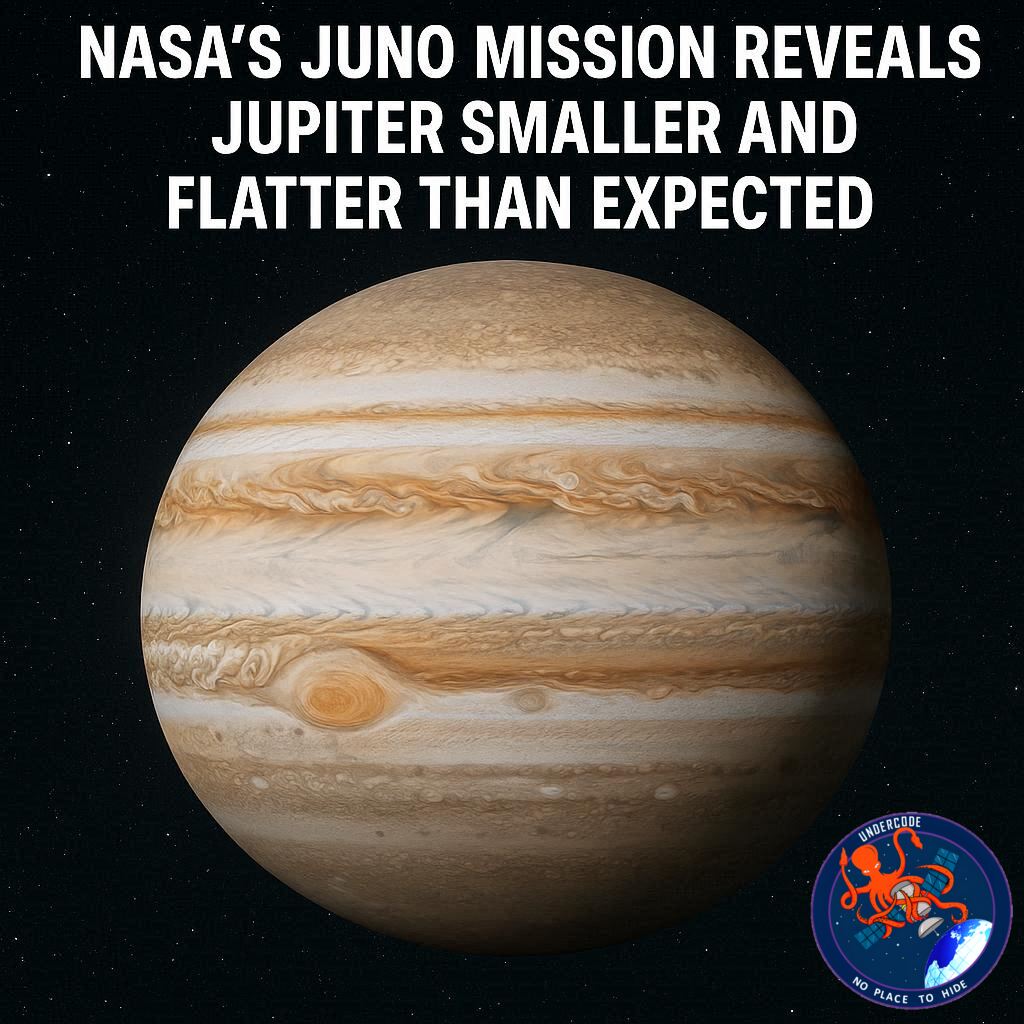
NASA’s Juno spacecraft has delivered surprising new insights into the solar system’s largest planet. Far from being a perfect sphere, Jupiter is now understood to be slightly smaller at its equator and more compressed at its poles than scientists previously thought. These findings, based on data from 13 flybys, refine our understanding of the gas giant’s size, shape, and internal structure—and could have significant implications for studying distant exoplanets.
By examining radio occultation data—where radio waves are sent through Jupiter’s dense atmosphere and measured as they bend and delay—researchers have been able to probe the planet’s hidden layers. These signals, analyzed via NASA’s Deep Space Network on Earth, reveal subtle variations in temperature, pressure, and electron density within the ionosphere. Factoring in the effects of Jupiter’s powerful zonal winds, Juno’s team determined that the planet is about 5 miles (8 kilometers) narrower at the equator and 15 miles (24 kilometers) flatter at the poles than previous estimates suggested.
Until now, scientists relied on data from six radio occultation experiments conducted by NASA’s Pioneer and Voyager missions in the 1970s. Those measurements provided a broad approximation of Jupiter’s dimensions, but the precision afforded by Juno offers the most accurate model yet. Understanding Jupiter’s true shape is critical, not just for mapping our own solar system but also for interpreting the characteristics of giant exoplanets orbiting other stars. Since Jupiter often serves as a reference for modeling these distant worlds, improved knowledge of its radius and flattening directly informs astronomical studies far beyond our cosmic neighborhood.
The findings were published in the Feb. 2, 2026 issue of Nature Astronomy and highlight the ongoing value of Juno, managed by NASA’s Jet Propulsion Laboratory in Pasadena, California, for the agency’s Science Mission Directorate in Washington.
What Undercode Say:
Juno’s new measurements underscore how even the most familiar planetary giants still hold secrets. Jupiter’s “squashed” shape is primarily caused by its rapid rotation—spinning once every roughly 10 hours—which flattens the poles and bulges the equator. Incorporating zonal wind data into these calculations adds a layer of sophistication, revealing the complex interplay between atmospheric dynamics and planetary structure.
For planetary scientists, these findings recalibrate models of internal mass distribution and core size, refining theories about gas giant formation. Knowing Jupiter’s precise flattening and radius helps distinguish between competing hypotheses about how heavy elements are layered within the planet. It also impacts gravitational field calculations, essential for predicting the motion of Jupiter’s moons and understanding tidal interactions.
Beyond the solar system, astronomers now have a sharper benchmark for characterizing exoplanets. Many “hot Jupiters”—gas giants orbiting close to their stars—are detected by the slight dimming they cause during transits. Small discrepancies in assumed planetary radii can drastically alter inferred densities and compositions. Juno’s updated measurements help reduce such uncertainties, offering a clearer lens for studying distant worlds.
Moreover, Juno’s approach demonstrates the power of radio occultation as a tool for probing hidden planetary layers. Unlike visual imaging, which is blocked by thick clouds, radio waves penetrate deep into the atmosphere, providing data on temperature, pressure, and electron density at multiple depths. As radio technology improves, this method could become standard for future missions exploring Uranus, Neptune, or even exoplanet atmospheres.
The mission also emphasizes long-term observation. Thirteen flybys over multiple years allowed scientists to account for temporal variations in Jupiter’s winds and atmospheric conditions. This contrasts with the single-mission snapshots of the 1970s, highlighting the need for persistent monitoring to understand dynamic planetary systems.
Finally, these results are a reminder of how planetary exploration informs multiple fields—from astrophysics to planetary geology to atmospheric science. Each incremental discovery about Jupiter reshapes our understanding of planetary formation, evolution, and the potential habitability of moons and nearby exoplanets.
Fact Checker Results:
✅ Radio occultation technique confirmed: Juno uses radio waves to probe atmospheric layers.
✅ Planetary flattening validated: Jupiter is flatter at poles due to rotation and zonal winds.
✅ Publication source verified: Results appear in Nature Astronomy, Feb. 2, 2026.
Prediction:
🌌 Juno’s refined measurements will likely set a new standard for modeling gas giants both within and beyond our solar system. Future exoplanet missions could rely on these benchmarks to more accurately determine planet sizes, densities, and compositions. Over the next decade, similar radio occultation studies may become central to characterizing Uranus- and Neptune-like planets, potentially uncovering atmospheric dynamics and internal structures previously unseen.
🕵️📝✔️Let’s dive deep and fact‑check.
References:
Reported By: science.nasa.gov
Extra Source Hub (Possible Sources for article):
https://www.reddit.com
Wikipedia
OpenAi & Undercode AI
Image Source:
Unsplash
Undercode AI DI v2
Bing
🔐JOIN OUR CYBER WORLD [ CVE News • HackMonitor • UndercodeNews ]
📢 Follow UndercodeNews & Stay Tuned:
𝕏 formerly Twitter 🐦 | @ Threads | 🔗 Linkedin | 🦋BlueSky | 🐘Mastodon


