
Listen to this Post
Introduction
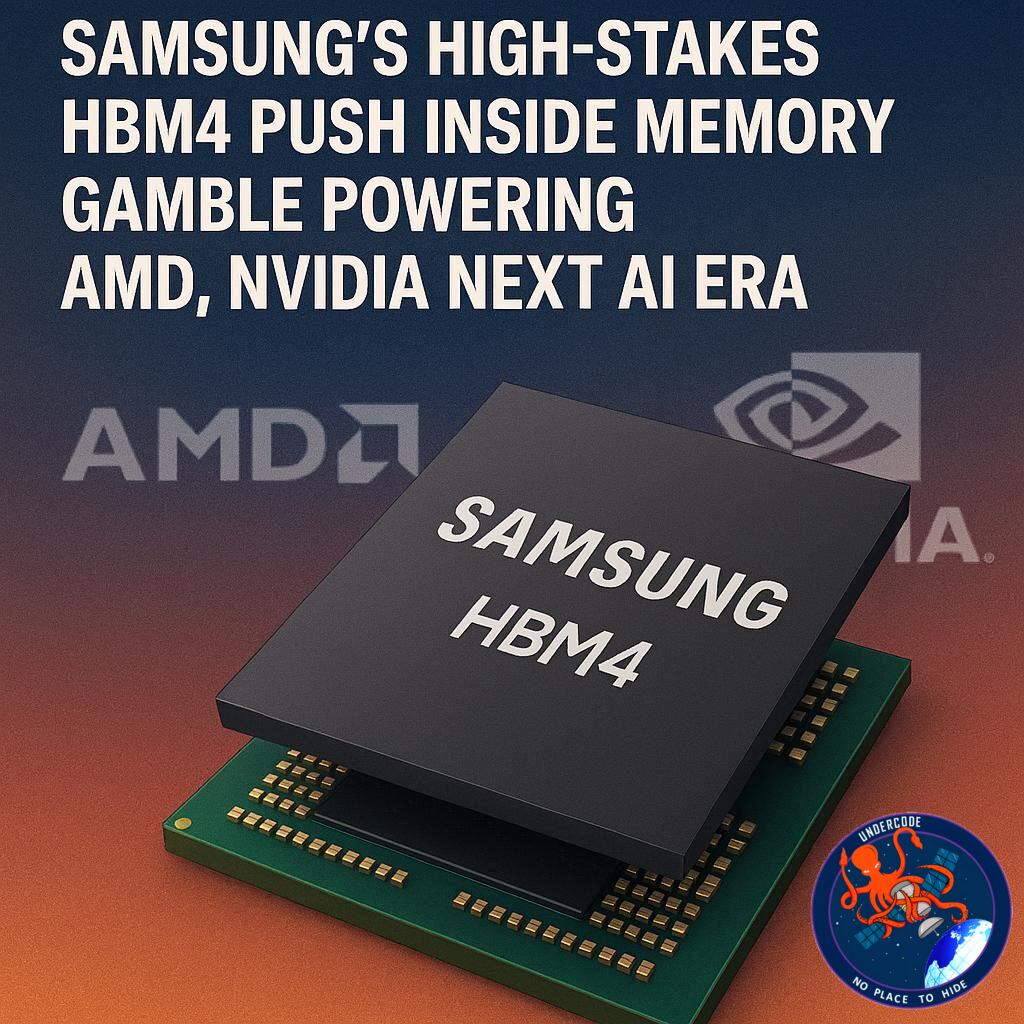
Samsung is accelerating its strategy to dominate the booming AI hardware market by aggressively expanding production of its next-generation high-bandwidth memory. As artificial intelligence workloads grow more complex and data-hungry, demand for advanced memory solutions has exploded. At the center of this shift is HBM4, the sixth generation of high-bandwidth memory, which promises higher performance and better efficiency than previous standards. Samsung’s latest move signals a decisive bet: that AI accelerators from industry giants like AMD and Nvidia will continue to drive extraordinary demand—and profits—for cutting-edge memory.
the Original
Samsung is rapidly increasing its production capacity for sixth-generation high-bandwidth memory (HBM4) chips, aiming to benefit from the surging AI accelerator market. Unlike conventional DDR memory, HBM chips command significantly higher margins, making them a strategic priority for the company. HBM4 will be a core component in next-generation AI systems from AMD, including the MI450, and Nvidia’s upcoming Rubin platform. Only a handful of manufacturers—primarily Samsung and SK Hynix—are currently capable of producing these advanced chips at scale, giving them a powerful position in the supply chain.
According to industry sources, Samsung plans to raise HBM4 DRAM wafer production to approximately 120,000 wafers per month. Achieving this level of output requires massive capital investment, but Samsung appears ready to spend aggressively to secure long-term competitiveness in AI memory. To support this expansion, the company is upgrading the P4 production line at its Pyeongtaek semiconductor facility in South Korea. This includes installing new manufacturing equipment and enhancing existing tools to improve yields and overall throughput.
The push comes after Samsung lagged behind competitors in the HBM3E segment last year, a setback that allowed rivals to gain ground. Since then, Samsung has focused on refining its processes and addressing performance issues. Early indications suggest that Samsung’s HBM4 chips may outperform alternatives from Micron and SK Hynix, partly due to a more advanced fabrication process. With AI hardware demand continuing to climb and HBM prices rising accordingly, Samsung sees HBM4 as a critical lever to boost profitability and regain technological leadership in the memory market.
What Undercode Say:
Samsung’s aggressive HBM4 expansion is less about catching up and more about reshaping the competitive landscape of AI memory. High-bandwidth memory has quietly become one of the most strategic components in modern computing, often dictating the real-world performance of AI accelerators more than raw GPU compute alone. By targeting 120,000 wafers per month, Samsung is signaling confidence not just in current demand, but in a multi-year AI infrastructure build-out that shows no signs of slowing.
This move also reflects a broader industry truth: margins in traditional memory segments are increasingly volatile, while AI-focused components offer relative pricing power. Every major cloud provider and AI lab is racing to deploy larger models, and those models are brutally memory-hungry. HBM4’s improvements in bandwidth, capacity stacking, and power efficiency directly translate into faster training times and lower total cost of ownership for data centers. That makes these chips strategically indispensable, not easily interchangeable commodities.
Samsung’s decision to heavily invest in the Pyeongtaek P4 line suggests it has learned from the HBM3E stumble. Yield and reliability matter as much as raw specs, especially when customers like Nvidia are notoriously demanding about validation and long-term supply stability. If early reports about superior HBM4 performance hold true, Samsung could flip the narrative from “playing catch-up” to “setting the pace” in the next cycle.
There is also a geopolitical and supply-chain angle. With only a few players capable of producing HBM at scale, any capacity expansion instantly strengthens bargaining power with AI chip designers. AMD and Nvidia both need diversified, reliable suppliers to avoid bottlenecks. Samsung positioning itself as a high-volume, high-performance HBM4 supplier could translate into deeper, longer-term partnerships that extend beyond a single product generation.
However, the risks are real. Capital expenditure at this scale assumes sustained AI demand and stable pricing. A sudden slowdown in AI spending or a breakthrough alternative memory architecture could pressure returns. Yet, given the current trajectory of AI investment—from hyperscalers to governments—Samsung’s bet appears calculated rather than reckless. In many ways, HBM4 is not just another memory upgrade; it is infrastructure for the AI economy, and Samsung wants to be one of its primary architects.
Fact Checker Results
Samsung has publicly emphasized HBM as a key growth driver in the AI era, aligning with reports of increased investment.
HBM4 is widely expected to be used in next-generation AI accelerators from AMD and Nvidia, consistent with industry roadmaps.
Pyeongtaek remains Samsung’s flagship advanced memory manufacturing site, making upgrades there a logical step.
Prediction
Samsung’s HBM4 ramp-up will likely intensify competition in the AI memory market through 2026, with pricing power favoring suppliers rather than buyers. If yield and performance targets are met, Samsung could regain leadership and secure long-term supply agreements with top AI chipmakers. Over the next two years, HBM may evolve from a niche premium component into one of Samsung’s most profitable semiconductor segments.
🕵️📝✔️Let’s dive deep and fact‑check.
References:
Reported By: www.sammobile.com
Extra Source Hub (Possible Sources for article):
https://www.medium.com
Wikipedia
OpenAi & Undercode AI
Image Source:
Unsplash
Undercode AI DI v2
Bing
🔐JOIN OUR CYBER WORLD [ CVE News • HackMonitor • UndercodeNews ]
📢 Follow UndercodeNews & Stay Tuned:
𝕏 formerly Twitter 🐦 | @ Threads | 🔗 Linkedin | 🦋BlueSky | 🐘Mastodon


