
Listen to this Post
Introduction
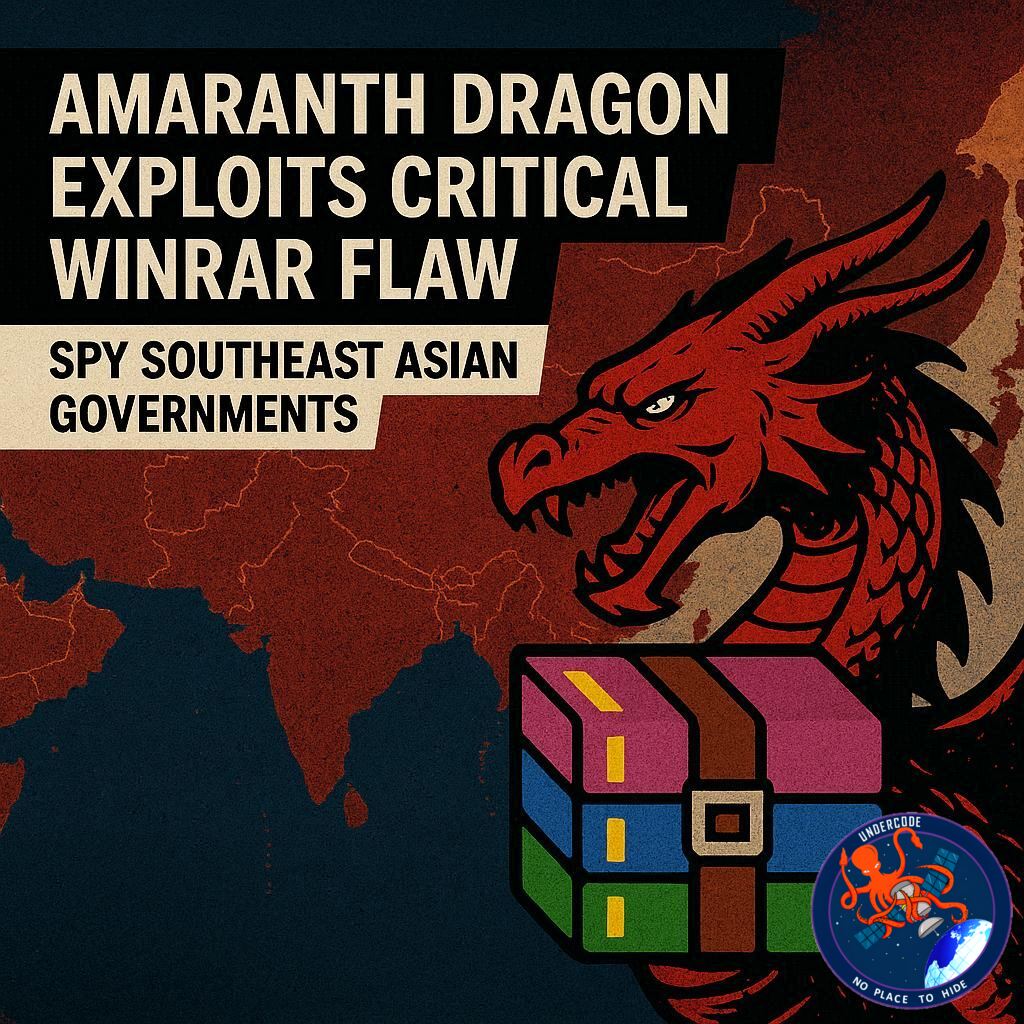
Cyber espionage campaigns rarely rely on flashy zero-days alone. More often, they succeed by weaponizing overlooked software flaws and wrapping them in carefully localized social engineering. Throughout 2025, a threat actor known as Amaranth-Dragon demonstrated this reality by exploiting a critical WinRAR vulnerability to quietly compromise government and law enforcement systems across Southeast Asia. By blending phishing, path traversal abuse, and sophisticated loader frameworks, the group showed how quickly a disclosed vulnerability can be operationalized into real-world espionage.
Summary of the Original
Amaranth-Dragon, a cyber threat group linked by researchers to China’s APT-41, conducted targeted espionage operations against Southeast Asian governments and law enforcement agencies during 2025. The campaigns relied on CVE-2025-8088, a critical path traversal flaw in WinRAR that affects versions prior to 7.13. This vulnerability allows attackers to craft malicious RAR archives that extract files outside the intended directory, enabling the placement of scripts directly into the Windows Startup folder for persistent execution after reboot.
The attack chain typically begins with phishing emails containing RAR attachments hosted on Dropbox or attacker-controlled servers. These emails are themed around local and timely topics such as salary adjustments, official announcements, or national anniversaries, increasing their credibility. Once a victim extracts the archive using a vulnerable WinRAR version, the malicious payload bypasses directory restrictions and installs a batch or command script into the Startup folder.
Upon system login, the script executes automatically, downloading an additional password-protected RAR archive from Dropbox. This second-stage archive is unpacked using tools like WinRAR or 7-Zip and leverages DLL sideloading techniques. A legitimate executable, often vcredist.exe, is abused to load a malicious DLL known as Amaranth Loader.
The loader retrieves an AES encryption key from public services such as Pastebin, including accounts like amaranthbernadine, or from attacker-operated websites. It then decrypts shellcode associated with the Havoc command-and-control framework using AES-CBC encryption with a fixed initialization vector, executing the payload entirely in memory to evade detection.
In a notable Indonesian campaign observed on September 5, 2025, the attackers deployed TGAmaranth RAT, a remote access tool controlled via Telegram bots. This malware included anti-EDR techniques, such as unhooking ntdll.dll by injecting code into a suspended cmd.exe process. Command-and-control infrastructure was protected behind Cloudflare, returning HTTP 403 errors to non-targeted IP addresses and effectively geofencing access to specific countries, including Indonesia, the Philippines, Thailand, Cambodia, Laos, and Singapore.
Check Point Research advised organizations to immediately update WinRAR to version 7.20 or later, noting that patches for CVE-2025-8088 were released following disclosure on August 8, 2025. Defensive recommendations also included scanning archives, blocking Dropbox-related indicators of compromise, monitoring the Windows Startup folder, hunting for known Amaranth Loader hashes, and deploying YARA rules to detect characteristic headers and encryption patterns. The campaign’s rapid exploitation, occurring just ten days after vulnerability disclosure, highlighted the group’s operational maturity and discipline.
What Undercode Say:
The Amaranth-Dragon campaign is a textbook example of how modern espionage groups capitalize on the gap between vulnerability disclosure and patch adoption. WinRAR is ubiquitous in government and enterprise environments, especially in regions where legacy workflows persist, making it an ideal target for attackers seeking scale without noise. Exploiting a path traversal flaw may seem technically simple, but its impact is amplified when paired with persistence mechanisms like the Windows Startup folder.
What stands out is the attackers’ emphasis on living-off-the-land techniques. By using legitimate tools such as vcredist.exe, WinRAR itself, and 7-Zip, Amaranth-Dragon minimizes behavioral anomalies that endpoint defenses typically flag. DLL sideloading remains a favored tactic because it exploits trust relationships within Windows environments rather than relying on overtly malicious binaries.
The use of public platforms like Dropbox and Pastebin reflects a broader trend in APT operations. These services provide resilient, globally accessible infrastructure that blends seamlessly with normal network traffic. Blocking them outright is often impractical, forcing defenders to rely on behavioral detection rather than simple indicators. The attackers’ ability to rotate keys and payload locations through these platforms further complicates long-term detection.
Another critical insight is the group’s disciplined geofencing strategy. By restricting command-and-control access to specific countries via Cloudflare, the operators reduce exposure to security researchers and automated scanners. This selective visibility suggests a mature operational model focused on espionage rather than mass compromise. The alignment with UTC+8 working patterns and tooling similarities reinforces attribution links to APT-41, even without explicit code reuse.
The Indonesian TGAmaranth RAT deployment illustrates how modular these campaigns have become. When traditional C2 frameworks risk detection, attackers pivot to unconventional channels like Telegram bots, leveraging encrypted, trusted messaging infrastructure. Anti-EDR techniques such as unhooking ntdll.dll show a deep understanding of modern defensive stacks and a willingness to invest in stealth over speed.
From a defensive perspective, this campaign underscores that patching alone is no longer sufficient if it is not timely. Ten days between disclosure and exploitation is a narrow window, yet many organizations still struggle to apply updates within that timeframe. Monitoring for abnormal archive extraction behavior, enforcing application allowlisting, and tightening controls around startup persistence points are now baseline requirements.
Ultimately, Amaranth-Dragon’s operations highlight the evolving reality of cyber espionage in 2025: success comes not from groundbreaking exploits, but from the precise orchestration of known techniques, regional awareness, and operational patience. Organizations that fail to adapt to this model will continue to be outpaced by adversaries who understand both technology and human behavior.
Fact Checker Results
✅ CVE-2025-8088 is accurately described as a WinRAR path traversal vulnerability enabling arbitrary file placement.
✅ The attack chain details align with publicly reported techniques, including DLL sideloading and Havoc C2 usage.
❌ Direct attribution to APT-41 remains circumstantial, based on tooling and behavioral overlaps rather than confirmed ownership.
Prediction
🔮 Exploitation of archive-handling vulnerabilities will accelerate as attackers observe consistent delays in enterprise patch cycles.
🔮 APT-linked groups will increasingly rely on public cloud and messaging platforms for C2 to blend into normal traffic.
🔮 Governments in Southeast Asia will face sustained pressure to modernize endpoint defenses beyond signature-based detection.
🕵️📝✔️Let’s dive deep and fact‑check.
References:
Reported By: cyberpress.org
Extra Source Hub (Possible Sources for article):
https://www.quora.com
Wikipedia
OpenAi & Undercode AI
Image Source:
Unsplash
Undercode AI DI v2
Bing
🔐JOIN OUR CYBER WORLD [ CVE News • HackMonitor • UndercodeNews ]
📢 Follow UndercodeNews & Stay Tuned:
𝕏 formerly Twitter 🐦 | @ Threads | 🔗 Linkedin | 🦋BlueSky | 🐘Mastodon


