
Listen to this Post
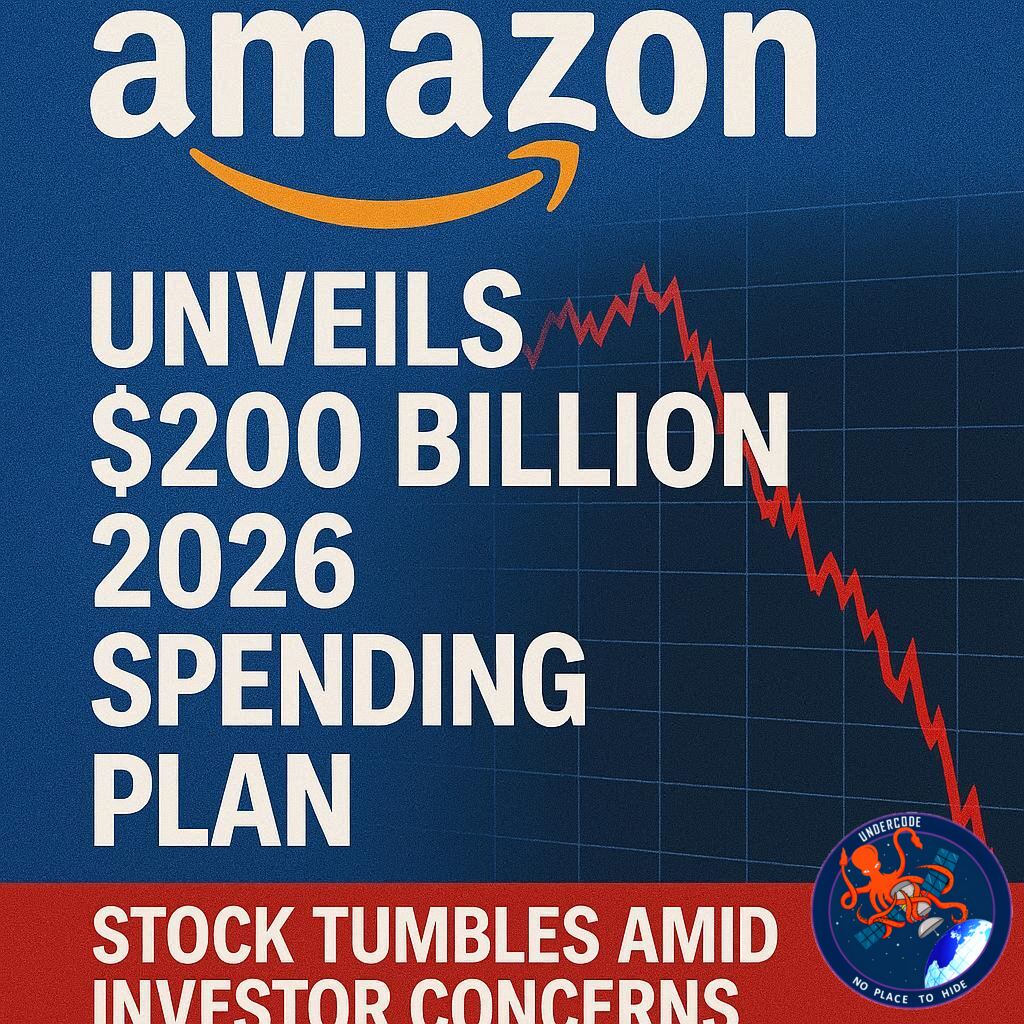
Amazon shocked markets on February 5 as its stock plunged 11% in extended trading, wiping out more than $250 billion in market value. The dramatic drop followed the company’s announcement of an ambitious $200 billion capital expenditure plan for 2026, far exceeding Wall Street expectations by over $50 billion. Investors reacted with concern to the scale and speed of spending, especially after the company already reported a massive increase in investment—from $38 billion in 2024 to $131 billion in property and equipment in 2025.
Surge in Capital Expenditure Raises Investor Eyebrows
The $200 billion plan signals Amazon’s aggressive push into infrastructure, technology, and AI-driven capabilities. Analysts note that such a massive investment could strain the company’s cash flow in the short term, while positioning it for long-term dominance in cloud computing and AI markets. The move marks Amazon’s largest single-year investment strategy in its history, emphasizing the company’s belief in high-growth opportunities, particularly in Amazon Web Services (AWS) and artificial intelligence applications.
CEO Andy Jassy Defends Aggressive Spending
On a conference call with analysts, Amazon CEO Andy Jassy defended the aggressive capital deployment. He emphasized that the investments are strategic, not reckless, aimed at meeting the rapidly growing demand for AI computing power. “We have confidence that these investments will yield strong returns on invested capital. We’ve done that with our core AWS business,” Jassy stated.
Jassy highlighted that AWS sales grew 24% in the most recent quarter, reaching $35.6 billion, the fastest growth in over three years. However, he cautioned that growth could have been even higher if Amazon had more computing capacity. The capital plan will fund data centers, chips, and networking equipment to accelerate AWS’s scaling capabilities.
AWS Capacity Expansion and AI Strategy
In 2025, AWS added nearly 4 gigawatts of computing power and plans to double that by 2027. Jassy described the expansion as “scrappy,” pointing to a persistent gap between supply and surging demand. On AI adoption, he used a “barbell” analogy: AI-native labs on one end, enterprises on the other, with a middle segment experimenting with AI applications. He suggested that this middle segment could become the largest and most enduring, providing a durable revenue opportunity for AWS as businesses increasingly adopt AI to enhance productivity and reduce costs.
Market Implications of Amazon’s Spending Blitz
Investors are grappling with the scale of the proposed spending. While some see it as a bold long-term growth play, others worry it could pressure margins and elevate risk. The market’s reaction indicates skepticism over whether Amazon can translate these investments into near-term profitability. Historical data shows that AWS’s infrastructure investments have driven substantial long-term revenue growth, but the sheer size of the 2026 plan is unprecedented and raises questions about timing and execution.
What Undercode Say: Strategic Analysis of Amazon’s Mega-Spending
Amazon’s $200 billion capital plan for 2026 is both audacious and strategically calculated. By investing heavily in cloud infrastructure and AI, the company is signaling its intent to dominate next-generation computing. The massive increase in property and equipment spending from $38 billion in 2024 to $131 billion in 2025 underscores the speed at which Amazon is scaling capacity to meet AI-driven demand.
From a market perspective, the 11% stock drop reflects investor discomfort with scale rather than doubt about strategy. Historically, mega-cap tech firms that undertake aggressive CAPEX often face short-term market volatility but secure long-term market dominance. AWS’s 24% growth in the last quarter proves that even under current capacity constraints, demand for cloud services remains robust. Doubling AWS’s computing power by 2027 could enable Amazon to capture a significant share of the AI infrastructure market, which is expected to balloon over the next decade.
Jassy’s “barbell” analogy highlights an important insight: the middle segment of companies experimenting with AI represents a massive, untapped market. Unlike AI-native labs, which focus on research, or enterprises fully adopting AI, these hybrid adopters will require scalable infrastructure to operationalize AI—precisely Amazon’s core strength. The strategy also hedges against market risk: by catering to a broad base of AI adopters, Amazon reduces reliance on a few high-profile clients while maximizing growth opportunities across industries.
Operationally, Amazon’s push into chips, networking, and data centers reflects an ecosystem approach, where control over hardware and software layers can create efficiency, cost advantages, and competitive moats. If successful, this strategy could cement AWS as the backbone of AI infrastructure globally. Yet execution risk remains high: delays in scaling, rising interest rates, or technological bottlenecks could temper returns. Investors may need to reconcile the tension between short-term earnings volatility and long-term growth potential.
Overall, Amazon’s 2026 capital plan is a calculated gamble. It risks near-term market backlash but positions the company to lead the AI-driven cloud revolution. The company’s capacity expansion, AI infrastructure investments, and strategic positioning in the hybrid enterprise segment collectively indicate a long-term vision that, if executed effectively, could redefine the competitive landscape in cloud computing and AI services.
Fact Checker Results
✅ Amazon stock dropped 11% in extended trading on February 5, 2026.
✅ The company’s 2026 capital expenditure plan is $200 billion, exceeding Wall Street expectations.
✅ AWS sales grew 24% to $35.6 billion in the most recent quarter.
Prediction
📊 Short-term volatility is likely to persist as investors digest Amazon’s massive spending plan.
📊 AWS expansion and AI infrastructure investments position Amazon to dominate the AI and cloud markets by 2027.
📊 Companies experimenting with AI adoption will become a durable growth driver for Amazon, potentially driving new revenue streams and strategic partnerships.
▶️ Related Video (84% Match):
🕵️📝✔️Let’s dive deep and fact‑check.
References:
Reported By: timesofindia.indiatimes.com
Extra Source Hub (Possible Sources for article):
https://www.quora.com/topic/Technology
Wikipedia
OpenAi & Undercode AI
Image Source:
Unsplash
Undercode AI DI v2
Bing
🔐JOIN OUR CYBER WORLD [ CVE News • HackMonitor • UndercodeNews ]
📢 Follow UndercodeNews & Stay Tuned:
𝕏 formerly Twitter 🐦 | @ Threads | 🔗 Linkedin | 🦋BlueSky | 🐘Mastodon


