
Listen to this Post
Introduction: A New Financial-Sector Target Emerges
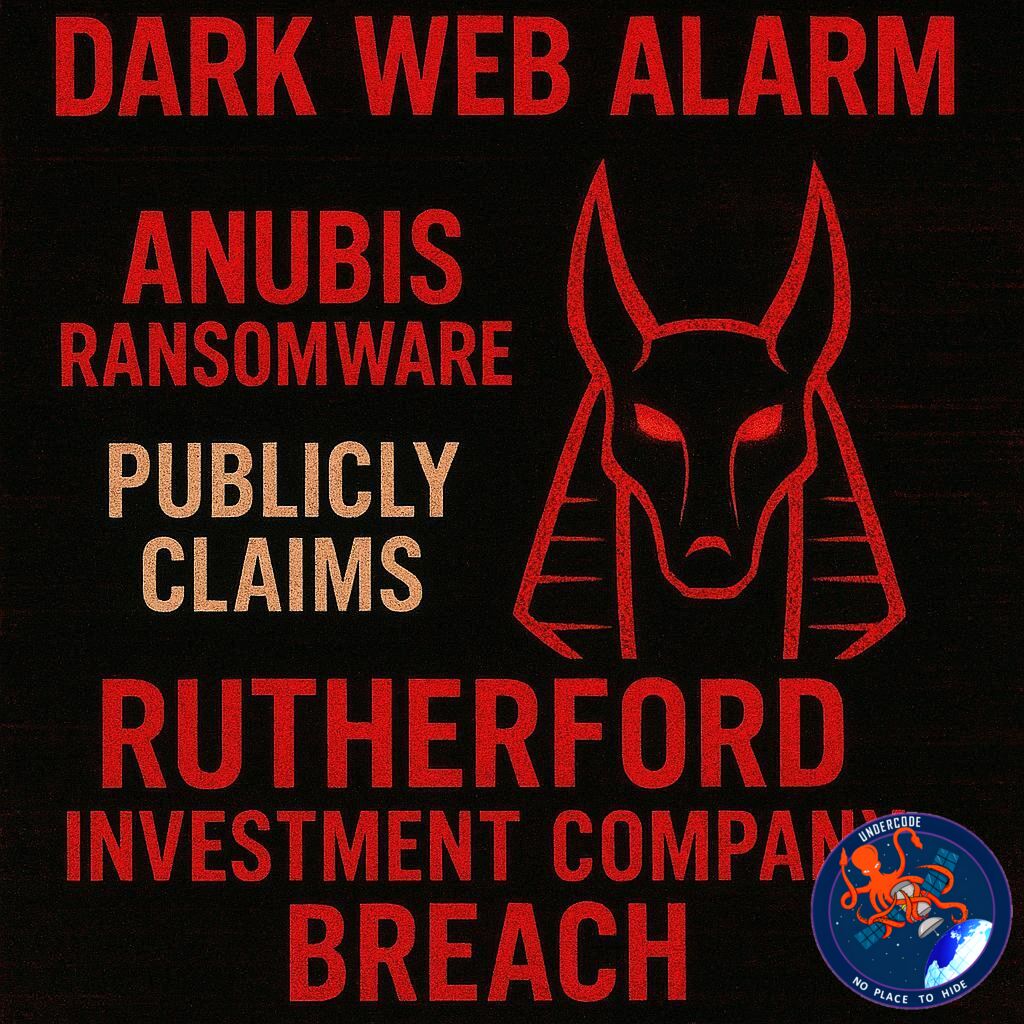
A fresh alert from dark web monitoring channels has placed Rutherford Investment Company in the spotlight after a notorious ransomware group publicly listed the firm as its latest victim. The claim, attributed to the Anubis ransomware operation, surfaced through threat intelligence monitoring and quickly began circulating across cybercrime tracking communities. While technical details remain limited, the incident highlights a growing pattern: financially focused organizations are increasingly attractive targets for extortion-driven cyber gangs operating in the shadows of the dark web.
the Original Report
Threat intelligence analysts detected new ransomware-related activity tied to the Anubis group, a name that has been steadily appearing in underground forums and leak sites. According to the alert, Rutherford Investment Company was added to Anubis’s list of victims on February 9, 2026, with the original post appearing late on February 8.
The disclosure was identified through dark web monitoring efforts conducted by the ThreatMon Threat Intelligence Team, which tracks ransomware victim announcements, indicators of compromise, and command-and-control infrastructure.
As with many ransomware disclosures, the post itself offered minimal context beyond the victim’s name and timestamp. No proof-of-data samples, ransom amount, or negotiation status were publicly attached at the time of detection.
The announcement gained modest visibility online, drawing attention from cybersecurity observers rather than mainstream audiences.
Such listings are commonly used by ransomware groups as psychological pressure tactics, signaling to victims that stolen data may be leaked if demands are not met.
The Anubis group’s decision to publicly name Rutherford Investment Company suggests that some level of unauthorized access or data exfiltration is being claimed, although independent verification has not yet been published.
This incident joins a broader wave of ransomware activity targeting investment firms, insurers, and financial service providers, sectors known for both sensitive data and high regulatory pressure.
Threat intelligence platforms like ThreatMon play a critical role in surfacing these claims early, allowing defenders, partners, and regulators to assess potential exposure.
At the time of reporting, Rutherford Investment Company had not issued a public statement confirming or denying the breach.
What Undercode Say:
The Anubis ransomware claim fits a familiar and troubling pattern in the modern ransomware economy. Financial and investment companies represent high-value targets not only because of their revenue, but because of the sensitivity of client data, internal communications, and compliance obligations. Even the threat of disclosure can be enough to force rapid negotiations behind closed doors.
What stands out in this case is the lack of immediate supporting evidence. Some ransomware groups post partial file trees or data samples to boost credibility, while others delay proof as a pressure tactic. Anubis has historically alternated between these strategies, which makes early-stage claims difficult to assess without corroboration.
The timing of the disclosure is also notable. Posting late in the day, close to a new business week, can maximize disruption for victims by forcing incident response teams into urgent weekend or overnight work. This tactic is frequently observed among financially motivated ransomware actors.
From a defensive perspective, the public naming alone can trigger downstream consequences. Partners may reassess risk, clients may demand clarification, and regulators may initiate inquiries even before technical facts are fully established. This secondary impact is precisely what ransomware groups exploit.
The use of dark web leak sites as a primary communication channel continues to reinforce the role of threat intelligence monitoring as an early-warning system. Organizations that rely solely on internal detection may already be days behind by the time a name appears publicly.
If the claim is accurate, the critical question becomes whether data exfiltration occurred. Modern ransomware operations increasingly focus on double or triple extortion, combining encryption, data theft, and reputational pressure. For investment firms, even limited data exposure can carry long-term trust implications.
It is also worth noting that ransomware groups sometimes exaggerate or misattribute victims to inflate their perceived success. False or recycled claims are not unheard of, particularly when groups compete for notoriety on underground forums.
Ultimately, this incident underscores the importance of proactive cyber hygiene in the financial sector: segmented networks, tested backups, rapid incident disclosure plans, and continuous dark web monitoring. Whether or not Anubis’s claim is fully substantiated, the public allegation alone is enough to justify serious concern and immediate defensive review.
Fact Checker Results
The claim originates from dark web ransomware monitoring and not from an official disclosure.
No independent forensic confirmation or data samples have been released publicly so far.
The victim listing should be treated as an unverified but credible ransomware claim pending further evidence.
Prediction
If Anubis follows its usual pattern, additional pressure may emerge in the form of leaked file samples or countdown timers within days. Financial-sector ransomware targeting is likely to intensify throughout 2026, with more investment firms appearing on dark web leak sites as attackers continue to chase high-impact, high-leverage victims.
🕵️📝✔️Let’s dive deep and fact‑check.
References:
Reported By: x.com
Extra Source Hub (Possible Sources for article):
https://www.quora.com
Wikipedia
OpenAi & Undercode AI
Image Source:
Unsplash
Undercode AI DI v2
Bing
🔐JOIN OUR CYBER WORLD [ CVE News • HackMonitor • UndercodeNews ]
📢 Follow UndercodeNews & Stay Tuned:
𝕏 formerly Twitter 🐦 | @ Threads | 🔗 Linkedin | 🦋BlueSky | 🐘Mastodon


