
Listen to this Post
Introduction
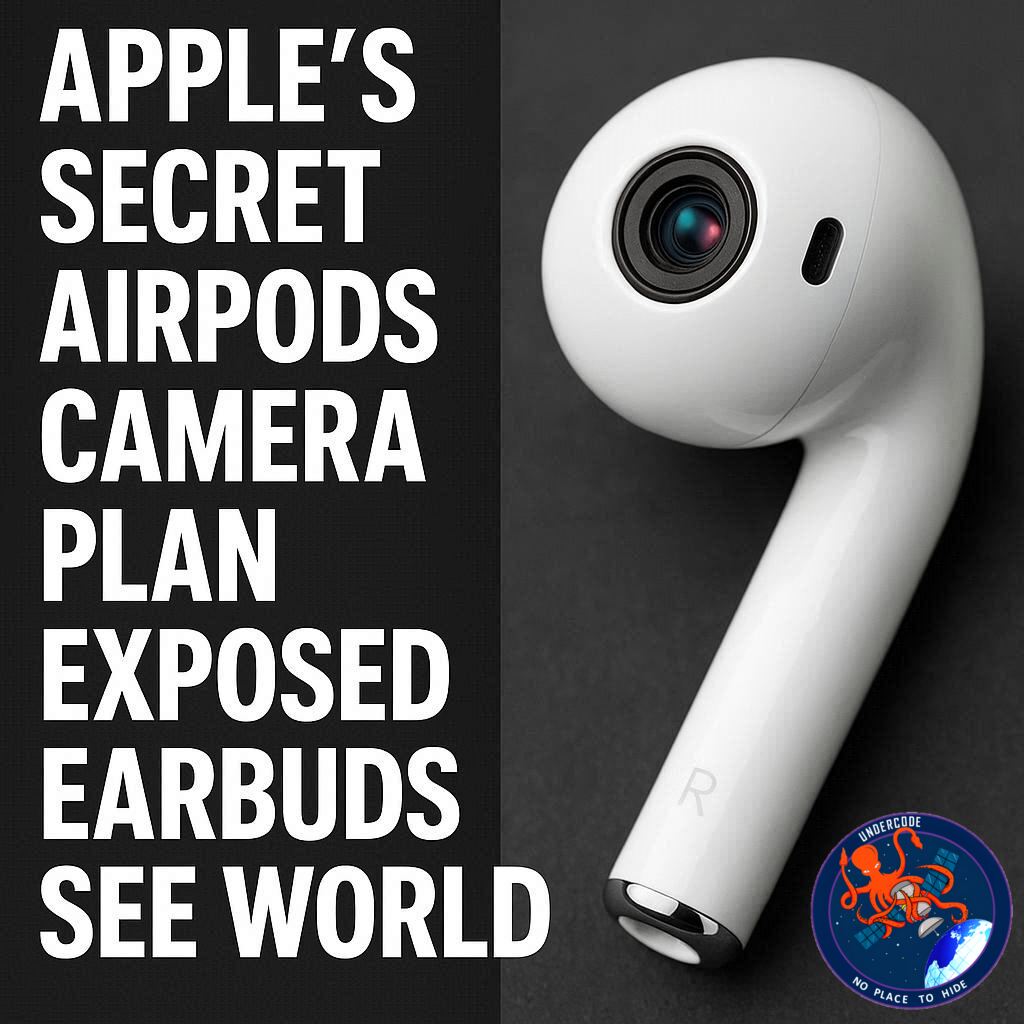
For years, Apple’s AirPods have evolved quietly but steadily, adding better sound, smarter noise cancellation, and deeper integration with the Apple ecosystem. Now, a rumor that refuses to die is gaining fresh momentum: AirPods with built-in cameras. What sounds like science fiction is increasingly being treated as an inevitable next step, backed by respected Apple watchers and supply-chain analysts. The real mystery is not if these camera-equipped AirPods will arrive, but why Apple wants them in the first place—and what that means for how we interact with technology on a daily basis.
the Original
Reports about AirPods featuring cameras first surfaced nearly two years ago, with prominent voices like Bloomberg’s Mark Gurman and analyst Ming-Chi Kuo suggesting the feature is on Apple’s roadmap, possibly as soon as this year. Despite the credibility of these sources, Apple’s intentions remain unclear, fueling intense speculation across the tech world.
One popular theory is that the cameras would be internal, similar in spirit to Apple Watch sensors. In this scenario, infrared cameras could collect health data such as heart-rate information, either processed directly by the AirPods or relayed to an iPhone for analysis. This would push AirPods deeper into the health-tracking space without requiring users to wear a watch.
Another widely discussed idea is that external cameras would allow AirPods to “see” the environment, enabling Apple Intelligence visual features. Gurman has suggested this approach, describing a product that understands the world around the user and delivers contextual information—essentially smart glasses, but without the glasses themselves.
A less convincing theory involves improving spatial audio when paired with Vision Pro. Since Apple’s headset already includes advanced cameras and sensors, many observers see little need to duplicate those capabilities in AirPods for this purpose alone.
The article then introduces a third, more intriguing possibility: hand-gesture recognition. Apple’s Vision Pro has shown that gesture control can be precise and intuitive when done right, outperforming similar systems in competing VR headsets. Applying this technology to AirPods could replace today’s awkward mix of taps and head gestures, which often struggle to distinguish between commands like play, pause, volume changes, and call controls.
With cameras operating in visible or infrared light, AirPods could recognize simple hand movements, making control faster, more natural, and far less error-prone. The article concludes by inviting readers to weigh in, questioning whether these rumored cameras are meant for health tracking, visual intelligence, gesture control, multiple functions—or whether the entire idea is simply overblown speculation.
What Undercode Say:
Apple rarely adds hardware features without a long-term strategic payoff, and the AirPods camera rumor fits that pattern perfectly. If these reports are accurate, the cameras are unlikely to serve just one narrow purpose. Apple’s recent product direction suggests convergence: health, AI, and spatial computing are slowly merging into a single ecosystem.
Gesture control stands out as the most immediately transformative use case. Current AirPods controls are functional but far from elegant. A system that relies on taps, presses, and head movements forces too many commands through too few inputs, increasing the chance of mistakes. Vision Pro proves Apple already has the software expertise to make gesture recognition feel natural rather than gimmicky. Scaling that experience down to AirPods would be a logical next step.
At the same time, environmental awareness powered by Apple Intelligence cannot be ignored. Apple is clearly positioning AI as an assistive layer that augments reality rather than replacing it. Cameras in AirPods could provide subtle, audio-based contextual feedback—directions, object recognition, or situational alerts—without the social friction of wearing smart glasses.
Health tracking, while attractive, feels like the weakest standalone justification. Apple Watch already dominates that space, and duplicating core metrics risks confusing consumers unless the data offers something meaningfully different. However, combined with gesture recognition and environmental sensing, health features could become part of a broader “always-on” wellness and awareness platform.
What makes this rumor especially credible is Apple’s timing. Vision Pro introduced users to eye and hand control, but it remains a niche product. AirPods, by contrast, are mainstream. Bringing gesture-based interaction to a mass-market device would normalize spatial interfaces long before true AR glasses are ready.
In that sense, camera-equipped AirPods may be less about earbuds and more about training users for Apple’s next computing paradigm—one where screens matter less, context matters more, and interaction happens almost subconsciously.
Fact Checker Results
Multiple credible analysts, including Mark Gurman and Ming-Chi Kuo, have referenced AirPods with cameras, lending weight to the rumor.
No official Apple documentation or announcements confirm the feature or its purpose.
All proposed use cases remain speculative until Apple provides concrete details.
Prediction
Apple will introduce AirPods with cameras as a multi-purpose platform, prioritizing hand-gesture control and contextual AI features first. Health tracking may arrive later as a secondary benefit, while the product quietly prepares users for a future dominated by spatial and screen-less computing.
🕵️📝✔️Let’s dive deep and fact‑check.
References:
Reported By: 9to5mac.com
Extra Source Hub (Possible Sources for article):
https://www.reddit.com
Wikipedia
OpenAi & Undercode AI
Image Source:
Unsplash
Undercode AI DI v2
Bing
🔐JOIN OUR CYBER WORLD [ CVE News • HackMonitor • UndercodeNews ]
📢 Follow UndercodeNews & Stay Tuned:
𝕏 formerly Twitter 🐦 | @ Threads | 🔗 Linkedin | 🦋BlueSky | 🐘Mastodon


