
Listen to this Post
Introduction: Apple’s Long Game Beyond Cell Towers
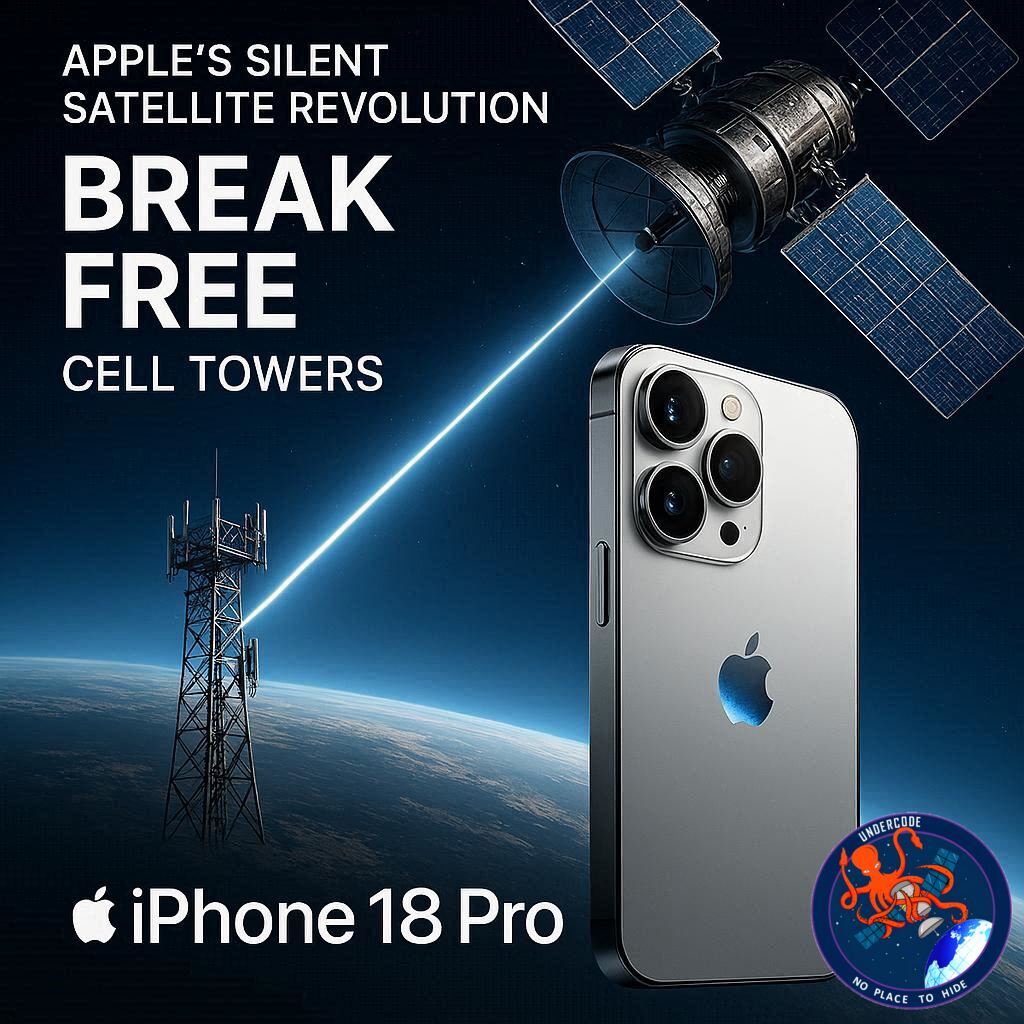
Apple’s approach to connectivity has never been loud, but it has always been deliberate. What started in 2022 as a life-saving backup feature—Emergency SOS via Satellite on the iPhone 14—now looks like the opening move in a much bigger strategy. Step by step, Apple appears to be working toward a future where iPhones can connect directly to satellites for everyday communication, potentially reducing dependence on traditional cellular networks. Recent reports suggest that the iPhone 18 Pro could mark a major milestone on this path, introducing early forms of 5G satellite connectivity that hint at a radical shift in how smartphones stay connected.
the Original
Apple has gradually expanded satellite features on the iPhone over the past four generations, beginning with Emergency SOS via Satellite. Initially limited to contacting emergency services when no cellular signal is available, the feature has since grown to include roadside assistance and basic messaging with family and friends. Despite these improvements, satellite communication on iPhone remains slow, restricted, and clearly positioned as a last-resort safety net rather than a full internet replacement.
Multiple reports over the years have suggested that Apple’s long-term ambition goes far beyond emergency use. The ultimate goal appears to be full mobile connectivity via satellite, potentially enabling 5G data access without relying on ground-based cell towers. According to recent leaks, this vision may begin to materialize with the iPhone 18 Pro.
A well-known Weibo leaker, Fixed Focus Digital, claims that Apple’s upcoming C2 baseband radio chip—expected to debut in the iPhone 18 Pro—will support NR-NTN technology. NR-NTN, or New Radio Non-Terrestrial Networks, is a 5G standard designed to integrate satellite communication directly into mobile networks. This would allow smartphones to connect to low-Earth-orbit satellites for data transmission, rather than using satellites solely for emergency messaging.
While this does not mean instant, high-speed satellite internet everywhere, it would represent a meaningful technical leap. Apple could expand satellite-based services beyond emergencies, offering broader coverage in remote areas. However, significant challenges remain, including satellite infrastructure limitations and Apple’s complex relationships with mobile carriers. Even so, if these reports are accurate, the iPhone 18 Pro could be the clearest sign yet that Apple is serious about a satellite-first future for mobile connectivity.
What Undercode Say:
Apple’s satellite strategy feels less like a feature rollout and more like a long-term escape plan. Emergency SOS was never about convenience—it was a proof of concept. Apple used it to test hardware reliability, regulatory boundaries, user behavior, and carrier tolerance, all under the banner of safety. That framing bought Apple time and goodwill while quietly laying the groundwork for something far more disruptive.
If the iPhone 18 Pro действительно introduces NR-NTN support via the C2 baseband, the implications go well beyond better coverage in remote areas. It signals Apple’s intent to become less dependent on carriers, at least technologically. Even partial satellite-based 5G shifts power away from traditional telecoms and toward device makers and satellite operators. That is a structural change, not just a spec upgrade.
However, expectations need to be realistic. Early 5G satellite connectivity will almost certainly be limited in speed, bandwidth, and availability. Latency, spectrum allocation, and satellite density remain major bottlenecks. Apple is unlikely to market this as “satellite internet” in the traditional sense. Instead, it will probably be framed as expanded coverage, smarter handoff between networks, and seamless connectivity where cellular fails.
The political and business implications are just as important as the technical ones. Carriers will not welcome a future where flagship iPhones can bypass their infrastructure. Apple must balance innovation with partnership economics, especially in markets where carrier subsidies and contracts still matter. This may explain why Apple is moving slowly, embedding satellite capabilities incrementally rather than flipping a switch overnight.
From a consumer perspective, the real value is resilience. A phone that can stay connected almost anywhere changes how people think about reliability, safety, and even travel. For enterprise, logistics, and emergency services, satellite-backed iPhones could become mission-critical tools. Apple is not chasing novelty here; it is chasing inevitability.
In that sense, the iPhone 18 Pro—if these leaks hold true—won’t be revolutionary on day one. It will be foundational. Apple’s biggest shifts rarely feel dramatic at launch. They feel obvious in hindsight.
Fact Checker Results
The existence of Emergency SOS via Satellite on recent iPhones is confirmed and well-documented.
NR-NTN is a real 5G standard designed for non-terrestrial networks, including satellites.
Claims about the iPhone 18 Pro and Apple’s C2 baseband remain unconfirmed leaks, not official announcements.
Prediction
Apple will introduce limited 5G satellite connectivity on the iPhone 18 Pro, focused on coverage expansion rather than speed. Within the next two to three iPhone generations, satellite communication will evolve from an emergency feature into a standard fallback network, subtly redefining what “mobile coverage” means worldwide.
🕵️📝✔️Let’s dive deep and fact‑check.
References:
Reported By: 9to5mac.com
Extra Source Hub (Possible Sources for article):
https://www.quora.com/topic/Technology
Wikipedia
OpenAi & Undercode AI
Image Source:
Unsplash
Undercode AI DI v2
Bing
🔐JOIN OUR CYBER WORLD [ CVE News • HackMonitor • UndercodeNews ]
📢 Follow UndercodeNews & Stay Tuned:
𝕏 formerly Twitter 🐦 | @ Threads | 🔗 Linkedin | 🦋BlueSky | 🐘Mastodon


