
Listen to this Post
Introduction: A Pivotal Moment for the Musk Empire
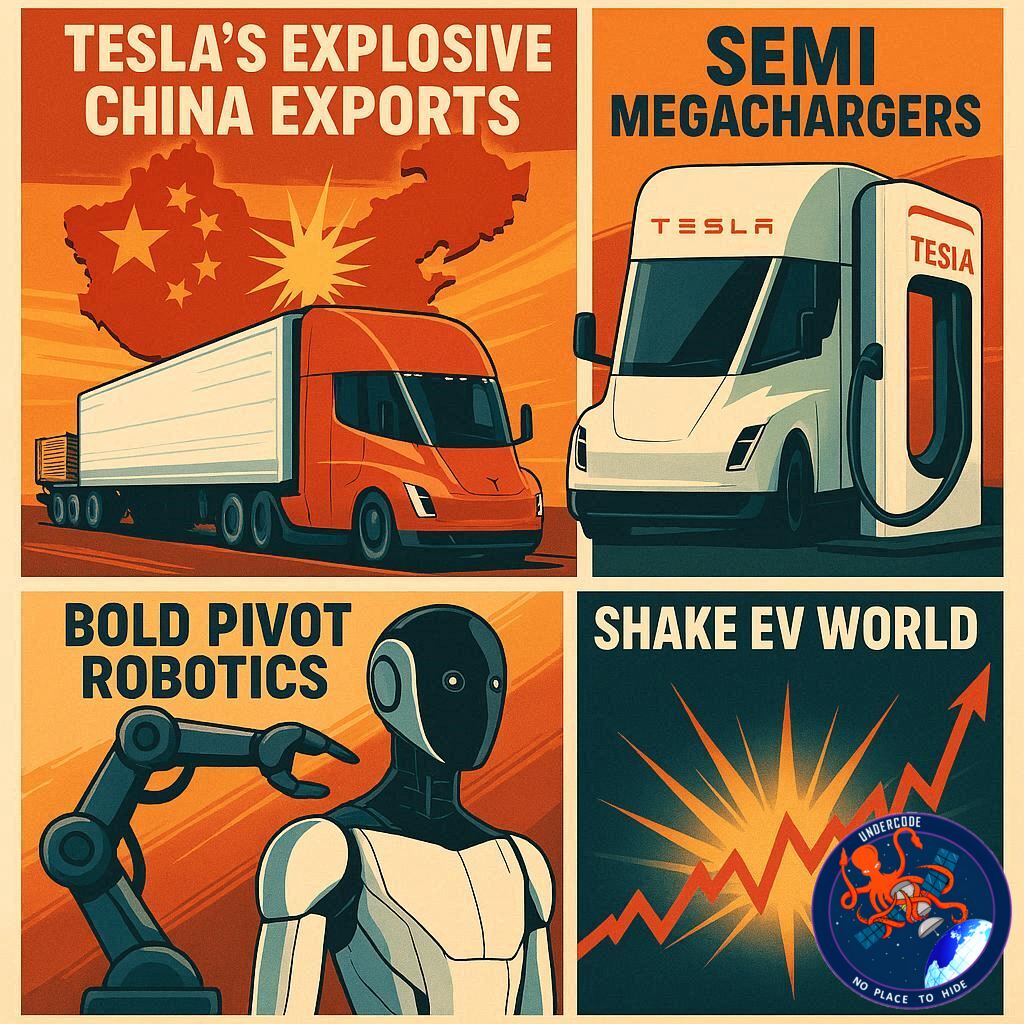
Tesla and its sister company SpaceX are entering a defining phase that stretches far beyond electric cars. Fresh data from China shows Tesla’s export engine roaring back to life, while new infrastructure hints that the long-promised Tesla Semi is finally approaching mass production. At the same time, Wall Street voices are reframing Tesla not as an automaker, but as a robotics and AI powerhouse, and SpaceX has scored a meaningful legal win in the United States. Taken together, these developments paint a picture of a company ecosystem in rapid transition, with implications for global EV markets, logistics, automation, and labor regulation.
China Export Surge Signals Renewed Global Momentum
Tesla China exported 50,644 vehicles in January, according to figures released by the China Passenger Car Association (CPCA). This represents a sharp increase both year-on-year and month-on-month for vehicles produced at Gigafactory Shanghai, primarily the Model 3 and Model Y. The result placed Tesla China second among all new energy vehicle exporters for the month, trailing only BYD.
New Energy Vehicles Dominate China’s Export Story
The CPCA report revealed that total new energy vehicle exports from China reached 286,000 units in January, marking a massive 103.6% increase compared to the same period last year. Battery electric vehicles accounted for roughly 65% of those exports, reinforcing China’s growing dominance as a global EV manufacturing hub.
Tesla’s Numbers in Context
Within that national total, Tesla China’s 50,644 exported vehicles stand out when compared to its own recent performance. In January of last year, Tesla exported 29,535 units, and in December, exports dropped to just 3,328 vehicles. This means January’s figure was about 1.7 times higher year-on-year and more than fifteen times higher than the previous month, highlighting how volatile yet powerful Tesla’s export cycles can be.
BYD’s Scale Still Sets the Benchmark
Despite Tesla’s strong showing, BYD retained the top exporter position with 96,859 new energy passenger vehicles shipped overseas in January. BYD’s advantage lies in scale: the company operates at least nine major production facilities across China, with a combined domestic production capacity of up to 5.82 million vehicles annually as of 2024. Tesla, by contrast, relies heavily on a more concentrated manufacturing footprint.
China Remains Tesla’s Strategic Backbone
Even though Tesla China competes domestically with only two core models, both positioned in the premium segment, it continues to perform competitively in one of the world’s most crowded EV markets. Strong exports suggest that Gigafactory Shanghai is not just serving local demand, but acting as a critical launchpad for Tesla’s international sales strategy.
Tesla Prepares the Ground for the Semi
Beyond passenger vehicles, Tesla has quietly taken a meaningful step toward commercial transport electrification. The company recently added Megacharger locations to its Navigation and Supercharger Map, signaling preparation for the Tesla Semi’s broader rollout. This update followed CEO Elon Musk’s confirmation that mass production processes for the Semi are scheduled for later this year.
Megachargers Reveal Tesla’s Logistics Strategy
Megachargers are designed specifically for the high-capacity needs of the all-electric Class 8 Semi. Initial deployments focus on the US West Coast, with heavy emphasis on major freight corridors such as I-5 and I-10. This approach targets routes where freight density is highest, ensuring immediate utility for regional and long-haul operations.
Early Infrastructure Rollout Across Key States
California and Texas are expected to host the largest number of early Megacharger sites, with 17 and 19 locations respectively. Additional sites are planned for Florida, Georgia, Illinois, Washington, New York, and Nevada. Currently, operational Megachargers are confirmed in Lathrop, California, and Sparks, Nevada—both locations closely tied to Tesla’s manufacturing ecosystem.
From Pilot Program to Production Reality
For years, the Tesla Semi has existed in a prolonged pilot phase. The completion of Tesla’s dedicated Semi manufacturing facility in Sparks, Nevada, combined with expanding Megacharger visibility, suggests the company is finally aligning production, infrastructure, and customer delivery timelines.
Wall Street Reframes Tesla’s Identity
Adding to the narrative shift, CNBC’s Jim Cramer recently described Tesla as “actually a robotics and Cybercab company,” openly stating his enthusiasm for the stock based on its non-automotive future. His remarks followed Tesla’s Q4 earnings report, which many viewed as underwhelming from a traditional car sales perspective.
The Earnings Call That Changed the Story
During the earnings call, Elon Musk emphasized that Tesla’s future lies in autonomy, AI, Cybercabs, and humanoid robots like Optimus. He even noted that the Model S and Model X would be discontinued after Q2, as they no longer align with Tesla’s long-term vision.
Investors Look Beyond Cars
Cramer echoed a growing sentiment among bullish investors: electric vehicles are becoming the past, while robotics and AI represent Tesla’s true growth engine. Tesla shares were trading at $423.69 at the time of publication, reflecting a market that is still digesting this strategic pivot rather than valuing Tesla purely as an automaker.
SpaceX Scores a Quiet but Important Legal Win
While Tesla reshapes its industrial identity, SpaceX secured a legal victory when the National Labor Relations Board dismissed a case alleging wrongful termination of engineers who criticized Elon Musk. The NLRB confirmed it lacked jurisdiction, stating that SpaceX falls under the National Mediation Board instead.
Jurisdictional Lines Redrawn
The National Mediation Board typically oversees airlines and railroads. In its opinion, the NMB argued that space transport qualifies as air travel due to the methods used to reach orbit. This decision removed the case from NLRB oversight and effectively closed the matter at the labor board level.
A Broader Implication for Corporate Regulation
SpaceX’s challenge is part of a wider trend, with other major companies, including Amazon, questioning the constitutionality and reach of the NLRB. The dismissal underscores how regulatory frameworks are struggling to keep pace with companies operating at the edges of traditional industry definitions.
What Undercode Say:
Tesla’s Multi-Front Strategy Comes Into Focus
Tesla’s January export surge from China is more than a statistical rebound; it reflects how the company uses Gigafactory Shanghai as a global pressure valve, scaling exports aggressively when domestic or regional demand softens. This flexibility is something few automakers can replicate.
Exports as a Competitive Weapon
By rapidly ramping exports, Tesla mitigates pricing pressure at home while maintaining factory utilization. In an era of global EV oversupply concerns, this export-first mindset helps Tesla protect margins without resorting to constant price cuts.
The Semi Is About Ecosystems, Not Trucks
The appearance of Megachargers on Tesla’s navigation maps matters because it confirms Tesla’s core philosophy: vehicles are only as powerful as the ecosystems around them. Just as Superchargers enabled mass EV adoption, Megachargers could define electric freight viability.
Infrastructure Before Scale
Tesla’s decision to map and publicize Megacharger locations before full-scale Semi production suggests a deliberate sequencing. The company wants logistics operators to see a credible charging backbone before committing fleets, reducing adoption risk.
Robotics Changes the Valuation Game
Cramer’s comments, while dramatic, reflect a deeper truth: if Tesla succeeds in autonomy, Cybercabs, and humanoid robots, traditional automotive metrics become irrelevant. Investors are increasingly valuing Tesla like a platform company rather than a manufacturer.
Risk Still Lurks Beneath the Optimism
This transition is not without danger. Delays in Full Self-Driving, regulatory pushback, or slower-than-expected robotics commercialization could expose Tesla to sharp sentiment reversals. The market is pricing in future dominance, not guaranteed execution.
SpaceX’s Case Signals Regulatory Friction Ahead
The SpaceX ruling highlights how emerging industries are forcing regulators into gray zones. As space, AI, and autonomous systems blur existing categories, companies like Tesla and SpaceX will likely face more legal battles over jurisdiction and oversight.
A Shared Playbook Across Musk’s Companies
What ties Tesla and SpaceX together is a willingness to challenge legacy systems—whether manufacturing norms, energy infrastructure, or labor regulation. This approach fuels innovation but also invites scrutiny, making volatility an inherent feature of the Musk ecosystem.
🔍 Fact Checker Results
Tesla China did export 50,644 vehicles in January, based on CPCA data. ✅
BYD remained the top new energy vehicle exporter for the month. ✅
The NLRB confirmed it no longer has jurisdiction over SpaceX in the cited case. ✅
📊 Prediction
Tesla’s China exports will remain volatile but structurally strong throughout the year, acting as a stabilizer during demand swings. The Semi is likely to see limited but symbolic commercial deployments, while investor focus continues shifting toward robotics and AI, increasing both upside potential and market sensitivity to execution risks.
🕵️📝✔️Let’s dive deep and fact‑check.
References:
Reported By: www.teslarati.com
Extra Source Hub (Possible Sources for article):
https://www.medium.com
Wikipedia
OpenAi & Undercode AI
Image Source:
Unsplash
Undercode AI DI v2
Bing
🔐JOIN OUR CYBER WORLD [ CVE News • HackMonitor • UndercodeNews ]
📢 Follow UndercodeNews & Stay Tuned:
𝕏 formerly Twitter 🐦 | @ Threads | 🔗 Linkedin | 🦋BlueSky | 🐘Mastodon


