
Listen to this Post
Introduction: A Market Giant Under Pressure
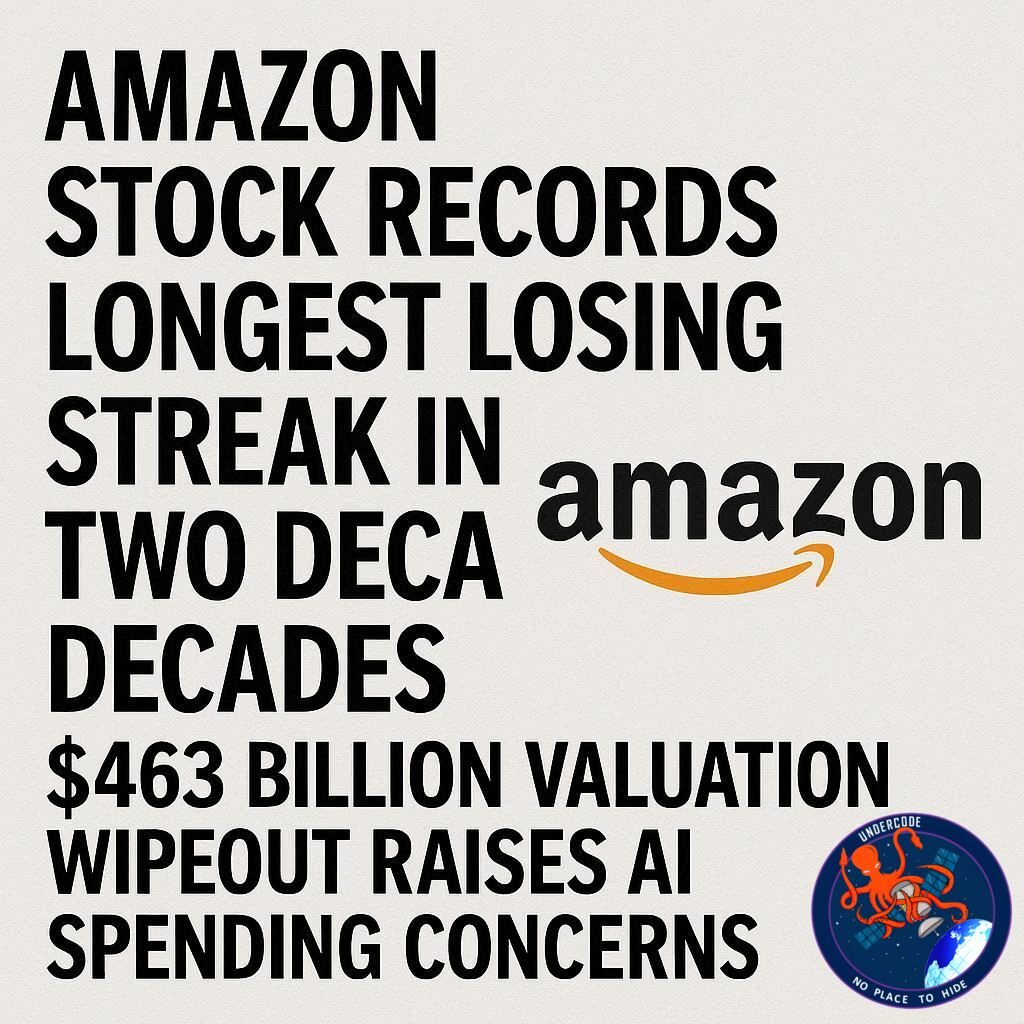
The relentless slide in Amazon’s share price has rattled Wall Street and revived a familiar question in technology investing: how much spending is too much? After nearly two decades without such a prolonged downturn, the company’s stock has entered its longest losing streak since 2006. What once symbolized aggressive expansion and market dominance now fuels investor anxiety. At the heart of the selloff lies a staggering $200 billion capital expenditure plan that has sparked fears of shrinking cash flow and rising competitive pressure in artificial intelligence and cloud computing.
Historic Nine-Day Slide Signals Deep Investor Anxiety
Amazon shares extended their decline on Friday, February 13, marking a ninth consecutive daily loss. This is the longest losing streak since July 2006, when the stock also endured a nine-session drop. The recent stretch erased approximately $463 billion in market capitalization, a stunning contraction even for a company of Amazon’s scale. Shares have fallen roughly 18 percent during this period and now trade at their lowest level since May. For the month so far, the stock is down about 17 percent, placing it on track for its steepest monthly percentage decline since April 2022.
Capital Expenditure Shock Sends Shares Lower
The primary catalyst behind this sustained downturn appears to be Amazon’s updated capital expenditure outlook. Earlier this month, the company revealed plans to invest $200 billion in 2026 on data centers, chips, and infrastructure. The figure exceeded analysts’ expectations by more than $50 billion. Investors, already wary of heavy AI-related spending across the technology sector, reacted swiftly. Markets interpreted the aggressive outlay as a potential threat to free cash flow and near-term profitability.
Analysts Warn of Negative Cash Flow Risk
Anthony Saglimbene, chief market strategist at Ameriprise, cautioned that if Amazon’s spending leads to negative cash flow, it would represent a significant red flag. The market increasingly views the scale of the investment as risky rather than visionary. A shift from strong cash generation to potential cash strain could fundamentally alter how investors value the company, especially during periods of broader market uncertainty.
DA Davidson Downgrades Amazon to Neutral
Concerns have not been limited to market strategists. Analysts at DA Davidson downgraded Amazon’s stock from Buy to Neutral. The downgrade cited worries about escalating capital expenditures, intensifying competition in cloud computing, and emerging risks tied to artificial intelligence reshaping online retail. According to the firm, Amazon Web Services may be losing its leadership advantage and now appears to be investing aggressively to regain ground.
Cloud Dominance Under Scrutiny
Amazon Web Services, long considered the backbone of Amazon’s profitability, now faces mounting competition from rivals such as Microsoft and Alphabet. Recent earnings reports from these competitors suggest a rapidly evolving AI landscape where speed and scale matter more than ever. Analysts fear that AWS may need sustained, heavy spending simply to maintain relevance in a market that no longer tolerates complacency.
AI Disruption Threatens Retail Foundations
Beyond cloud infrastructure, analysts have expressed concern that generative AI platforms like Gemini and ChatGPT could alter consumer behavior in ways that challenge Amazon’s retail ecosystem. If shopping experiences increasingly shift toward AI-driven conversational interfaces, traditional e-commerce models may need rapid reinvention. This adds another layer of uncertainty to Amazon’s investment thesis.
CEO Andy Jassy Defends Aggressive Spending
Amazon CEO Andy Jassy defended the spending strategy during the company’s earnings call. He expressed confidence that the cloud unit would generate strong returns on invested capital over time. Jassy emphasized that the investments are not speculative pursuits but responses to high demand for AI computing power. According to him, expanding infrastructure in data centers, chips, and networking equipment is essential to meet surging AI workloads and secure long-term growth.
Big Tech’s Collective $650 Billion Spending Wave
Amazon is not alone in drawing scrutiny. The four largest technology spenders, Amazon, Alphabet, Microsoft, and Meta Platforms, are projected to allocate a combined $650 billion in capital expenditures in 2026. Investors increasingly demand tangible returns rather than promises of future dominance. If this unprecedented spending wave results in weaker or negative cash flow, the valuation framework for the entire sector could shift dramatically.
What Undercode Say:
Capital Intensity Marks a New Phase in Tech Evolution
Amazon’s recent downturn is not merely a reaction to earnings volatility. It reflects a deeper structural shift in how technology giants operate. The era of asset-light digital platforms is giving way to capital-heavy AI infrastructure battles. Building advanced data centers and custom AI chips demands massive upfront investment. This is no longer about incremental server expansion. It is about constructing the backbone of the AI economy.
Investors Reprice Growth Under Stricter Conditions
Markets once rewarded tech companies for aggressive reinvestment. Today, the mood is more skeptical. After years of rising interest rates and macroeconomic uncertainty, investors want clarity on return timelines. When a company signals $200 billion in spending without specifying when returns will materialize, volatility becomes inevitable. Valuation multiples compress when certainty declines.
AWS at a Strategic Crossroads
Amazon Web Services remains profitable and influential, yet the perception of losing ground to Microsoft’s Azure and Google Cloud carries weight. In technology markets, leadership is as much about narrative as numbers. If investors believe AWS is catching up rather than leading, confidence erodes quickly. That perception can influence capital flows more than quarterly metrics.
AI as Both Opportunity and Threat
Artificial intelligence is a double-edged sword for Amazon. On one side, it powers cloud growth and enterprise services. On the other, it could disrupt the core retail model. Conversational AI tools may redefine how consumers search, compare, and purchase products. If search engines evolve into AI shopping assistants, traffic patterns could shift away from traditional marketplaces.
Cash Flow Discipline Becomes the Deciding Factor
The real question is not whether AI infrastructure will be valuable. It almost certainly will. The question is whether Amazon can fund this transformation without sacrificing financial flexibility. If free cash flow turns negative for an extended period, investor patience may thin rapidly. Markets tolerate bold strategy only when balance sheets remain resilient.
Competitive Spending Creates Sector-Wide Risk
The combined $650 billion projected spending across major tech firms signals an arms race. When every player invests aggressively, margins across the industry can compress. Infrastructure oversupply is a historical risk in capital-intensive sectors. If AI demand does not scale as projected, returns could disappoint across the board.
Long-Term Vision Versus Short-Term Sentiment
Andy Jassy’s confidence suggests management sees this as a generational investment cycle. History shows that Amazon has previously invested heavily, endured skepticism, and emerged stronger. AWS itself was once viewed as an experimental bet. Yet today’s macroeconomic environment is less forgiving than in past expansion phases.
Market Stress Could Amplify Valuation Shifts
If broader market stress emerges, high-spending companies with uncertain cash flow trajectories often experience sharper corrections. Investors reallocate toward stability and predictable returns. Amazon’s current trajectory places it directly in the spotlight of this dynamic.
Strategic Patience May Define the Outcome
Ultimately, the sustainability of Amazon’s valuation will depend on execution. If infrastructure investments translate into dominant AI services and expanding enterprise contracts, the current selloff could appear shortsighted. If not, the $463 billion valuation loss may be only an early chapter in a longer repricing cycle.
Fact Checker Results
✅ Amazon recorded a nine-day losing streak, its longest since 2006.
✅ The company projected approximately $200 billion in capital expenditures for 2026, exceeding analyst expectations.
❌ There is no confirmed evidence yet that Amazon currently has sustained negative cash flow due to this spending plan.
Prediction
📉 If AI infrastructure demand accelerates faster than expected, Amazon’s heavy investment could drive long-term dominance and stabilize valuation.
⚖️ If cash flow weakens amid broader market stress, further short-term volatility is likely before confidence returns.
🕵️📝✔️Let’s dive deep and fact‑check.
References:
Reported By: timesofindia.indiatimes.com
Extra Source Hub (Possible Sources for article):
https://www.pinterest.com
Wikipedia
OpenAi & Undercode AI
Image Source:
Unsplash
Undercode AI DI v2
Bing
🔐JOIN OUR CYBER WORLD [ CVE News • HackMonitor • UndercodeNews ]
📢 Follow UndercodeNews & Stay Tuned:
𝕏 formerly Twitter 🐦 | @ Threads | 🔗 Linkedin | 🦋BlueSky | 🐘Mastodon


