
Listen to this Post
 A New Era of Phishing Built on Trust and Precision
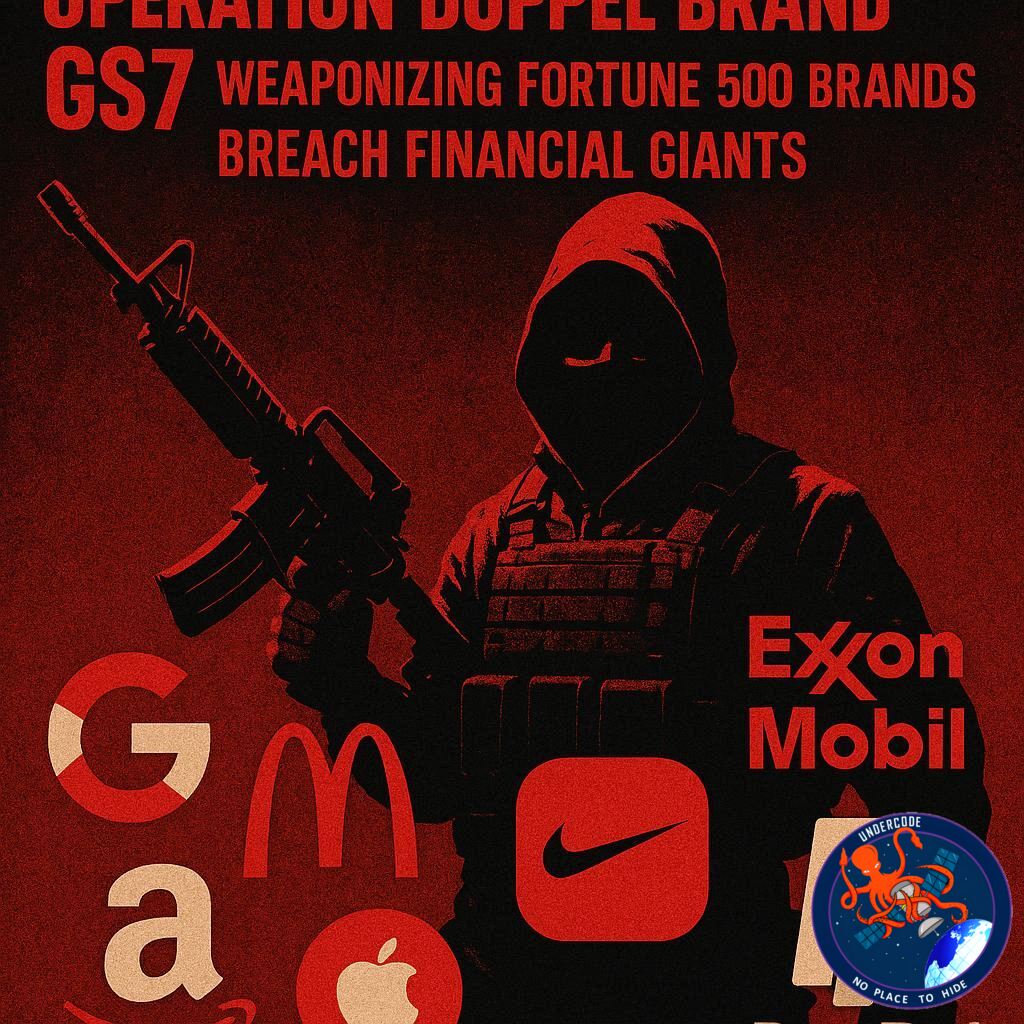
Cybercrime has entered a phase where deception is no longer crude or obvious. It is polished, branded, and disturbingly authentic. A financially motivated threat group known as GS7 is behind a sophisticated phishing operation called Operation DoppelBrand, a campaign that turns the trusted identities of Fortune 500 corporations into weapons. By cloning corporate login portals with near-flawless accuracy, the group is stealing credentials, harvesting sensitive data, and quietly building pathways into some of the most powerful financial institutions in the United States and beyond.
Operation DoppelBrand Targets America’s Financial Backbone
Operation DoppelBrand, first observed between December and January, primarily targets major financial institutions such as Wells Fargo, USAA, Navy Federal Credit Union, Fidelity Investments, and Citibank. However, the scope does not end there. Technology firms, healthcare providers, and telecommunications companies across multiple regions have also been caught in the campaign’s expanding net.
Security researchers from SOCRadar revealed that GS7 has been active since at least 2022, though evidence suggests the group may have deeper roots. Despite years of activity, the operation managed to avoid widespread detection, highlighting how organized phishing networks have evolved into highly disciplined enterprises.
The Anatomy of a Near-Perfect Phishing Infrastructure
The true power of Operation DoppelBrand lies in its infrastructure. GS7 does not rely on sloppy domain typos or poorly designed login forms. Instead, the group constructs websites that mirror official corporate portals with striking precision. Logos, color schemes, login flows, and even subtle design details are replicated so convincingly that distinguishing the fake from the real becomes extraordinarily difficult.
To sustain this illusion, GS7 registered more than 150 malicious domains in just a few months. These domains were acquired through registrars such as NameCheap and OwnRegistrar, while traffic was routed through Cloudflare to obscure backend infrastructure. This layered approach not only protects the attackers’ servers but also complicates investigative tracing efforts.
Such operational discipline indicates careful planning. Targets are selected in advance. Portals are crafted individually. Infrastructure is rotated regularly to reduce detection risk. This is phishing conducted with corporate-level efficiency.
From Stolen Credentials to Full Remote Access
Once a victim submits login information, the harvested data is immediately exfiltrated. Stolen credentials include usernames, passwords, IP addresses, geolocation data, browser fingerprints, device identifiers, and timestamps. These are transmitted in real time to attacker-controlled Telegram bots, including a group identified as “NfResultz by GS.”
The objective extends beyond credential harvesting. In multiple observed incidents, victims who completed the fake login process triggered the download of remote management and monitoring tools. These RMM utilities allow attackers to establish persistent remote access, deploy additional malware, or move laterally within a compromised network.
Security researchers believe GS7 may be operating as an Initial Access Broker. Instead of executing ransomware attacks directly, the group may sell verified access to other cybercriminal affiliates. If confirmed, this positions GS7 within a broader underground supply chain that fuels ransomware and large-scale financial fraud operations.
A Strategic Focus on English-Speaking Markets
Recent activity shows a strong emphasis on English-speaking markets, with the United States being the primary target. However, the campaign has expanded into Europe and other global regions. The pattern suggests that GS7 prioritizes high-value entities with significant financial throughput and brand recognition.
The group allegedly maintains ties to Brazilian cybercrime forums, where stolen financial data and login credentials are traded. These digital marketplaces serve as both supply and distribution channels, allowing harvested data to circulate rapidly within criminal ecosystems.
A person claiming to represent GS7 reportedly demonstrated a phishing portal mimicking Fidelity, showing how login submissions could lead directly to remote access tool downloads. The demonstration reinforces the group’s technical confidence and suggests a level of operational maturity uncommon in lower-tier phishing operations.
Phishing’s Dangerous Evolution into Corporate-Grade Crime
Operation DoppelBrand demonstrates that phishing is no longer limited to bulk spam campaigns or poorly disguised scam emails. It has become an engineered system built on infrastructure management, brand replication, and data monetization strategies.
The campaign’s longevity without detection highlights a troubling reality. Modern phishing groups can build scalable infrastructures, continuously rotate domains, and leverage anonymization services to operate in the shadows for years. This is not opportunistic hacking. It is sustained, strategic cybercrime.
For defenders, mitigation requires more than awareness training. Multi-factor authentication, strict domain monitoring, behavioral analytics, and zero-trust architectures are increasingly essential. The illusion of a trusted login page can no longer be accepted at face value.
What Undercode Say:
Operation DoppelBrand reflects a structural shift in cybercrime economics. The attackers are no longer merely stealing passwords. They are manufacturing credibility at scale. By cloning Fortune 500 brands with pixel-level precision, GS7 exploits the most powerful vulnerability in cybersecurity, human trust.
What makes this campaign especially alarming is its layered monetization model. Credential harvesting is only the first revenue stream. The installation of RMM tools suggests long-term persistence and post-compromise exploitation. If GS7 is indeed functioning as an Initial Access Broker, it occupies a pivotal role in the ransomware supply chain. Access brokers reduce operational risk for ransomware gangs, allowing specialization within criminal networks.
The registration of over 150 domains within months indicates capital investment and structured planning. This is not random phishing. It resembles project management. Infrastructure rotation, traffic obfuscation through Cloudflare, and Telegram-based automation signal a mature threat actor comfortable with automation pipelines.
There is also a psychological dimension. When victims see a flawless replica of a bank’s login page, cognitive defenses weaken. Familiar branding lowers suspicion. In high-pressure contexts such as urgent financial notifications, users may respond reflexively. GS7 capitalizes on that reflex.
Another critical factor is the data granularity being harvested. Browser fingerprints, geolocation, and timestamp metadata enhance resale value. Buyers can verify legitimacy, reduce fraud detection triggers, and optimize follow-on attacks. The stolen dataset becomes a premium commodity rather than a simple username-password pair.
The alleged links to Brazilian cybercrime forums highlight how localized underground markets can support global campaigns. Cybercrime has become geographically distributed but digitally centralized. Regional forums function as trading hubs, reputation systems, and recruitment channels.
Defensively, traditional URL filtering and blacklist-based controls are insufficient. When attackers continuously register fresh domains, detection windows shrink. Proactive domain similarity monitoring and AI-driven anomaly detection must complement standard controls.
Financial institutions face a reputational risk beyond immediate financial losses. Even when breaches occur via phishing impersonation rather than direct compromise, public perception may conflate the two. Brand trust erodes regardless of technical fault.
Operation DoppelBrand is not an anomaly. It is a preview. As automation improves and generative technologies enhance design replication, phishing portals will become indistinguishable from legitimate services. The arms race will shift toward behavioral biometrics and adaptive authentication rather than static credentials.
In essence, GS7 demonstrates how cybercrime groups are professionalizing. They manage infrastructure portfolios, maintain branding standards, and integrate communication bots. The line between criminal syndicate and shadow IT enterprise is narrowing.
If defenders treat this as another phishing wave, they will underestimate the threat. Operation DoppelBrand represents organized, scalable credential warfare.
Fact Checker Results
✅ GS7 has been linked to a phishing campaign called Operation DoppelBrand targeting major financial institutions.
✅ The campaign involved registering over 150 malicious domains and using infrastructure obfuscation techniques.
❌ There is no confirmed public attribution identifying the physical location or leadership of GS7.
Prediction
🔮 Credential-based attacks will increasingly evolve into access-broker ecosystems where groups like GS7 specialize in harvesting and reselling verified enterprise entry points.
🔐 Financial institutions will accelerate adoption of passwordless authentication and behavioral biometrics to counter brand-cloning campaigns.
🌍 Cross-border cybercrime marketplaces will continue expanding, making international cooperation essential for disruption.
🕵️📝✔️Let’s dive deep and fact‑check.
References:
Reported By: www.darkreading.com
Extra Source Hub (Possible Sources for article):
https://www.pinterest.com
Wikipedia
OpenAi & Undercode AI
Image Source:
Unsplash
Undercode AI DI v2
Bing
🔐JOIN OUR CYBER WORLD [ CVE News • HackMonitor • UndercodeNews ]
📢 Follow UndercodeNews & Stay Tuned:
𝕏 formerly Twitter 🐦 | @ Threads | 🔗 Linkedin | 🦋BlueSky | 🐘Mastodon


