
Listen to this Post
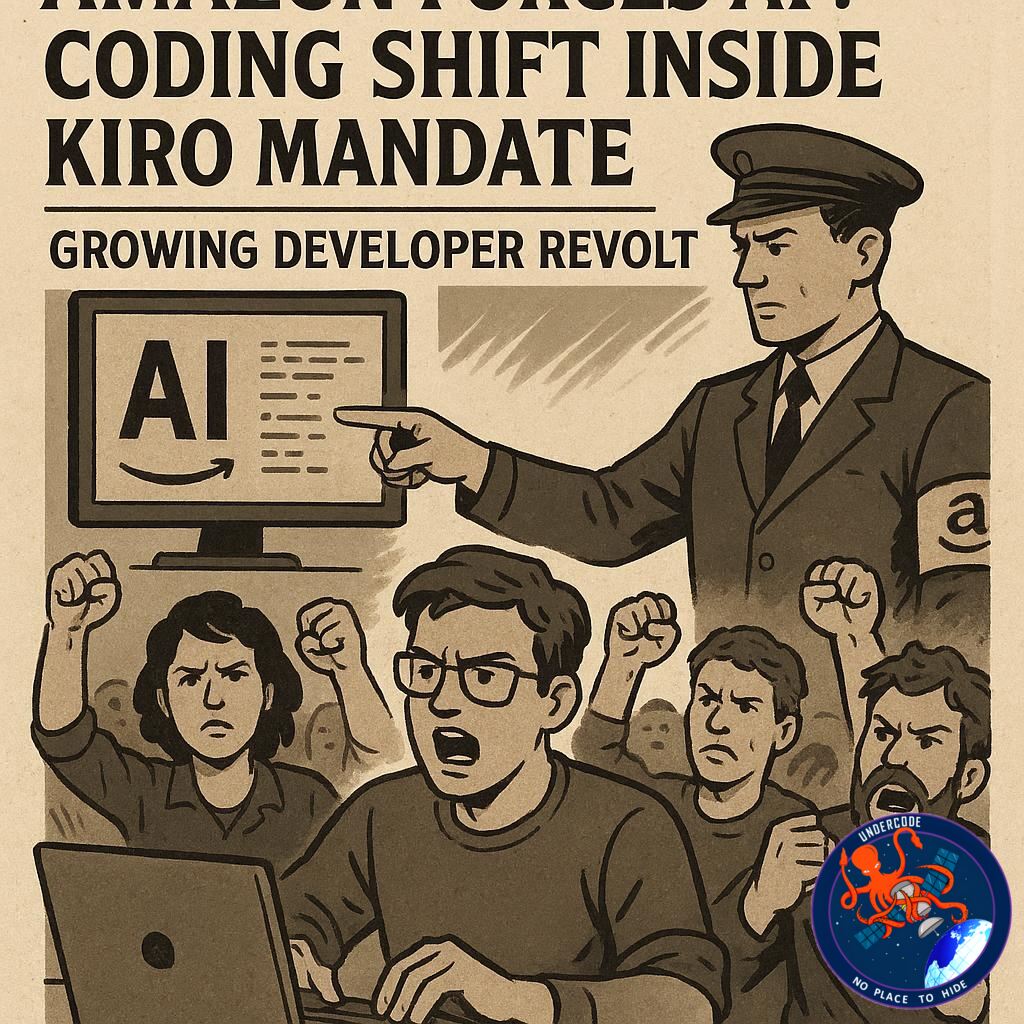
Amazon is not quietly experimenting with artificial intelligence. It is restructuring its engineering culture around it. In a bold internal push, the company wants 80 percent of its developers using AI-assisted coding tools at least once per week. This is not framed as a suggestion. It is a strategic directive. And the tool of choice is not OpenAI’s Codex or Anthropic’s Claude Code. It is Kiro, Amazon’s own in-house AI coding assistant launched in July 2025.
The move signals more than a product rollout. It reflects a company-wide transformation under CEO Andy Jassy, who is steering Amazon toward a future where AI does not supplement productivity but defines it.
Amazon’s AI Coding Mandate and the Rise of Kiro
Amazon has made its position unmistakably clear. According to reporting from Financial Times, the company wants AI-assisted coding to become a weekly routine for the vast majority of its engineers. The internal benchmark stands at 80 percent adoption. Currently, around 70 percent of Amazon’s software engineers reportedly used Kiro at least once in January, a figure confirmed to Business Insider by a company spokesperson.
The tool at the center of this initiative is Kiro, described internally as Amazon’s recommended AI-native development environment. Unlike optional developer tools that grow organically through peer recommendation, Kiro is being institutionalized through executive direction.
Internal Memo Restricts Third-Party AI Tools
An internal memo viewed by Reuters outlined the company’s stance with unusual clarity. The memo stated that Amazon does not plan to support additional third-party AI development tools. It was signed by two senior executives: Peter DeSantis and Dave Treadwell. Both emphasized that Kiro would serve as the official AI-native development tool going forward.
The language did not simply promote Kiro. It effectively discouraged alternatives.
OpenAI’s Codex and Claude Code Under Scrutiny
OpenAI’s Codex, the AI coding model from OpenAI, was placed on a “Do Not Use” list after a six-month internal review. Anthropic’s Claude Code from Anthropic was also temporarily flagged in a similar way before that designation was later reversed.
Amazon insists there is no outright ban on Claude Code. Instead, it claims that stricter requirements apply for production-level tools. That distinction may be technically accurate, but for many engineers, the operational impact feels the same.
1,500 Engineers Back Claude Code Instead
Resistance inside Amazon has been vocal. Around 1,500 employees supported the formal adoption of Claude Code in an internal discussion forum. Many of them argued that Claude simply performs better for real-world coding tasks.
One employee reportedly criticized Kiro’s competitiveness, suggesting that a tool unable to match rivals risks relying on forced adoption rather than genuine value. That sentiment highlights a deeper tension between top-down strategy and bottom-up engineering culture.
AWS Sales Engineers Face an Awkward Contradiction
The conflict becomes even more complicated within Amazon Web Services. AWS sales engineers are responsible for promoting Claude Code to customers through the Bedrock platform. Yet internally, they are discouraged or restricted from using the same tool in production.
This creates a credibility problem. If Amazon’s own engineers are not freely adopting a tool, customers may question why they should trust it. The optics are delicate, especially in a market where AI trust and performance determine enterprise contracts.
Billions Invested in AI Partnerships
The irony is striking. Amazon has invested $8 billion in Anthropic, the company behind Claude Code. At the same time, it signed a massive $38 billion cloud computing deal with OpenAI, whose Codex tool is also restricted internally.
These partnerships position Amazon as a financial backer and infrastructure provider for leading AI labs. Yet inside its own walls, it is consolidating developer workflows around a proprietary alternative.
AI Efficiency and Workforce Reduction
Kiro’s rollout is part of a broader AI transformation. Under Andy Jassy’s leadership, Amazon has committed a record $200 billion in capital expenditures this year, much of it directed toward AI infrastructure and data centers.
At the same time, the company has reduced its corporate workforce by 30,000 roles since October 2025, marking the largest job reduction in its history. Jassy has openly stated that AI-driven efficiency gains will gradually shrink Amazon’s corporate workforce.
The message is clear. AI is not a side project. It is the foundation of Amazon’s next operational era.
Internal Skepticism Toward Amazon’s Own Models
Despite heavy investment, not all engineers are convinced. Several told the Financial Times they preferred Anthropic’s Claude over Amazon’s internal Nova models for coding tasks. One AWS engineer reportedly admitted they were unaware that Amazon even had its own model.
That remark reveals a disconnect between executive ambition and grassroots awareness. Building an AI tool is one challenge. Building developer loyalty is another.
What Undercode Say:
Amazon’s strategy reflects a classic platform-control play. By standardizing Kiro as the internal AI coding assistant, the company reduces fragmentation, improves data feedback loops, and accelerates internal model training. Every line of code generated through Kiro becomes proprietary insight. Every rejected suggestion becomes model improvement data. That is strategic gold.
Yet the forced nature of adoption introduces risk. Developers are not passive users. They are power users. If they believe an external tool such as Claude Code delivers better context handling, fewer hallucinations, or more accurate refactoring, they will resist quietly or creatively. Productivity tools thrive on trust. Mandates alone cannot manufacture that trust.
There is also a reputational dimension. AWS is selling AI services through Bedrock while internally prioritizing Kiro. Enterprise customers are sophisticated. They will ask whether Amazon uses the same tools it recommends. If the answer feels ambiguous, competitors will exploit that gap.
Financially, Amazon’s AI spending, reported at $200 billion in capital expenditure, signals infrastructure dominance. Combined with the $8 billion investment in Anthropic and the $38 billion cloud partnership with OpenAI, Amazon is positioning itself as both investor and gatekeeper of AI compute. But compute leadership does not automatically translate into developer mindshare.
Another layer involves workforce restructuring. Cutting 30,000 corporate roles while mandating AI usage reinforces a narrative that automation is replacing human capacity. For engineers, this creates psychological pressure. If AI adoption becomes tied to performance metrics, resistance may be interpreted as inefficiency rather than preference.
The long-term question is whether Kiro becomes genuinely competitive or remains internally sustained through policy. If Kiro matches or surpasses Claude and Codex in speed, reasoning depth, and codebase awareness, adoption will stabilize naturally. If it does not, enforcement will grow heavier.
Amazon’s advantage lies in scale. With tens of thousands of engineers feeding data into Kiro weekly, iteration speed could outpace rivals. But cultural alignment remains the unpredictable variable. Technology evolves quickly. Trust evolves slowly.
Fact Checker Results
✅ Amazon aims for 80 percent weekly AI coding adoption and has reported around 70 percent Kiro usage internally.
✅ Amazon invested $8 billion in Anthropic and signed a $38 billion cloud agreement with OpenAI.
❌ There is no confirmed absolute ban on Claude Code; Amazon states it applies stricter production standards instead.
Prediction
🔮 Amazon will intensify internal AI standardization while quietly improving Kiro’s capabilities to reduce developer resistance.
📈 Enterprise customers will increasingly demand proof that Amazon uses the same AI tools it sells.
⚡ The internal battle between proprietary control and best-in-class performance will shape Amazon’s developer culture over the next three years.
▶️ Related Video (80% Match):
🕵️📝✔️Let’s dive deep and fact‑check.
References:
Reported By: timesofindia.indiatimes.com
Extra Source Hub (Possible Sources for article):
https://www.twitter.com
Wikipedia
OpenAi & Undercode AI
Image Source:
Unsplash
Undercode AI DI v2
Bing
🔐JOIN OUR CYBER WORLD [ CVE News • HackMonitor • UndercodeNews ]
📢 Follow UndercodeNews & Stay Tuned:
𝕏 formerly Twitter 🐦 | @ Threads | 🔗 Linkedin | 🦋BlueSky | 🐘Mastodon


