
Listen to this Post
 Introduction: The Small Desktop at the Center of a Big AI Storm
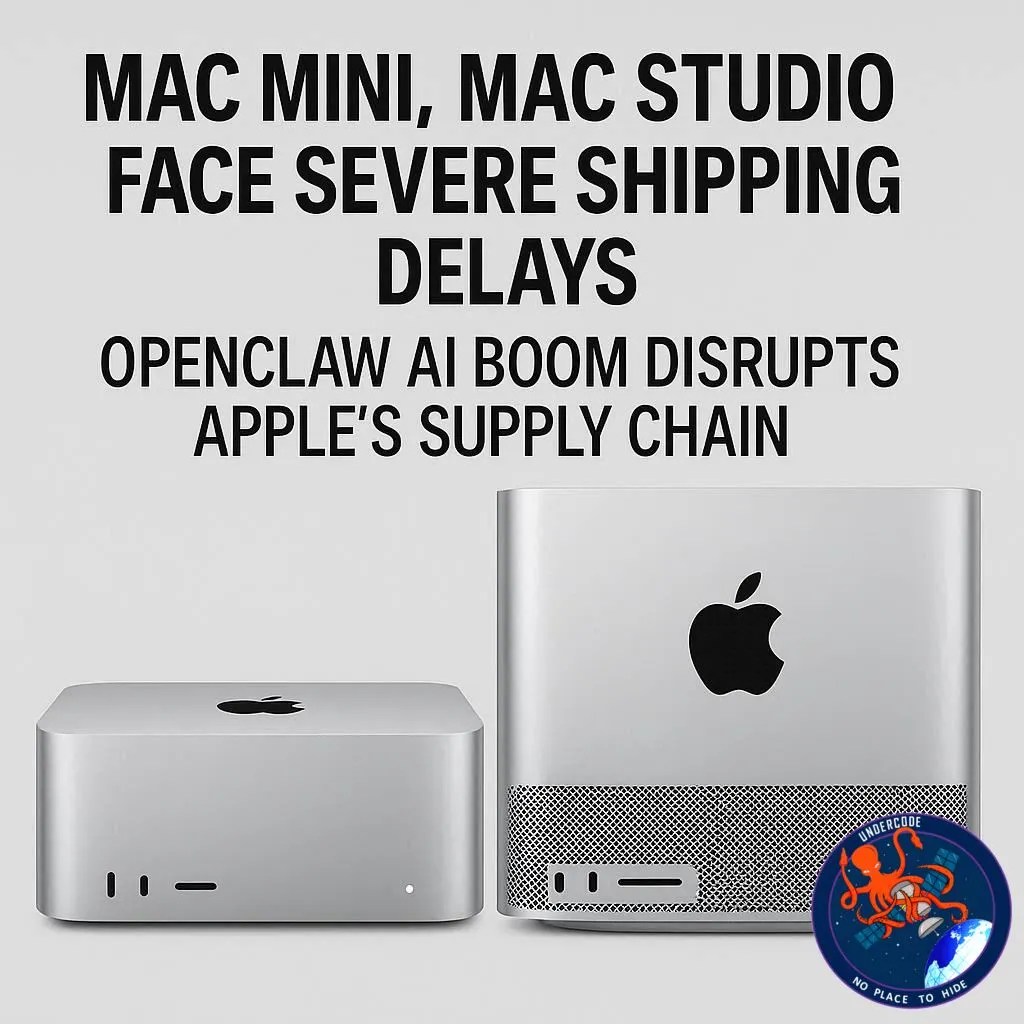
Apple’s compact desktops were never designed to spark a supply crisis. Yet that is precisely what is unfolding. The once easily available Mac mini and the more powerful Mac Studio are now facing significant shipping delays, especially for configurations with higher memory. What seemed like a quiet product cycle has transformed into a hardware bottleneck driven by a surprising force: the explosive rise of local artificial intelligence workloads, particularly fueled by the popularity of OpenClaw. A small computer is suddenly at the heart of a much larger technological shift.
Summary: AI Demand Is Draining Apple’s High-RAM Desktop Inventory
Reports indicate that Apple’s Mac mini and Mac Studio are experiencing extended delivery timelines, particularly for models equipped with memory beyond baseline configurations. Observers noticed that what used to be a manageable two-week wait has ballooned into delays exceeding a month for certain builds.
The shift appears closely linked to the accelerating interest in running artificial intelligence models locally instead of relying solely on cloud-based services. OpenClaw, an AI agent platform gaining traction among developers and startups, has pushed many users toward machines capable of handling demanding large language models directly on-device.
Running AI locally requires substantial unified memory. Apple’s architecture, where memory is shared between CPU, GPU, and neural processing units, makes high-RAM Macs especially appealing for such tasks. The Mac mini and Mac Studio allow configurations with significant memory capacities, making them attractive to AI builders who want private, low-latency inference without cloud dependency.
Current listings on Apple’s US store show immediate shipping for base Mac mini configurations with 16GB of RAM. However, upgrading to 24GB or 32GB introduces waiting periods of two to three weeks. The situation intensifies with higher-tier chips. Mac mini models powered by more advanced processors also face similar delays unless configured at the entry memory level.
The Mac Studio’s situation is more dramatic. Configurations with higher RAM capacities, such as 64GB or 128GB, are showing delivery estimates stretching from four to six weeks. Even more extreme builds, such as models featuring massive unified memory allocations, are subject to similar extended timelines.
Industry observers speculate that startups and AI-focused companies are buying these machines in bulk. Clusters of Mac Studios are reportedly being deployed for long-running agentic tasks and private large language models. Their compact size, power efficiency, and high-bandwidth unified memory design make them ideal for sustained inference workloads.
While it is tempting to attribute the entire shortage to OpenClaw and the local AI movement, other factors may also be at play. Memory supply constraints have affected the broader semiconductor industry in cycles before. Apple’s enormous scale does not make it immune to inventory pressure, especially when demand spikes unexpectedly in a specific configuration category.
The unified memory architecture remains central to this phenomenon. Unlike traditional PCs with separate system RAM and VRAM, Apple Silicon pools memory for all computational units. This allows AI models to operate more efficiently, particularly those requiring significant tensor processing across CPU and GPU resources.
As more developers experiment with running LLMs privately, demand for high-memory configurations rises sharply. These are not casual buyers. They are technical users, startups, and AI labs that require machines capable of sustained, high-performance computation without cloud latency or ongoing subscription fees.
If the pattern continues, pricing pressure could follow. Memory upgrades are already costly, and if supply tightens further, availability may become constrained even for those willing to pay premium pricing.
The broader implication is that Apple’s compact desktops have become unlikely infrastructure nodes in the AI revolution. What was once a niche desktop for creatives and developers is evolving into a preferred local AI workstation.
What Undercode Say: The Real Meaning Behind the Mac Mini Mania
The shortage of high-memory Mac minis and Mac Studios is not just a temporary shipping hiccup. It signals a structural shift in how artificial intelligence is being deployed.
For years, AI computation was almost entirely synonymous with cloud infrastructure. Massive GPU farms, hyperscale data centers, and subscription-based inference APIs defined the ecosystem. Now, a countercurrent is forming. Developers increasingly want control. They want privacy, predictable costs, and autonomy from cloud providers.
This is where Apple’s unified memory design becomes strategically important. By allowing CPU, GPU, and neural engines to access the same memory pool at high bandwidth, Apple Silicon reduces overhead typically seen in discrete architectures. For large language models, especially quantized or optimized versions designed for local inference, this efficiency matters.
OpenClaw’s rise reflects a broader trend toward agentic AI systems that operate semi-autonomously. These systems often require persistent background execution, constant reasoning cycles, and private data handling. Running them locally eliminates recurring cloud costs and mitigates privacy risks.
What is happening with Mac hardware resembles a micro version of GPU shortages seen during crypto mining booms. When a new computational use case emerges, hardware optimized for it becomes scarce. In this case, the “mining rig” is a compact Apple desktop with abundant unified memory.
The psychology of the market also plays a role. Once reports of shortages surface, buyers accelerate purchasing decisions. This compounds supply strain. Developers who were considering upgrades later in the year may move forward immediately, fearing longer delays or price increases.
Another dimension involves enterprise adoption. Small AI startups often prefer off-the-shelf hardware over custom server builds during early scaling. Clusters of Mac Studios can serve as cost-effective inference nodes compared to enterprise GPU servers, particularly when models are optimized for Apple Silicon.
However, sustainability remains a question. If Apple cannot secure sufficient high-bandwidth memory inventory, delays could extend further. Memory manufacturing is capital-intensive and cyclical. Sudden demand spikes are difficult to absorb instantly, even for a company of Apple’s scale.
There is also competitive signaling here. If Apple’s desktops are becoming desirable AI workstations, competitors in the Windows and Linux ecosystem may respond with similar unified memory architectures or optimized AI-centric desktop offerings.
The local AI movement also redefines consumer hardware boundaries. A device once marketed as a creative workstation is now quietly entering the realm of AI infrastructure. This blurs the line between consumer electronics and enterprise compute hardware.
In the long term, Apple could leverage this shift. AI-optimized marketing, bundled development tools, and expanded memory tiers could transform the Mac mini from a budget desktop into an AI developer’s staple machine.
At the same time, rising demand could intensify pricing concerns. High-memory configurations are already premium purchases. If supply tightens further, entry barriers for independent developers may increase.
Ultimately, this shortage tells a deeper story. Artificial intelligence is no longer confined to distant data centers. It is moving onto desks. And the humble Mac mini is unexpectedly standing at the crossroads of that transformation.
Fact Checker Results
✅ Shipping delays for higher-RAM Mac mini and Mac Studio configurations are currently visible on Apple’s US store listings.
✅ Unified memory architecture in Apple Silicon benefits AI workloads by sharing memory across CPU and GPU.
❌ There is no official confirmation from Apple directly attributing shortages solely to OpenClaw or the local AI boom.
Prediction
🚀 High-memory compact desktops will become standard tools for AI developers within the next 12 months.
📈 Apple may introduce expanded memory tiers or AI-focused marketing to capitalize on demand.
⚠️ Continued AI growth could push hardware prices upward if memory supply constraints persist.
🕵️📝✔️Let’s dive deep and fact‑check.
References:
Reported By: www.techradar.com
Extra Source Hub (Possible Sources for article):
https://www.linkedin.com
Wikipedia
OpenAi & Undercode AI
Image Source:
Unsplash
Undercode AI DI v2
Bing
🔐JOIN OUR CYBER WORLD [ CVE News • HackMonitor • UndercodeNews ]
📢 Follow UndercodeNews & Stay Tuned:
𝕏 formerly Twitter 🐦 | @ Threads | 🔗 Linkedin | 🦋BlueSky | 🐘Mastodon


