
Listen to this Post
Introduction: When the Evidence Vanishes Before Investigators Arrive
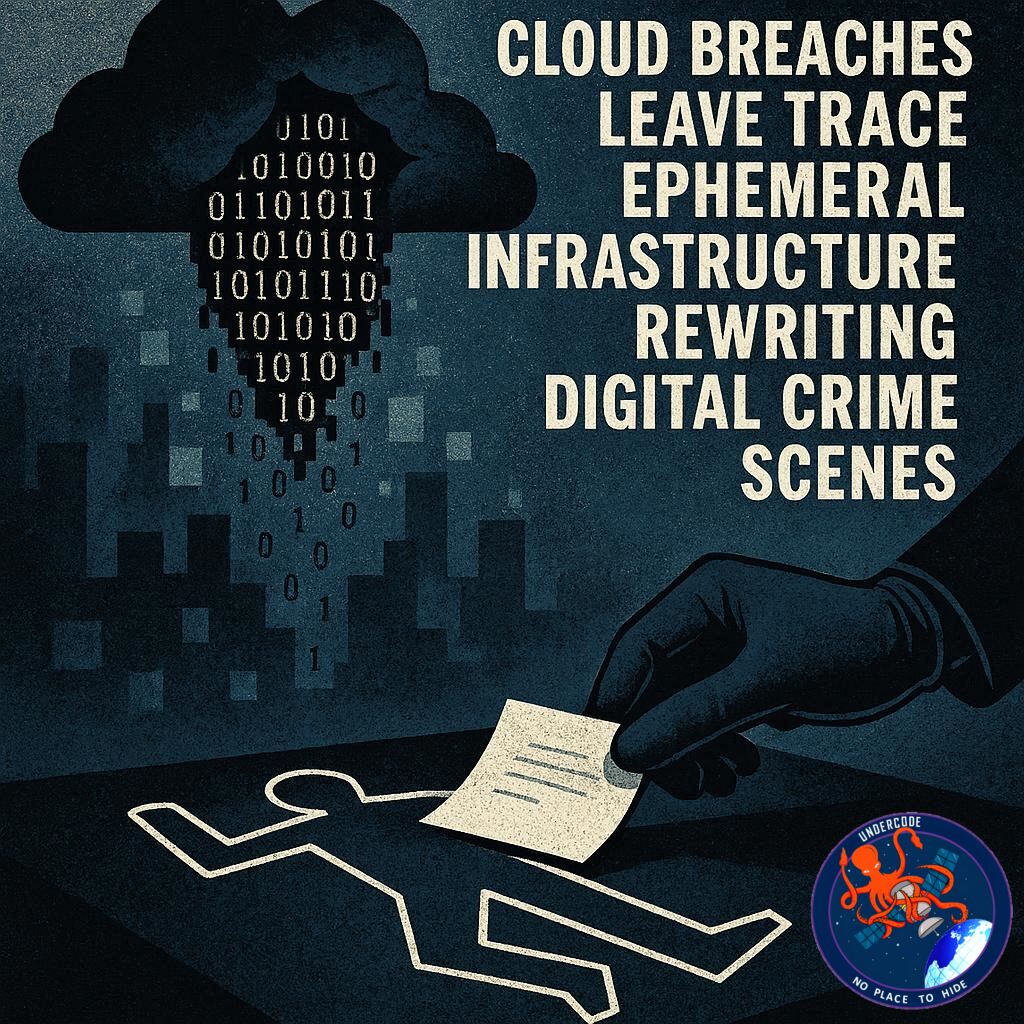
Cloud breaches are no longer slow, noisy intrusions that leave behind obvious forensic footprints. In today’s elastic cloud environments, attackers can spin up compromised instances, steal data, and disappear before defenders even realize something went wrong. A short post by Cybersecurity News Everyday highlights a growing reality for defenders: ephemeral instances and expiring logs are erasing evidence at machine speed, forcing Security Operations Centers (SOCs) to rethink how investigations are conducted in the cloud era.
the Original The Rise of Disappearing Breaches
The article explains how modern cloud architectures, designed for speed and scalability, have unintentionally created ideal conditions for stealthy attackers. Ephemeral instances—virtual machines or containers that exist only briefly—can be abused to perform malicious actions and then terminate automatically. When combined with short log-retention windows, this means traditional forensic artifacts often vanish within minutes or hours.
The post emphasizes that legacy incident response models, which rely on disk images and long-lived system logs, are increasingly ineffective in cloud-native environments. By the time an alert is triggered, the compromised workload may no longer exist, leaving defenders with fragmented telemetry.
To counter this, modern SOC teams are adopting AI-driven, context-aware forensics. These approaches correlate signals across identity systems, access logs, network telemetry, and cloud control planes in near real time. Instead of relying on a single source of truth, investigators reconstruct attacks by stitching together multiple weak signals.
The article argues that speed is now the most critical factor in cloud investigations. Automated analysis can compress what once took days into minutes, allowing teams to identify attacker behavior before the trail goes cold. In this new model, forensics is no longer a post-incident activity but a continuous, intelligence-driven process embedded directly into cloud operations.
What Undercode Say:
Cloud forensics is undergoing a fundamental shift, and this shift exposes a hard truth: the cloud favors attackers who understand its transient nature better than defenders do. Ephemeral infrastructure is not a flaw—it is a feature—but one that security teams underestimated for years.
From an operational perspective, the biggest mistake organizations make is treating cloud incidents like traditional server compromises. In on-prem environments, persistence was the attacker’s goal. In the cloud, impermanence is the weapon. Attackers no longer need to hide for weeks; they only need a few minutes of unchecked access.
AI-driven correlation is not a luxury here—it is survival. Human analysts cannot manually correlate identity events, API calls, workload telemetry, and network flows at cloud scale in real time. Without automation, the investigation starts after the evidence has already expired.
Another overlooked issue is identity sprawl. Many cloud breaches do not begin with malware but with abused credentials, misconfigured roles, or overprivileged service accounts. Context-aware forensics that links “who did what” across accounts and services is often more valuable than traditional malware analysis.
There is also a strategic implication for attackers. Ephemeral attacks dramatically reduce attribution risk. If the infrastructure is gone and logs are truncated, proving intent or scope becomes far more difficult, especially in legal or regulatory contexts.
For defenders, this means incident response must move closer to prevention. Continuous logging, longer retention for high-risk assets, and real-time anomaly detection are becoming baseline requirements, not advanced options.
Ultimately, cloud security teams must accept that forensic certainty is no longer guaranteed. The goal shifts from perfect reconstruction to rapid, probabilistic understanding—knowing enough, fast enough, to contain damage and block repeat attacks. In this sense, cloud forensics is less about looking backward and more about staying one step ahead.
🔍 Fact Checker Results
✅ Cloud environments commonly use ephemeral instances and short log-retention periods.
✅ AI-assisted correlation is increasingly deployed in modern SOC workflows.
❌ Traditional disk-based forensics alone is no longer sufficient for cloud-native breaches.
📊 Prediction
Cloud providers and enterprises will extend real-time telemetry collection while shortening human-led investigations. Over the next two years, AI-driven forensics will become embedded directly into cloud platforms by default, turning incident response into an automated, always-on function rather than a reactive process.
© 2026 X Corp.
🕵️📝✔️Let’s dive deep and fact‑check.
References:
Reported By: x.com
Extra Source Hub (Possible Sources for article):
https://www.digitaltrends.com
Wikipedia
OpenAi & Undercode AI
Image Source:
Unsplash
Undercode AI DI v2
Bing
🔐JOIN OUR CYBER WORLD [ CVE News • HackMonitor • UndercodeNews ]
📢 Follow UndercodeNews & Stay Tuned:
𝕏 formerly Twitter 🐦 | @ Threads | 🔗 Linkedin | 🦋BlueSky | 🐘Mastodon


