
Listen to this Post
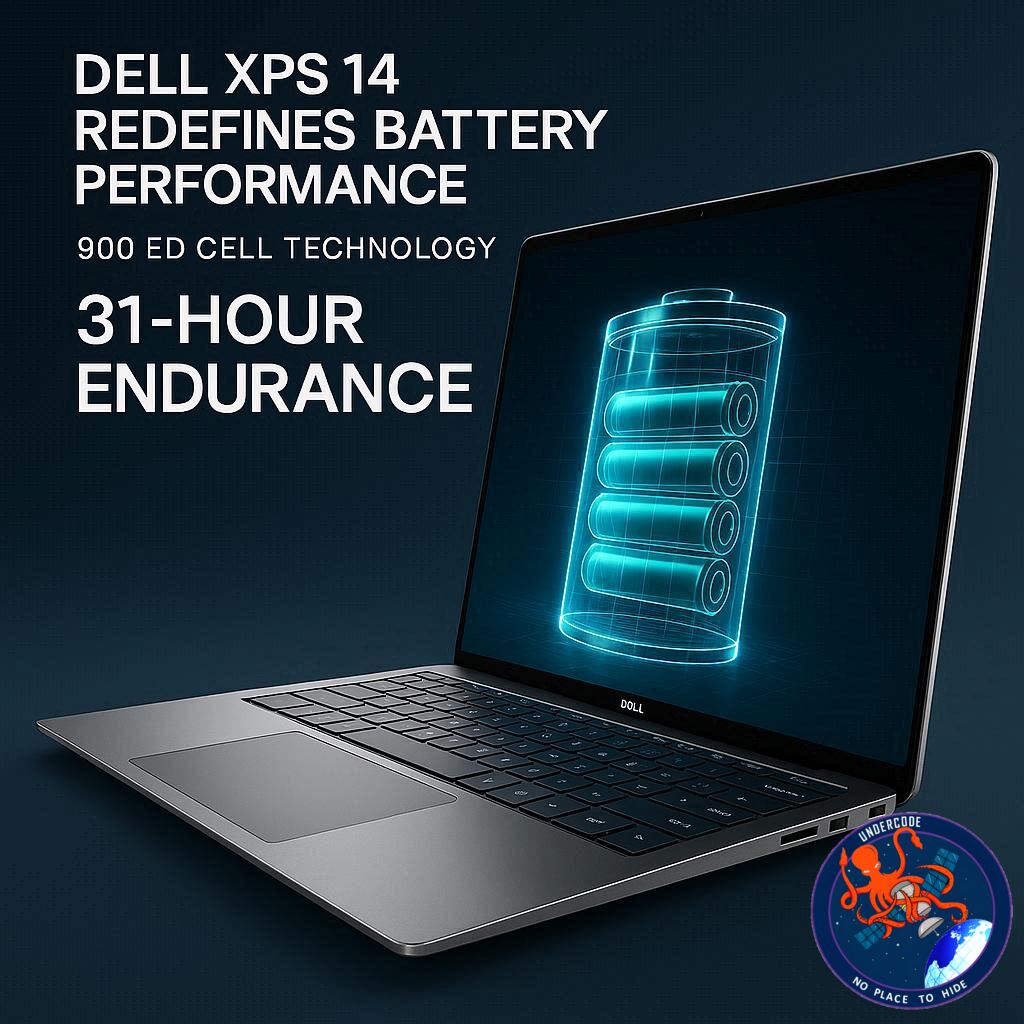
The modern laptop market is crowded with promises of “all-day battery life,” yet few devices genuinely deliver on that claim under real-world conditions. The new Dell XPS 14 changes that conversation. This is not merely a cosmetic refresh of a familiar product line. It represents a structural leap in energy efficiency, battery chemistry, display engineering, and processor design. From its ultra-dense 900ED battery cells to Intel’s next-generation Panther Lake processor, the XPS 14 is engineered with one clear objective: maximize performance without sacrificing longevity.
At first glance, the redesign is striking. The chassis is slimmer, cleaner, and more refined than any previous 14-inch XPS. But beneath the minimal exterior lies a deliberate focus on power efficiency. Dell has introduced industry-leading 900ED battery cells, raising the energy density ceiling in a compact 70Whr battery. The result is remarkable: up to 31 hours of Netflix streaming on the LCD model and up to 24 hours on the OLED version. Those figures are based on 4K streaming at 250 nits brightness, conditions that simulate realistic daily use rather than artificial idle tests.
Energy density is the core breakthrough. The “ED” in 900ED stands for energy density, and higher density means more stored energy within the same physical footprint. Instead of enlarging the battery and compromising portability, Dell packed more power into the same space. This engineering choice allows the XPS 14 to remain just 14.6mm thin while outperforming most rivals in endurance.
Battery life, however, is never the result of chemistry alone. The processor plays a central role. The XPS 14 runs on Intel’s Panther Lake architecture, part of the Core Ultra mobile lineup. Intel claims Panther Lake achieves Lunar Lake-level power efficiency while delivering Arrow Lake-class performance. In practical terms, that means stronger computing output without increasing power draw. It is a rare balance between speed and restraint.
Panther Lake also integrates powerful Xe3 graphics. These integrated GPUs are approximately 50% faster than the previous Xe2 generation found in Lunar Lake chips. While this does not transform the XPS 14 into a high-end gaming rig, it allows smooth 1080p gameplay at 60 frames per second in mainstream titles like Fortnite and Minecraft. More importantly, integrated graphics eliminate the extra power consumption associated with discrete GPUs, preserving battery life during both creative tasks and casual gaming.
Memory efficiency further strengthens the equation. Dell selected LPDDR5X RAM, known for lower power consumption compared to traditional memory modules. This helps reduce energy drain during multitasking, creative editing, or extended browsing sessions.
The display introduces another critical innovation. Dell implemented an advanced variable refresh rate system capable of dropping as low as 1Hz on the 2K LCD model. This is an industry-first level of flexibility in a laptop display. When viewing static content such as documents or images, the screen does not need to refresh at 120Hz. Lowering the refresh rate to 1Hz conserves energy dramatically. The OLED variant also benefits from dynamic VRR ranging between 20Hz and 120Hz, optimizing power use according to on-screen activity.
Beyond refresh rate optimization, the display itself is 30% more power-efficient than previous-generation XPS panels. Considering that screens and CPUs are typically the largest energy consumers in a laptop, this improvement contributes substantially to extended battery performance.
Thermal engineering also plays a role. The XPS 14 features the thinnest fans ever used in an XPS device. A redesigned bearing structure makes them slimmer yet more efficient. Their expanded surface area enhances airflow while reducing friction and power consumption. Improved cooling means the CPU can operate at optimal temperatures without ramping up energy usage. Efficient thermals translate into consistent performance and healthier long-term battery lifespan.
Portability benefits from these advances. Thanks to higher energy density, Dell reduced both thickness and weight. The new XPS 14 is nearly 20% lighter than its predecessor, creating a footprint smaller than many competing ultrabooks in its class. Increased mobility combined with extended endurance forms a compelling package for professionals on the move.
For creatives, the XPS 14 delivers sustained performance in demanding applications such as Adobe Photoshop and graphic design software. The combination of efficient processing, integrated Xe3 graphics, and long battery life allows extended editing sessions without tethering to a power outlet. For productivity users, extended video streaming or document work stretches comfortably beyond a standard workday.
The XPS 14 is not marketed as a hardcore gaming machine. Dedicated gaming laptops such as the Alienware Area-51 remain better suited for intensive AAA titles. Yet the XPS 14 demonstrates that thin-and-light notebooks no longer need to compromise entirely on graphics capability. Casual gaming, content creation, and productivity coexist without rapid battery depletion.
The broader achievement lies in integration. Battery chemistry, processor architecture, RAM selection, display engineering, and cooling design operate in harmony. Each component contributes incremental gains, and collectively they produce a laptop capable of genuine all-day endurance. Rather than chasing raw performance alone, Dell optimized systemic efficiency.
In a market where incremental updates are common, the XPS 14 stands out because its redesign addresses fundamental constraints. Longer battery life does not come at the cost of thickness, and stronger performance does not erode portability. The XPS 14 demonstrates that premium aesthetics and engineering substance can coexist.
What Undercode Say:
The Dell XPS 14 reflects a larger industry shift toward energy-first architecture. For years, laptop development focused primarily on processing benchmarks and graphics scaling. Battery improvements were incremental, often secondary to performance metrics. With the introduction of 900ED cells, Dell signals that battery density is now a competitive weapon.
Energy density innovation is particularly important because physical space inside thin laptops is limited. Manufacturers cannot simply enlarge batteries without sacrificing portability. By increasing density instead of size, Dell preserves slim design while extending endurance. This approach suggests that future ultrabooks will compete less on raw watt-hour capacity and more on chemical efficiency breakthroughs.
Panther Lake’s efficiency also illustrates Intel’s recalibrated strategy. The focus is no longer brute-force speed but performance per watt. Achieving Lunar Lake-level efficiency with Arrow Lake-class output indicates a maturing architecture optimized for mobility. For professionals, this means stable performance under sustained loads rather than short bursts followed by throttling.
Variable refresh rate dropping to 1Hz is arguably as important as the battery itself. Displays are persistent power drains. Allowing the panel to scale refresh dynamically down to near-static levels eliminates unnecessary energy waste during reading, editing, or browsing. This is a subtle innovation, yet it compounds battery savings throughout the day.
Thermal efficiency is another underrated factor. Cooler components draw less power and experience reduced degradation over time. By miniaturizing fan components while expanding airflow efficiency, Dell balances acoustics, thermals, and endurance. Battery longevity is not only about daily hours but about lifespan health across years of use.
Integrated graphics strategy is equally pragmatic. Instead of including a discrete GPU that would inflate power demands and thickness, Dell optimized integrated Xe3 performance. Casual gaming at 1080p and creative acceleration become feasible without compromising endurance. This design philosophy aligns with the realities of most users, who prioritize mobility over extreme gaming.
Portability improvements further amplify the product’s positioning. Nearly 20% weight reduction transforms usability for travelers and remote professionals. Extended battery life combined with lighter build directly influences purchasing decisions in the premium ultrabook segment.
From a competitive standpoint, achieving up to 31 hours of streaming sets a new narrative benchmark. Even if real-world mixed usage falls below laboratory conditions, surpassing the 24-hour psychological threshold changes consumer expectations. Battery anxiety becomes less relevant.
The XPS 14 signals that premium laptops are entering an efficiency renaissance. Rather than escalating wattage and compensating with larger batteries, manufacturers are engineering synergy between components. Dell’s approach may influence broader design standards across the industry.
Ultimately, the XPS 14 is less about a single specification and more about integration discipline. Every subsystem contributes to the same goal. When hardware design converges around energy efficiency without sacrificing power, the result is a laptop that feels genuinely future-ready.
Fact Checker Results
✅ The XPS 14 introduces 900ED battery cells with industry-leading energy density.
✅ Dell claims up to 31 hours of Netflix streaming on the LCD model under tested conditions.
✅ Panther Lake processors emphasize improved performance-per-watt efficiency over prior generations.
Prediction
📊 Battery density innovation will become the primary battleground in premium ultrabooks over the next two years.
📊 Variable refresh rate scaling to ultra-low Hz levels will expand across competing brands seeking endurance gains.
📊 Integrated graphics efficiency will increasingly replace entry-level discrete GPUs in thin-and-light designs.
▶️ Related Video (82% Match):
🕵️📝✔️Let’s dive deep and fact‑check.
References:
Reported By: www.techradar.com
Extra Source Hub (Possible Sources for article):
https://www.quora.com/topic/Technology
Wikipedia
OpenAi & Undercode AI
Image Source:
Unsplash
Undercode AI DI v2
Bing
🔐JOIN OUR CYBER WORLD [ CVE News • HackMonitor • UndercodeNews ]
📢 Follow UndercodeNews & Stay Tuned:
𝕏 formerly Twitter 🐦 | @ Threads | 🔗 Linkedin | 🦋BlueSky | 🐘Mastodon


