
Listen to this Post
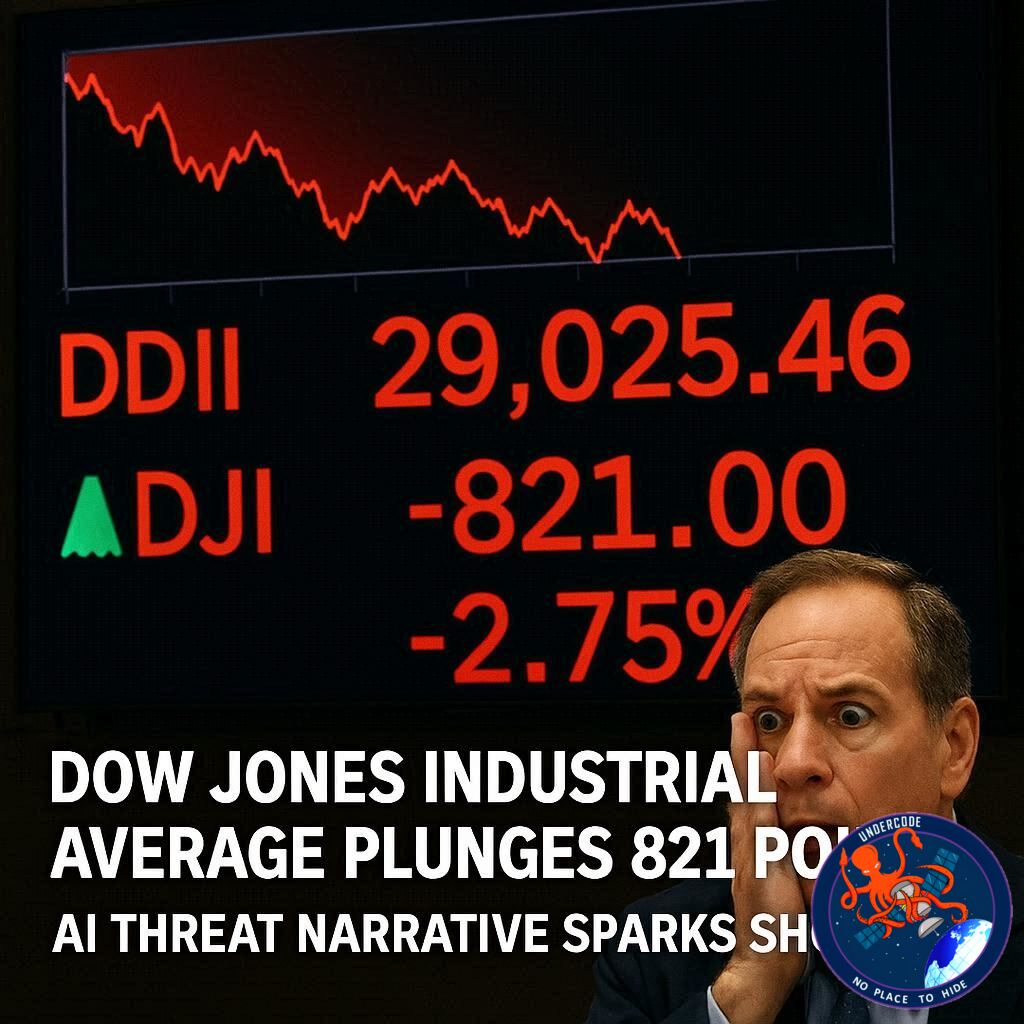
A Sudden Market Jolt Driven by Fear and Uncertainty
Wall Street endured a dramatic selloff as the Dow Jones Industrial Average tumbled 821 points, closing at 48,804. The sharp decline reflected more than routine volatility. Investors were already navigating mounting uncertainty surrounding tariff policies under the Trump administration, but a new catalyst intensified the pressure. Concerns that artificial intelligence could fundamentally disrupt existing business models rippled through the market, accelerating the downward momentum. A single research report built around a “thought experiment” about AI’s long-term impact became an unexpected trigger, fueling debate and amplifying investor anxiety.
Market Selloff Deepens Amid Trade Policy Uncertainty
The trading session was marked by compounding negative factors. Ongoing ambiguity regarding US tariff policy unsettled investors who fear prolonged trade tensions could strain global supply chains and corporate profitability. This macroeconomic backdrop created a fragile environment where any additional shock could magnify downside risks. When AI-related fears entered the equation, sentiment quickly deteriorated, and sellers gained the upper hand across multiple sectors.
AI Threat Narrative Gains Traction on Wall Street
The market’s reaction was not sparked by concrete regulatory action or immediate technological breakthroughs. Instead, it was fueled by a thought experiment presented in a widely discussed report. The document explored scenarios in which rapid advancements in artificial intelligence could destabilize established industries, compress profit margins, and accelerate job displacement. Though theoretical in nature, the narrative gained enough traction to shift short-term market psychology.
Technology shares, already sensitive to valuation pressures, faced intensified scrutiny. Investors began reassessing which companies stand to benefit from AI integration and which could see their core operations eroded. The shift from enthusiasm about AI-driven productivity to concern over structural disruption introduced a volatile dynamic into equity pricing.
Investor Psychology Amplifies the Shock
Markets often react not only to tangible data but also to narratives. The AI “threat theory” exemplified how quickly sentiment can change when a compelling storyline emerges. Traders and institutional investors alike moved to reduce exposure, wary that earnings forecasts may not fully account for the pace of technological transformation.
This behavioral shift highlights a broader reality in modern markets. As artificial intelligence evolves, it generates both opportunity and existential risk. Investors struggle to quantify its long-term economic implications, leading to sharp swings whenever new interpretations surface.
Broader Implications for Corporate America
Beyond the immediate stock decline, the episode underscores a structural tension facing corporate America. On one hand, AI promises efficiency gains, cost reductions, and innovation. On the other, it threatens to compress competitive advantages that companies have built over decades. Industries reliant on intellectual property, human expertise, or data-driven services may find their moats narrowing faster than anticipated.
The selloff reflects a market attempting to price in not just quarterly earnings risk, but the possibility of fundamental change. When uncertainty spans trade policy, geopolitical tensions, and technological disruption simultaneously, volatility becomes almost inevitable.
What Undercode Say:
The 821-point drop in the Dow Jones Industrial Average is not merely a reaction to headlines. It signals a deeper shift in how markets interpret technological acceleration. Artificial intelligence has long been framed as a growth catalyst, driving valuations higher in sectors tied to cloud computing, semiconductors, and automation. What changed is the framing. The narrative pivoted from “AI as opportunity” to “AI as destabilizer,” and markets rarely handle narrative inversions calmly.
The thought experiment that triggered the selloff did not introduce new technology. It introduced doubt. That distinction matters. Financial markets price future expectations, and when expectations swing from expansion to erosion, capital reallocates swiftly. Investors began asking harder questions. If AI systems can replicate cognitive labor at scale, what happens to service-based revenue models? If productivity surges, will pricing power collapse due to hyper-competition? These are structural concerns, not cyclical ones.
Trade policy uncertainty acted as dry tinder. Tariffs influence supply chains, input costs, and corporate guidance. When companies face rising geopolitical risk, their resilience depends on stable demand and innovation clarity. Add AI disruption to the mix, and strategic planning becomes more complex. Investors dislike complexity when it cannot be modeled reliably.
Another layer to consider is valuation sensitivity. After years of strong equity performance, especially in technology-driven sectors, valuations sit at levels that assume continued earnings growth. Any narrative suggesting margin compression or structural upheaval challenges those assumptions. In high-valuation environments, even theoretical threats can trigger sharp corrections.
There is also a generational dimension. Artificial intelligence differs from previous technological waves because of its speed and scope. Unlike industrial automation, which primarily affected physical labor, AI targets cognitive functions. That expands the circle of disruption to finance, healthcare, legal services, media, and beyond. Markets are grappling with a transformation that does not neatly fit historical precedent.
From a macro perspective, the Dow’s plunge may represent an early phase of repricing rather than a singular event. Capital markets are beginning to differentiate between AI enablers and AI casualties. Companies that control data infrastructure, computing power, or proprietary models could consolidate power. Firms dependent on traditional human-driven processes may face margin pressure.
The psychological component should not be underestimated. Thought experiments can be powerful because they bypass immediate data constraints. They invite investors to imagine extreme but plausible futures. Once such scenarios enter mainstream discourse, even conservative portfolio managers must consider them in risk assessments.
Ultimately, the episode reveals how interconnected modern market risks have become. Trade tensions, technological acceleration, monetary policy, and investor sentiment form a tightly woven web. A disturbance in one area can cascade rapidly across asset classes. The Dow’s sharp fall reflects this interconnected fragility.
Yet it also underscores opportunity. Volatility often marks transition points. Markets reprice, capital rotates, and new leaders emerge. AI will not uniformly destroy value. It will redistribute it. The challenge for investors lies in identifying where the value migrates next.
Fact Checker Results
AI-related concerns were linked to the Dow’s 821-point decline during the session. ✅
The drop occurred amid ongoing uncertainty surrounding US tariff policy. ✅
The AI trigger was based on a theoretical report rather than new legislation or regulation. ✅
Prediction
📊 Markets may experience continued volatility as AI disruption narratives evolve.
📊 Companies positioned as AI infrastructure leaders could attract renewed capital inflows.
📊 Sectors vulnerable to automation may face sustained valuation pressure in the coming quarters.
▶️ Related Video (80% Match):
🕵️📝✔️Let’s dive deep and fact‑check.
References:
Reported By: xtechnikkeicom_ad99e9052ca466f52c236315
Extra Source Hub (Possible Sources for article):
https://www.reddit.com/r/AskReddit
Wikipedia
OpenAi & Undercode AI
Image Source:
Unsplash
Undercode AI DI v2
Bing
🔐JOIN OUR CYBER WORLD [ CVE News • HackMonitor • UndercodeNews ]
📢 Follow UndercodeNews & Stay Tuned:
𝕏 formerly Twitter 🐦 | @ Threads | 🔗 Linkedin | 🦋BlueSky | 🐘Mastodon


