
Listen to this Post
Introduction: When Security Vendors Become the Weakest Link
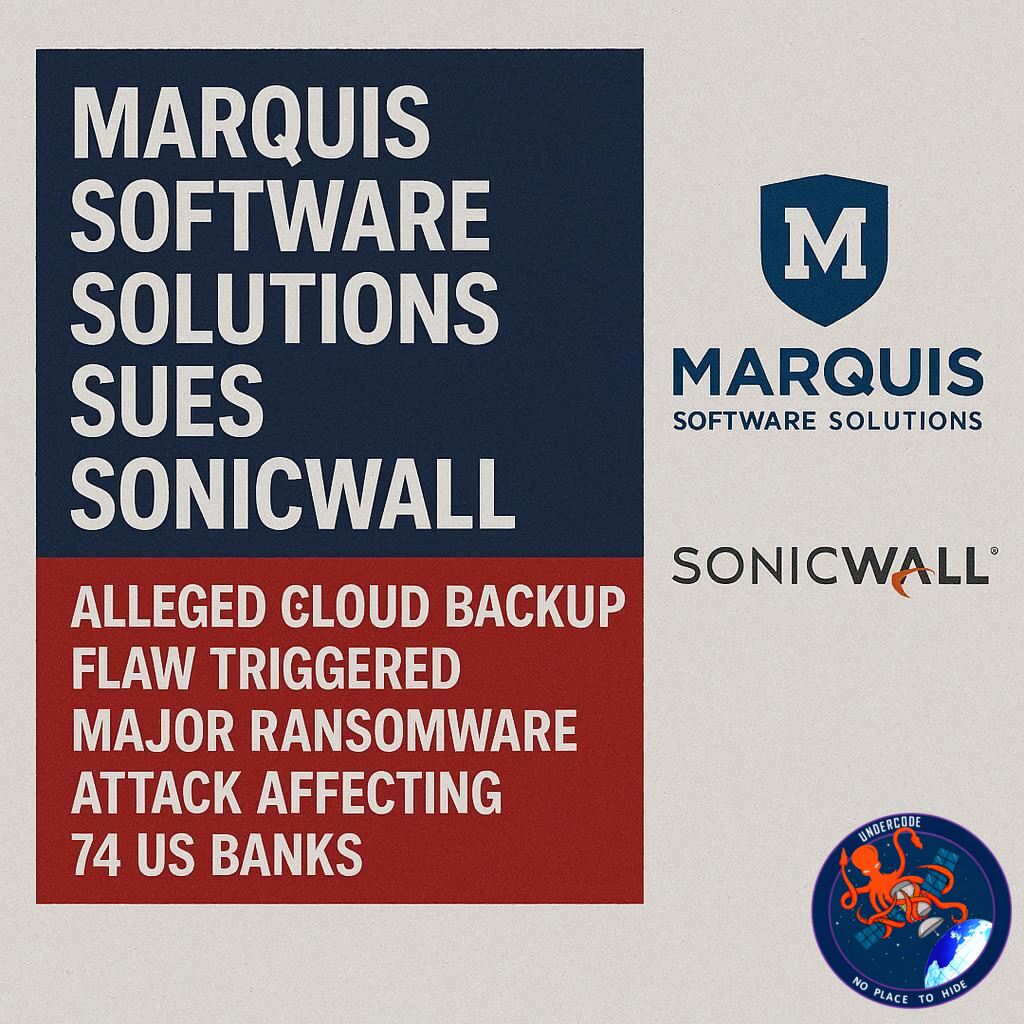
In a lawsuit that could reshape accountability in the cybersecurity industry, Marquis Software Solutions has taken legal action against SonicWall, accusing the firewall vendor of gross negligence and misrepresentation. The complaint centers on a ransomware attack that allegedly began with a flaw in SonicWall’s cloud backup infrastructure and ultimately disrupted operations across 74 U.S. banks.
This case is not just another post-breach blame game. It raises deeper questions about vendor responsibility, cloud backup security, and whether customers can truly trust the platforms designed to protect them. At stake are millions in damages, dozens of lawsuits, and reputational fallout that could reverberate far beyond the companies involved.
The Ransomware Incident That Sparked Legal Action
On August 14, 2025, hackers infiltrated Marquis Software Solutions’ network in a ransomware attack that the company says began with the compromise of a SonicWall firewall.
The attackers reportedly exfiltrated files containing highly sensitive personal information provided by Marquis’ business partners.
The stolen data included names, home addresses, phone numbers, Social Security numbers, Taxpayer Identification Numbers, and financial account details.
Marquis, a major provider of data analytics, CRM tools, compliance reporting, and digital marketing services, serves more than 700 banks, credit unions, and mortgage lenders.
The scale of exposure therefore extended well beyond Marquis itself, affecting dozens of financial institutions across the United States.
Initially, it was believed that the breach resulted from an unpatched firewall vulnerability.
However, after further investigation, Marquis concluded that the attackers had exploited something far more concerning.
According to the complaint filed in January 2026, the hackers leveraged configuration data extracted from SonicWall’s cloud backup infrastructure.
The alleged vulnerability stemmed from a February 2025 API code change in the MySonicWall cloud backup service.
This change reportedly introduced a security gap that allowed unauthorized access to firewall configuration backup files stored in SonicWall’s cloud.
Those backup files contained AES-256 encrypted credentials, configuration data, and even MFA scratch codes.
The presence of MFA scratch codes in accessible backups is particularly alarming, as such codes are often designed as emergency access mechanisms.
SonicWall disclosed the incident three weeks after discovering it.
At first, the company estimated that around 5 percent of its customer base had been impacted.
Later, it reportedly confirmed that all clients were affected.
An investigation conducted by Mandiant concluded that the attack was carried out by state-sponsored hackers.
Marquis maintains that its firewall was fully updated at the time of the breach.
Multi-factor authentication was enabled.
Additional security controls were in place.
Despite these measures, the attackers allegedly bypassed protections using information exposed in the cloud backup breach.
Marquis claims it directly contacted SonicWall about the MFA bypass.
According to the lawsuit, the vendor withheld critical information and did not adequately respond to the inquiry.
The financial consequences have been severe.
Marquis states that it has suffered customer losses, reputational harm, lost revenue, and diminished enterprise value.
The company is now defending more than 36 consumer class action lawsuits tied to the ransomware attack.
In its complaint, Marquis seeks monetary damages, indemnification, contribution for potential judgments, attorneys’ fees, and equitable relief.
The Cloud Backup Risk No One Talks About
Cloud backups are typically marketed as a safety net.
They are meant to protect against device failure, misconfiguration, or disaster.
Yet this case suggests that backup systems can become a high-value target themselves.
If configuration files contain encrypted credentials and MFA recovery codes, they effectively represent a blueprint to the protected network.
Even strong encryption such as AES-256 cannot compensate for improper access controls.
Security often fails not because of weak cryptography, but because of flawed implementation.
API-level changes are particularly dangerous.
A small coding oversight in a cloud service can expose thousands of customers simultaneously.
Unlike on-premises vulnerabilities, cloud infrastructure flaws scale instantly.
If SonicWall’s entire client base was ultimately affected, that signals systemic exposure rather than isolated misconfiguration.
Vendor Accountability in the Cybersecurity Industry
The lawsuit also touches on a sensitive industry issue: how much responsibility should security vendors bear when their systems fail?
Organizations rely on firewalls as perimeter defense systems.
When those systems are compromised through a vendor-controlled cloud service, the liability equation changes.
Marquis argues that it maintained updated firmware and enabled MFA.
If true, that suggests the breach vector existed outside the customer’s direct control.
This shifts the focus to vendor-side cloud security practices.
The delay in disclosure is another critical factor.
Three weeks in cybersecurity is an eternity.
Threat actors can weaponize exposed data within hours.
Transparency timelines often determine whether downstream damage can be contained.
The Domino Effect Across 74 Banks
Financial institutions operate under strict regulatory frameworks.
When a service provider suffers a breach, regulators inevitably scrutinize third-party risk management practices.
The exposure of personal and financial information across dozens of banks amplifies the stakes.
Consumer trust is fragile in the banking sector.
Even indirect breaches can erode confidence.
The ripple effects may extend to compliance audits, insurance claims, and contract renegotiations.
For Marquis, defending 36 class action lawsuits could become more costly than the initial ransom incident itself.
For SonicWall, the reputational damage could be equally significant if the allegations are proven accurate.
What Undercode Say:
This lawsuit represents a turning point in how enterprises evaluate security vendors.
For years, organizations have been told to adopt layered defenses and enable MFA.
Marquis claims it did exactly that.
If a vendor’s cloud infrastructure undermined those defenses, then traditional security best practices were not enough.
The deeper issue is centralization of trust.
Modern cybersecurity increasingly depends on cloud-managed services.
When backup repositories, configuration files, and authentication mechanisms are stored in vendor clouds, customers inherit invisible dependencies.
The MySonicWall case illustrates how a backend API modification can quietly expand the attack surface.
Security architecture must assume that backups are as sensitive as production systems.
MFA scratch codes stored in accessible backups introduce a paradox.
They exist to recover access, yet in the wrong hands they become bypass tools.
Vendors must reevaluate what data is included in automated backups and whether sensitive recovery artifacts should ever be cloud-stored.
Disclosure timing also deserves scrutiny.
A three-week delay can undermine customer response strategies.
In critical infrastructure sectors like banking, even hours matter.
State-sponsored involvement further raises the stakes.
Nation-state actors typically pursue long-term strategic objectives rather than opportunistic ransomware campaigns.
This suggests reconnaissance, data harvesting, or geopolitical motives could have been involved.
The legal outcome may redefine indemnification clauses in cybersecurity contracts.
Enterprises may demand stronger guarantees, stricter breach notification timelines, and clearer shared responsibility models.
Cyber insurance providers are also watching closely.
If vendor cloud flaws become a common breach vector, underwriting standards will tighten.
Another important lesson is cloud visibility.
Customers often lack deep insight into vendor-managed backup systems.
Independent third-party audits of cloud backup infrastructure may soon become standard contractual requirements.
The broader market impact could include increased segmentation of backup environments.
Instead of centralized global repositories, vendors may move toward regionally isolated storage architectures.
This case could also influence regulatory oversight.
Financial regulators may introduce stricter third-party security validation rules for service providers.
Ultimately, this lawsuit is not just about damages.
It is about whether security vendors can be held financially accountable when their own infrastructure becomes the attack vector.
The outcome may set precedent for the next decade of cybersecurity litigation.
Fact Checker Results
✅ Marquis filed a lawsuit alleging negligence and misrepresentation linked to a ransomware attack affecting 74 banks.
✅ The alleged breach involved exposure of firewall configuration backups stored in a vendor cloud environment.
❌ No court ruling has yet determined liability; the claims remain allegations pending legal proceedings.
Prediction
🔮 Vendor contracts will increasingly include stricter breach disclosure timelines and indemnification clauses.
🔮 Financial regulators may impose tighter third-party cloud security auditing requirements for service providers.
🔮 Security vendors will redesign backup architectures to minimize storage of sensitive authentication recovery data.
🕵️📝✔️Let’s dive deep and fact‑check.
References:
Reported By: www.bleepingcomputer.com
Extra Source Hub (Possible Sources for article):
https://www.discord.com
Wikipedia
OpenAi & Undercode AI
Image Source:
Unsplash
Undercode AI DI v2
Bing
🔐JOIN OUR CYBER WORLD [ CVE News • HackMonitor • UndercodeNews ]
📢 Follow UndercodeNews & Stay Tuned:
𝕏 formerly Twitter 🐦 | @ Threads | 🔗 Linkedin | 🦋BlueSky | 🐘Mastodon


