
Listen to this Post
Introduction: Innovation Meets a Brutal Reality
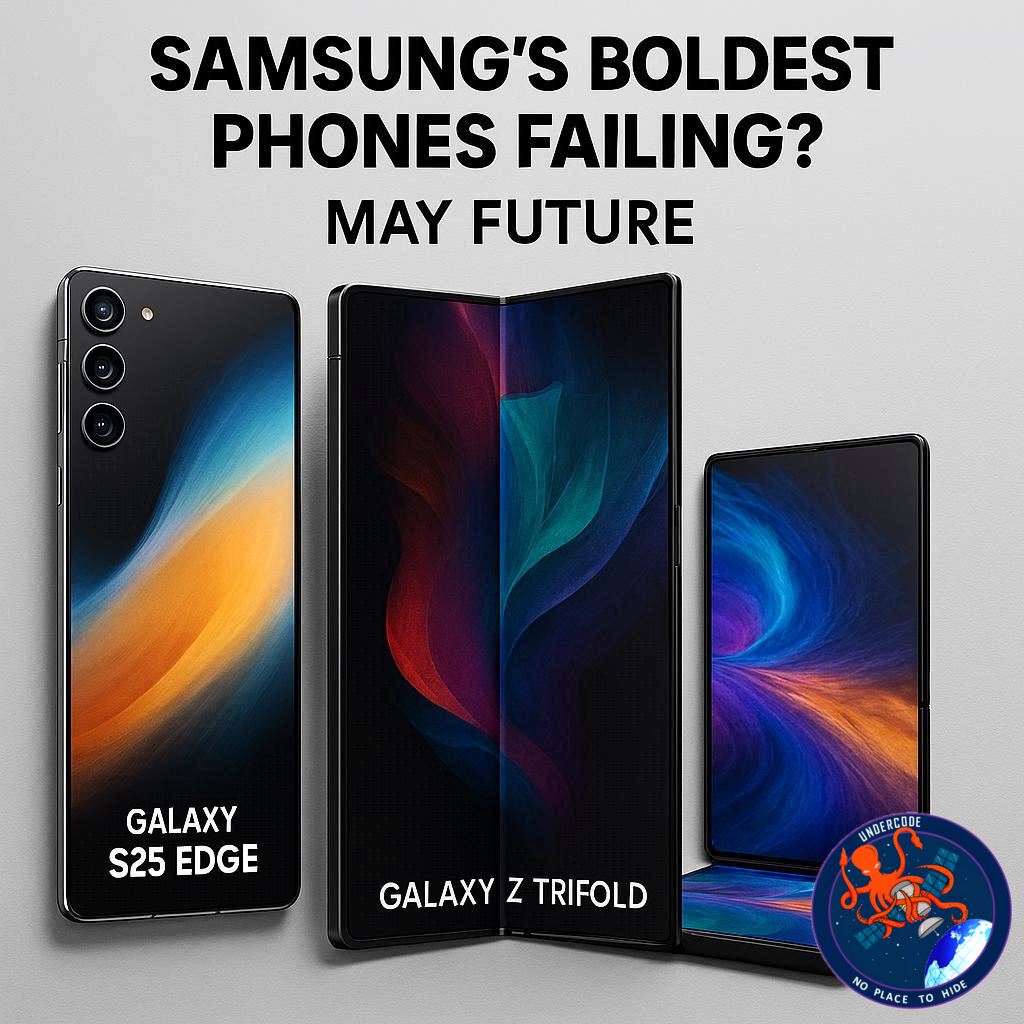
Samsung has never been afraid to experiment. From curved displays to foldable screens, the company has consistently tried to redefine what a smartphone can be. But innovation alone doesn’t guarantee success. Two of Samsung’s most ambitious devices—the ultra-thin Galaxy S25 Edge and the futuristic Galaxy Z TriFold—have exposed a harsh truth about the market: consumers don’t always reward bold ideas, especially when they come with compromises and sky-high prices.
Background: Samsung’s Experimental Leap
Last year, Samsung introduced two radical devices designed to showcase its engineering dominance. The Galaxy S25 Edge arrived as the thinnest smartphone the company had ever produced, measuring just 5.8mm. Meanwhile, the Galaxy Z TriFold pushed foldable technology even further, transforming from a standard phone into a tablet-sized device through a complex tri-fold mechanism. Both products were technical marvels—but commercial success told a very different story.
Design Philosophy: Thinness vs. Practicality
The Galaxy S25 Edge was built around a simple but risky idea: extreme thinness as a premium feature. Much like Apple’s minimalist design experiments, Samsung bet that consumers would value sleekness over endurance. However, ultra-thin designs inevitably come with trade-offs, particularly in battery capacity and camera hardware—two areas where buyers are increasingly demanding more, not less.
Sales Reality: A Harsh Wake-Up Call
In an interview with Bloomberg, Samsung MX Chief Operating Officer Won-Joon Choi confirmed what many analysts suspected: sales of the Galaxy S25 Edge were significantly lower than other Galaxy S-series models. As a result, Samsung is now re-evaluating whether the Edge lineup even has a future.
Executive Perspective: Uncertainty at the Top
Choi acknowledged that consumer preferences vary widely and emphasized that no final decision has been made regarding a successor. The Edge concept hasn’t been canceled—but it’s clearly on thin ice. Internally, Samsung is weighing whether there is enough long-term demand for a product category defined more by aesthetics than everyday usability.
The Apple Comparison: A Shared Problem
Samsung’s struggle isn’t unique. Reports suggest Apple faced similar issues with its ultra-thin iPhone Air concept, as buyers showed little enthusiasm for paying premium prices for devices that sacrifice battery life and camera performance. This parallel reinforces a broader industry lesson: mainstream consumers prioritize reliability and longevity over design extremes.
The Galaxy Z TriFold: Engineering Without an Audience
The Galaxy Z TriFold represents a different challenge altogether. Choi openly admitted—half jokingly—that he was initially hesitant to approve the project due to its immense complexity and reliance on custom components. The device was never designed for mass adoption; it was a statement piece meant to prove Samsung’s technical superiority.
Price Barrier: Innovation Out of Reach
That statement came at a cost. The Galaxy Z TriFold’s extremely high price placed it far beyond the reach of average consumers. While it succeeded in attracting attention, it failed to generate meaningful sales volume. This has led Samsung executives to openly debate whether developing a successor makes any financial sense.
Current Status: No Successors in Development
As of now, Samsung is not actively developing follow-up models for either the Galaxy S25 Edge or the Galaxy Z TriFold. Both product lines remain under internal review, with no clear roadmap forward. Technical brilliance alone is no longer enough to justify continued investment.
the Original
Samsung launched two highly experimental smartphones—the ultra-thin Galaxy S25 Edge and the foldable Galaxy Z TriFold—to showcase its technological leadership. Despite the attention they generated, both devices suffered from weak sales compared to other Galaxy S and Z series phones. Samsung executives confirmed that the Galaxy S25 Edge underperformed due to consumer reluctance to accept compromises in battery life and camera quality for a thinner design. Similar issues reportedly affected Apple’s ultra-thin phone efforts, suggesting a broader market trend. The Galaxy Z TriFold, while technically impressive, faced a different obstacle: an extremely high price that limited its appeal to a niche audience. Samsung pursued the tri-fold device primarily to create a new product category and demonstrate engineering capabilities, not to dominate sales charts. Now, the company is reconsidering whether either product line deserves a successor, and no active development is currently underway.
What Undercode Say:
Samsung’s situation highlights a growing disconnect between innovation theater and real-world consumer priorities. The Galaxy S25 Edge proves that thinness alone is no longer a compelling selling point in a market obsessed with battery endurance, camera versatility, and long-term reliability. Users are willing to pay premium prices—but only when the premium delivers tangible daily benefits, not aesthetic bragging rights.
The Galaxy Z TriFold, on the other hand, exposes the limits of experimental hardware as a commercial product. It functions more as a concept car than a mass-market device: impressive, aspirational, and impractical. Samsung likely understood this from the beginning, but the lack of a clear transition from showcase technology to scalable product is now evident.
More broadly, these failures suggest the smartphone market is entering a phase of conservative maturity. Incremental improvements in AI, battery efficiency, and software ecosystems are resonating more than radical form-factor changes. Samsung’s willingness to experiment remains a strength—but without a clearer alignment to consumer value, such experiments risk becoming expensive dead ends rather than stepping stones to the future.
🔍 Fact Checker Results
Sales Performance Reality ✅ Confirmed by Samsung executives that Galaxy S25 Edge sales were lower than other Galaxy S models.
Development Status ✅ Samsung is not actively developing successors for either device at this time.
Market Assumptions ❌ No evidence suggests strong consumer demand for ultra-thin or tri-fold phones at premium prices.
📊 Prediction
Samsung will quietly phase out the Galaxy S Edge concept while keeping tri-fold technology in long-term research. Future innovation will likely focus on AI-driven features and battery breakthroughs rather than radical hardware designs, as the company pivots back toward what mainstream buyers are actually willing to pay for.
🕵️📝✔️Let’s dive deep and fact‑check.
References:
Reported By: www.sammobile.com
Extra Source Hub (Possible Sources for article):
https://www.instagram.com
Wikipedia
OpenAi & Undercode AI
Image Source:
Unsplash
Undercode AI DI v2
Bing
🔐JOIN OUR CYBER WORLD [ CVE News • HackMonitor • UndercodeNews ]
📢 Follow UndercodeNews & Stay Tuned:
𝕏 formerly Twitter 🐦 | @ Threads | 🔗 Linkedin | 🦋BlueSky | 🐘Mastodon


