
Listen to this Post
 A Turning Point for Retail and Mobile Innovation in Early March
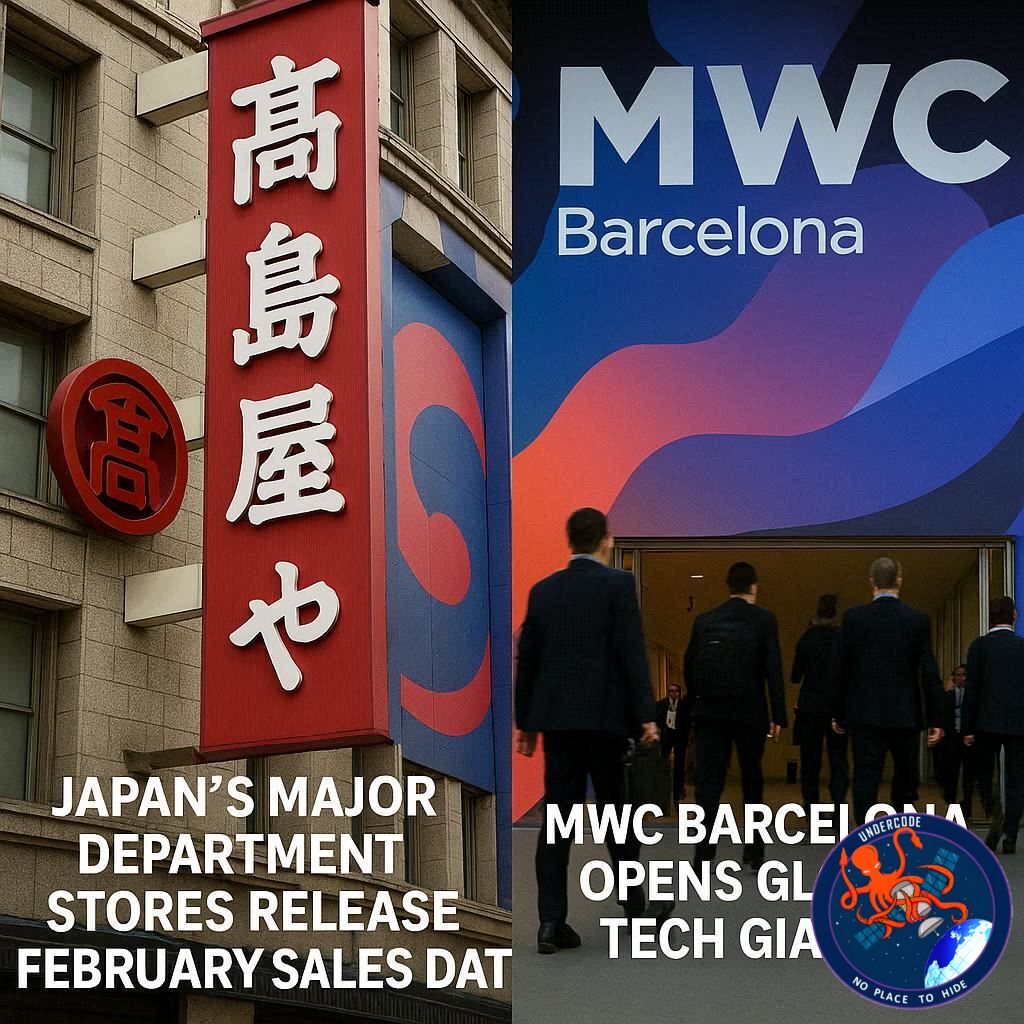
March 2 marks a pivotal moment in both Japan’s retail sector and the global technology industry. On one side, four of Japan’s largest department store groups are releasing their preliminary February same-store sales figures, offering a real-time snapshot of consumer sentiment. On the other, the world’s biggest mobile industry exhibition, MWC, opens in Barcelona, gathering telecom giants, digital disruptors, and hardware innovators under one roof. Together, these developments paint a broader picture of how consumption and connectivity are evolving in 2026.
February Sales Figures from Japan’s Retail Giants Signal Consumer Resilience
After 3:30 p.m., four major department store operators, including Mitsukoshi Isetan Holdings and Takashimaya, will publish their preliminary February same-store sales data. These figures are closely watched by analysts as they reflect not only domestic spending patterns but also inbound tourism trends and luxury consumption dynamics.
In January, all four companies reported year-on-year revenue growth compared with the same month in the previous fiscal year. This broad-based increase surprised some market observers who had anticipated a more cautious start to the year. Instead, department stores experienced strong momentum across several key categories.
Luxury brands were a primary growth driver. Anticipation of upcoming price hikes triggered a wave of “rush demand,” with consumers accelerating purchases of high-end handbags, jewelry, and watches. Such pre-price increase surges are not uncommon in Japan’s luxury retail market, where price sensitivity is intertwined with brand loyalty and long-term value perception.
Seasonal winter apparel also performed better than expected. Cold-weather items, supported by effective merchandising strategies and improved inventory planning, contributed meaningfully to overall sales. Promotional events and in-store exhibitions further enhanced foot traffic, reinforcing the department store model as more than just a shopping venue but a curated lifestyle space.
One headwind, however, came from declining duty-free sales. A request from the Chinese government urging its citizens to refrain from overseas travel negatively impacted inbound tourism spending, particularly from Chinese visitors who traditionally account for a substantial share of tax-free purchases. Despite this, the combined effect of domestic demand and event-driven sales managed to offset the drop in tax-free revenue.
February’s results will therefore reveal whether January’s growth was a temporary spike driven by pre-price hike demand, or whether consumer confidence remains strong enough to sustain momentum into late winter.
MWC Barcelona Opens as Global Telecom and Tech Leaders Gather
At the same time, the global technology spotlight shifts to Spain as Mobile World Congress opens in Barcelona. Widely regarded as the world’s largest mobile industry exhibition, MWC serves as a stage for unveiling new devices, next-generation network solutions, AI-powered services, and strategic partnerships.
Japanese telecom players including the NTT Group, KDDI, and Rakuten Group are participating, highlighting Japan’s ongoing investment in digital infrastructure and platform ecosystems.
Global technology powerhouses such as Google and Huawei are also exhibiting, underlining the international scope of the event. With discussions likely to revolve around AI integration, 5G evolution, private networks, and edge computing, MWC continues to act as a barometer for the direction of the mobile economy.
The exhibition runs through March 5, drawing industry leaders, policymakers, and analysts who are eager to gauge competitive positioning in a rapidly transforming tech landscape.
Retail and Telecom: Two Sides of a Changing Consumption Model
Although department store sales figures and a mobile technology trade show may appear unrelated at first glance, they are deeply interconnected through the lens of modern consumption. Retail performance increasingly depends on digital integration, data analytics, and omnichannel engagement. Meanwhile, telecom infrastructure and mobile platforms enable the very ecosystems that drive both physical and online shopping behavior.
The performance of luxury brands in Japanese department stores reflects not only economic factors but also the power of digital marketing, social media influence, and mobile payment systems. Similarly, telecom companies exhibiting at MWC are pushing innovations that will shape how consumers discover, compare, and purchase products in the years ahead.
Together, these developments signal that consumer resilience and technological acceleration are unfolding simultaneously.
What Undercode Say:
Retail Strength Masks Structural Shifts Beneath the Surface
The January growth reported by Japan’s leading department stores should not be interpreted as simple proof of a full retail revival. A significant portion of the surge came from anticipatory buying ahead of price increases. This behavior suggests strategic consumers responding rationally to inflationary signals rather than a pure expansion in discretionary spending power.
Luxury Demand as a Psychological Hedge
Luxury purchases before price hikes often function as a form of psychological hedge. Consumers justify high-end acquisitions by framing them as investments against future inflation. In Japan, where brand trust and resale value remain strong, this mindset can temporarily amplify sales. Yet such demand can also cannibalize future months, potentially flattening growth once the price increases take effect.
Inbound Tourism Volatility Remains a Structural Risk
The decline in duty-free sales due to Chinese travel restraint highlights a persistent vulnerability. Japanese department stores have, over the past decade, integrated inbound tourism into their core revenue models. Any geopolitical or regulatory disruption affecting cross-border mobility can rapidly impact performance. February’s data will show whether domestic consumption is strong enough to sustainably compensate for reduced tourist flows.
Department Stores Reinventing Their Role
Another overlooked factor is experiential retail. Events, curated exhibitions, and limited-time showcases are transforming department stores into destinations rather than mere transactional spaces. This strategy aligns with broader global trends in brick-and-mortar retail survival, where engagement and exclusivity matter more than sheer product volume.
MWC as a Window into Retail’s Digital Future
The opening of MWC in Barcelona is not just a telecom story. It is also a retail infrastructure story. The rollout of advanced 5G capabilities, AI-driven personalization tools, and integrated payment ecosystems directly shapes how department stores operate. Data analytics and mobile connectivity determine inventory optimization, targeted marketing, and customer journey mapping.
Japanese Telecoms Navigating Global Competition
Japanese firms such as NTT Group, KDDI, and Rakuten Group are competing in a global arena where scale and platform dominance are critical. Their presence at MWC signals ambition beyond domestic markets. Yet competition from companies like Google and Huawei underscores the intense pressure in AI-enabled services, cloud integration, and network virtualization.
The Broader Economic Context
Retail sales and telecom innovation both unfold against a backdrop of shifting monetary policies and global trade dynamics. If inflation persists, rush demand patterns may become cyclical rather than exceptional. At the same time, digital infrastructure investments may determine which markets capture long-term growth.
Convergence of Physical and Digital Economies
Ultimately, the release of February sales figures and the opening of MWC illustrate a convergence. Physical department stores depend on digital ecosystems, and telecom networks increasingly monetize through commerce-driven applications. The boundary between retail and technology is dissolving, replaced by an integrated consumer economy shaped by data, mobility, and behavioral insights.
Fact Checker Results
✅ Four major Japanese department store groups are scheduled to release February same-store sales data.
✅ January sales showed year-on-year growth across all four major operators.
✅ MWC in Barcelona is one of the world’s largest mobile industry exhibitions, featuring global telecom and technology companies.
Prediction
📊 Retail sales in March may show stabilization rather than continued acceleration if pre-price hike demand subsides.
📊 AI-driven retail solutions and 5G network enhancements unveiled at MWC are likely to deepen integration between physical stores and digital platforms in 2026.
🕵️📝✔️Let’s dive deep and fact‑check.
References:
Reported By: xtechnikkeicom_3296facab11f0a230c25f2c5
Extra Source Hub (Possible Sources for article):
https://www.reddit.com/r/AskReddit
Wikipedia
OpenAi & Undercode AI
Image Source:
Unsplash
Undercode AI DI v2
Bing
🔐JOIN OUR CYBER WORLD [ CVE News • HackMonitor • UndercodeNews ]
📢 Follow UndercodeNews & Stay Tuned:
𝕏 formerly Twitter 🐦 | @ Threads | 🔗 Linkedin | 🦋BlueSky | 🐘Mastodon


