
Listen to this Post
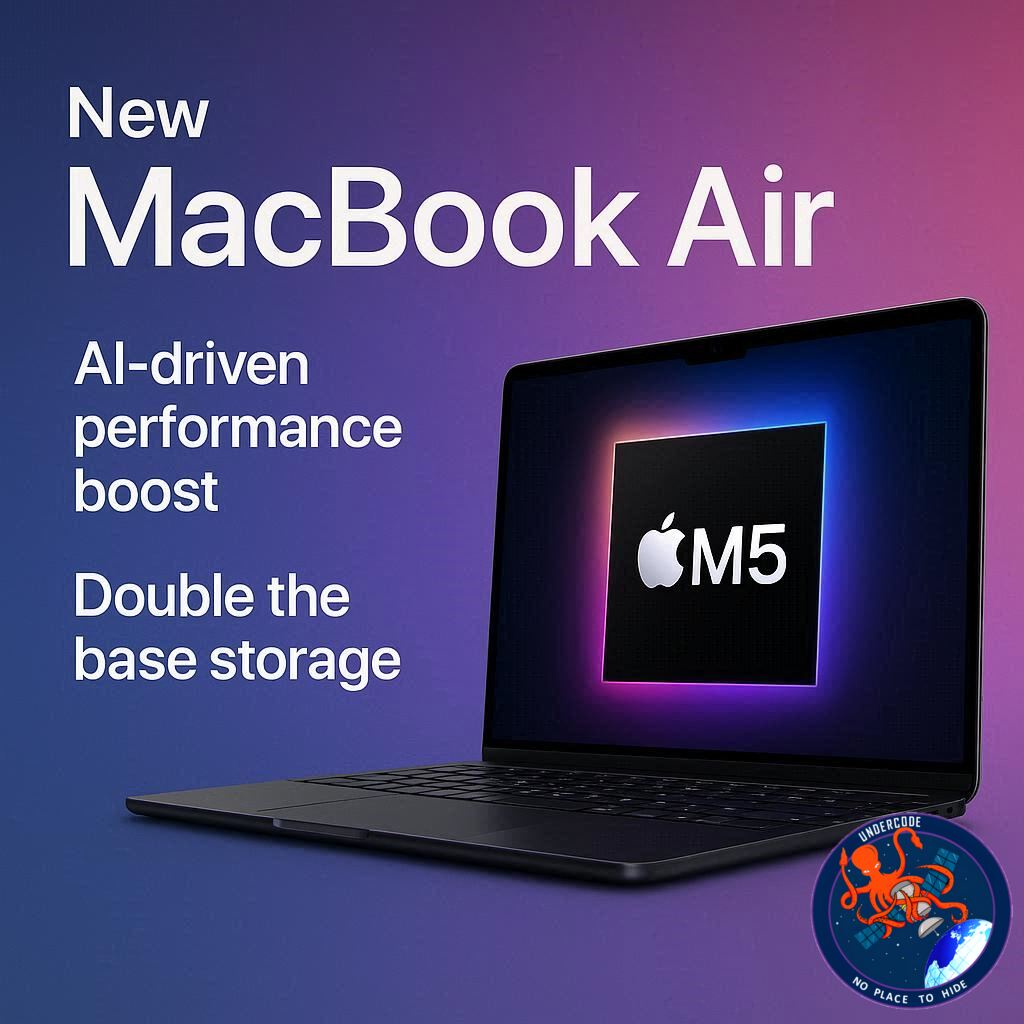 A Quiet Upgrade That Could Redefine the All-Round Laptop Market
Apple has officially introduced the latest evolution of its most popular notebook, the MacBook Air M5. At first glance, it looks identical to its predecessor. The same slim aluminum chassis. The same minimalist aesthetic. The same dual Thunderbolt 4 ports. Yet beneath that familiar shell lies a new processor that Apple claims dramatically improves artificial intelligence performance and overall computing power.
The previous generation, powered by the M4 chip, dominated many “best laptop” rankings for months. It balanced portability, battery life, speed, and price in a way few competitors could match. Now Apple is attempting to raise the bar again with the M5, promising faster AI processing, stronger performance in creative applications, and more generous storage right out of the box.
Performance Upgrade Centered on the New M5 Chip
The heart of the MacBook Air M5 is its next-generation Apple Silicon processor. While the design remains unchanged, the silicon architecture receives the spotlight. According to Apple, the M5 delivers up to four times faster performance in AI-focused tasks compared to the M4 version. That claim positions the new Air not just as a lightweight productivity machine, but as a serious AI-capable device.
In real-world scenarios, Apple highlights applications like Topaz Video, where AI-based video enhancement reportedly runs 1.9 times faster than before. That matters for content creators who rely on machine learning tools for upscaling, noise reduction, or video sharpening. Even if most casual users never push the hardware that far, the performance ceiling has clearly been raised.
Storage Expansion Becomes Standard
One of the most practical upgrades is the new base storage configuration. The MacBook Air M5 now starts with 512GB of storage, doubling what previous entry-level models offered. In an era where software sizes balloon and media files consume more space than ever, this change removes one of the most common complaints about earlier MacBook Air models.
For power users, Apple now allows configurations up to 4TB of storage for the first time in the Air lineup. That significantly narrows the gap between the Air and the more expensive MacBook Pro models in terms of capacity flexibility.
Connectivity and Design Remain Familiar
Physically, very little changes. The MacBook Air M5 maintains its sleek, fanless design and lightweight aluminum body. The left side continues to house two Thunderbolt 4 ports, supporting up to two external displays. Apple has also improved wireless connectivity, although specific technical details remain limited in the early announcement.
Battery life expectations remain strong, following the efficient performance pattern of Apple Silicon chips. While exact numbers were not fully detailed at launch, the M-series lineage suggests that efficiency will remain one of the laptop’s biggest advantages.
Pricing and Availability
Apple has opened pre-orders beginning March 4. Pricing starts at $1,099 for the 13-inch model and $1,299 for the 15-inch version. These figures maintain Apple’s traditional pricing structure, positioning the MacBook Air as a premium yet relatively accessible laptop within the company’s ecosystem.
With its combination of upgraded performance, increased storage, and unchanged design philosophy, the MacBook Air M5 appears poised to defend its title as one of the strongest all-around laptops available.
What Undercode Say:
The MacBook Air M5 is not a radical redesign. It is something more calculated. Apple understands that the Air formula already works. Instead of reinventing the product, it reinforces its strongest pillars: performance efficiency, AI acceleration, and value perception.
The emphasis on AI speed is not accidental. The entire technology industry is pivoting toward on-device machine learning. By advertising four times faster AI processing, Apple signals that future software experiences, from photo editing to productivity automation, will increasingly depend on neural engine performance rather than raw CPU power alone.
Doubling the base storage is arguably more impactful than the chip upgrade for everyday users. Many consumers previously felt pushed toward higher-priced configurations because 256GB filled up too quickly. By starting at 512GB, Apple reduces that friction and strengthens the entry-level value proposition without lowering the base price.
The move to allow up to 4TB in an Air model is equally strategic. It blurs the distinction between “consumer” and “professional” categories. In practical terms, most professionals still gravitate toward the MacBook Pro for its active cooling and sustained performance under heavy loads. But psychologically, Apple is positioning the Air as capable enough for creative workflows.
Keeping the same design is also a statement. The Air chassis remains modern, thin, and highly recognizable. Apple avoids redesign fatigue and production complexity, while maintaining the premium aesthetic that defines the brand. Consistency builds identity, and identity drives loyalty.
From a competitive standpoint, the real question is whether the performance gains justify the generational upgrade. For M4 owners, probably not. The M5 appears evolutionary rather than transformative. But for users coming from Intel-based MacBooks or older M1 models, the jump will feel dramatic.
There is also a broader narrative at play. The laptop market has matured. Most improvements are incremental. Apple’s strategy appears to be reinforcing dominance rather than chasing spectacle. It focuses on refinement, ecosystem integration, and forward-looking silicon capabilities.
If AI-powered workflows truly become mainstream across operating systems, the MacBook Air M5 could age very well. Its neural engine improvements may prove more relevant two or three years from now than on launch day.
In short, the MacBook Air M5 does not attempt to shock the industry. It strengthens an already winning formula. That may be less exciting, but it is strategically powerful.
Fact Checker Results
✅ Apple officially announced the MacBook Air M5 with a new M5 chip and improved AI performance claims.
✅ The base storage has increased to 512GB, with configurations up to 4TB available.
✅ Starting prices are set at $1,099 for the 13-inch model and $1,299 for the 15-inch version.
Prediction
📈 The MacBook Air M5 is likely to maintain its position among the best-selling premium laptops due to its balanced upgrades and stronger AI capabilities.
💻 AI-focused performance improvements may become its biggest long-term advantage as more software integrates on-device machine learning.
🚀 Unless competitors deliver disruptive innovation at lower prices, Apple’s incremental strategy will continue to dominate the ultraportable segment.
🕵️📝✔️Let’s dive deep and fact‑check.
References:
Reported By: www.techradar.com
Extra Source Hub (Possible Sources for article):
https://www.stackexchange.com
Wikipedia
OpenAi & Undercode AI
Image Source:
Unsplash
Undercode AI DI v2
Bing
🔐JOIN OUR CYBER WORLD [ CVE News • HackMonitor • UndercodeNews ]
📢 Follow UndercodeNews & Stay Tuned:
𝕏 formerly Twitter 🐦 | @ Threads | 🔗 Linkedin | 🦋BlueSky | 🐘Mastodon


