
Listen to this Post
Introduction: A Silent Offensive Hidden Inside Trusted Systems
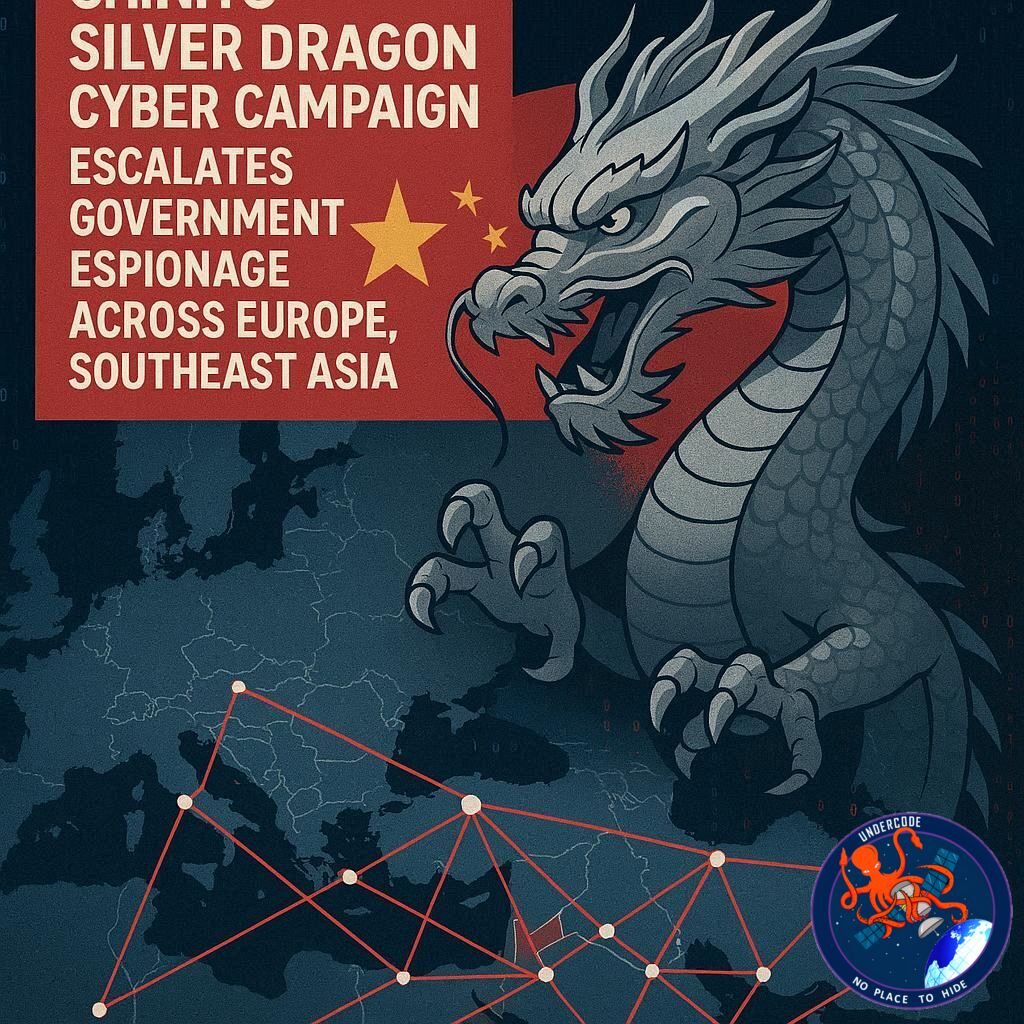
A new Chinese-linked cyber-espionage group has emerged with alarming precision, targeting government institutions across Europe and Southeast Asia. Operating quietly behind legitimate Windows services and trusted cloud platforms, the threat actor known as Silver Dragon is not smashing through firewalls in dramatic fashion. Instead, it slips through familiar doors, disguises its malicious tools as routine system activity, and lingers undetected. Security researchers warn that this group, tied to the notorious APT41 network, represents a strategic evolution in state-aligned cyber warfare, one that prioritizes stealth, persistence, and intelligence gathering over noisy disruption.
Silver Dragon’s Emergence as a Strategic Espionage Actor
Silver Dragon has been active since at least mid-2024, according to cybersecurity firm Check Point Software Technologies. The group primarily targets government entities in Southeast Asia and Europe, focusing on intelligence collection rather than financial theft. Its operational pattern suggests a clear geopolitical motive, consistent with Chinese state-aligned espionage priorities.
Unlike many cybercriminal groups that rely on brute force or ransomware to generate revenue, Silver Dragon’s objective appears strategic. The campaign centers on gaining long-term access to sensitive government networks, extracting valuable data, and maintaining quiet surveillance without triggering alarms.
Phishing and Vulnerable Servers as Initial Entry Points
Silver Dragon begins its operations through carefully crafted phishing emails and the exploitation of public-facing servers with known vulnerabilities. The phishing emails often contain malicious attachments disguised as legitimate documents. In one documented incident, government entities in Uzbekistan received emails impersonating official correspondence, complete with weaponized shortcut files designed to execute malicious payloads upon interaction.
Beyond phishing, the group actively scans for exposed servers that have not been patched against known exploits. Once vulnerabilities are identified, attackers deploy compressed archives containing installation scripts that initiate deeper compromise. These tactics reveal disciplined reconnaissance and a systematic approach to infiltration.
Three Distinct Infection Chains Enable System Compromise
Researchers identified three primary infection chains used by Silver Dragon. The first two rely on techniques known as AppDomain hijacking and Service DLL manipulation. Both methods are typically delivered via compressed RAR archives, indicating deployment during post-exploitation phases after an initial foothold is secured.
These archives contain batch scripts executed by the attackers to install malicious components. The similarities between these infection chains suggest a shared operational framework, likely inherited from APT41’s established tradecraft.
The third infection method involves phishing emails containing malicious LNK files. These shortcut files deploy a loader dubbed BamboLoader, a tool that acts as a gateway for additional malware delivery. This tactic further underscores the group’s focus on blending malicious activity into routine system processes.
Service DLL Hijacking Enables Stealthy Persistence
One of Silver Dragon’s most concerning techniques is Service DLL hijacking. After gaining access, the attackers modify legitimate Windows service configurations, inserting malicious code into trusted system components. Because the malware operates within legitimate services, traditional security tools often struggle to distinguish it from normal activity.
This method allows Silver Dragon to maintain long-term persistence within compromised networks. Instead of installing conspicuous backdoors, the group hides inside routine system operations, significantly reducing the likelihood of detection.
Custom Malware Arsenal Strengthens Operational Depth
Silver Dragon deploys a range of sophisticated tools once inside a network. Among them are Cobalt Strike beacons, commonly used in advanced attacks to establish an early foothold. The group also employs DNS tunneling techniques to transmit command-and-control traffic discreetly, bypassing certain network monitoring defenses.
A particularly notable development is the introduction of a custom backdoor called GearDoor. This tool leverages Google Drive as its command-and-control channel, allowing attackers to communicate through a trusted cloud service. By routing malicious instructions through legitimate cloud infrastructure, Silver Dragon minimizes suspicion and avoids raising red flags.
The group’s toolkit also includes SSHcmd, designed for lateral movement and remote command execution within compromised environments. Another tool, SilverScreen, captures periodic screenshots of user activity, providing real-time surveillance capabilities and enabling attackers to monitor sensitive data directly.
Links to APT41 Reveal a Familiar Strategic Signature
Security researchers linked Silver Dragon to APT41 due to strong similarities in tooling and operational behavior. APT41, also known by aliases such as Double Dragon and Winnti, has been active since at least 2012 and is widely associated with Chinese state-backed espionage campaigns.
APT41 has a history of targeting governments, corporations, and even political figures during sensitive geopolitical events. Silver Dragon’s use of similar loaders, installation scripts, and post-exploitation strategies suggests either direct affiliation or shared infrastructure and training pipelines.
While APT41 has occasionally engaged in financially motivated cybercrime, Silver Dragon appears more focused on long-term strategic intelligence collection. Its behavior indicates careful planning, sustained resourcing, and institutional backing.
Governments Urged to Reinforce Defenses
The emergence of Silver Dragon highlights the importance of patching Internet-facing systems and monitoring unauthorized changes to Windows services. Public sector organizations remain particularly vulnerable due to legacy infrastructure and complex administrative environments.
Experts recommend continuous vulnerability management, strict service configuration monitoring, and active detection of indicators of compromise. Silver Dragon’s stealth tactics make reactive security insufficient. Proactive threat hunting and behavioral analytics are essential in identifying subtle anomalies that traditional signature-based defenses might overlook.
What Undercode Say:
Strategic Espionage Over Financial Crime Signals State Priorities
Silver Dragon’s operational discipline strongly indicates geopolitical intent rather than criminal opportunism. The absence of ransomware deployment or immediate monetization tactics reveals that intelligence gathering is the true objective. This aligns with broader Chinese cyber strategy, which historically prioritizes long-term strategic access over short-term disruption.
Legitimate Infrastructure as a Weaponized Shield
The group’s use of legitimate Windows services and trusted cloud platforms such as Google Drive marks a tactical evolution in espionage methodology. Instead of deploying exotic malware that triggers alarms, Silver Dragon weaponizes trust itself. When attackers operate within legitimate system processes, detection becomes exponentially more difficult.
This technique reflects a larger trend in advanced persistent threat operations worldwide. The battlefield is no longer defined by malware sophistication alone, but by how seamlessly malicious activity blends into everyday digital operations.
Persistent Access Equals Strategic Leverage
Long-term persistence provides intelligence agencies with strategic leverage. Access to government communications, internal policy drafts, diplomatic discussions, and defense planning offers immense geopolitical value. Even seemingly minor data points, when aggregated over time, can produce powerful intelligence insights.
Silver Dragon’s emphasis on screenshot capture tools like SilverScreen suggests real-time intelligence monitoring rather than simple data theft. This is surveillance in its purest digital form.
Operational Maturity Suggests Institutional Backing
The rapid evolution of Silver Dragon’s tools and infection chains indicates dedicated research and development resources. Groups with limited funding rarely demonstrate such consistent innovation. The systematic testing of new loaders and C2 mechanisms implies structured oversight and ongoing strategic objectives.
The connection to APT41 reinforces this interpretation. APT41 has long operated at the intersection of state-directed espionage and cyber operations with global impact. Silver Dragon’s operational overlap suggests continuity rather than coincidence.
Implications for European and Southeast Asian Cyber Defense
Governments in Europe and Southeast Asia face a complex challenge. Defensive strategies must now account for threats that exploit trust, not just vulnerability. Traditional perimeter-based security models are insufficient against adversaries who hide inside legitimate system services.
Zero-trust architectures, strict service integrity monitoring, and advanced endpoint detection must become foundational security principles. Without these measures, stealth actors like Silver Dragon will continue operating beneath detection thresholds.
The Expanding Cyber Cold War Landscape
Silver Dragon’s campaign underscores a broader geopolitical shift. Cyber-espionage has become an integral component of international power projection. Intelligence operations that once required physical infiltration can now be conducted remotely, persistently, and at scale.
This digital transformation has lowered operational risk while amplifying strategic impact. As state-linked groups refine stealth techniques, the line between espionage and covert cyber warfare becomes increasingly blurred.
Fact Checker Results
✅ Silver Dragon has been linked to APT41 based on tooling and operational similarities reported by cybersecurity researchers.
✅ The group uses phishing, service DLL hijacking, and cloud-based C2 channels to maintain stealth persistence.
❌ There is no public evidence confirming direct official acknowledgment from the Chinese government regarding Silver Dragon’s activities.
Prediction
🔮 Governments in Europe and Southeast Asia will accelerate zero-trust security adoption within the next 12–24 months.
🔮 Cloud service providers may implement stricter anomaly detection to counter abuse of trusted platforms for C2 communication.
🔮 Silver Dragon or similar APT41-linked actors are likely to expand targeting into additional politically strategic regions.
▶️ Related Video (82% Match):
🕵️📝✔️Let’s dive deep and fact‑check.
References:
Reported By: www.darkreading.com
Extra Source Hub (Possible Sources for article):
https://www.quora.com
Wikipedia
OpenAi & Undercode AI
Image Source:
Unsplash
Undercode AI DI v2
Bing
🔐JOIN OUR CYBER WORLD [ CVE News • HackMonitor • UndercodeNews ]
📢 Follow UndercodeNews & Stay Tuned:
𝕏 formerly Twitter 🐦 | @ Threads | 🔗 Linkedin | 🦋BlueSky | 🐘Mastodon


