
Listen to this Post
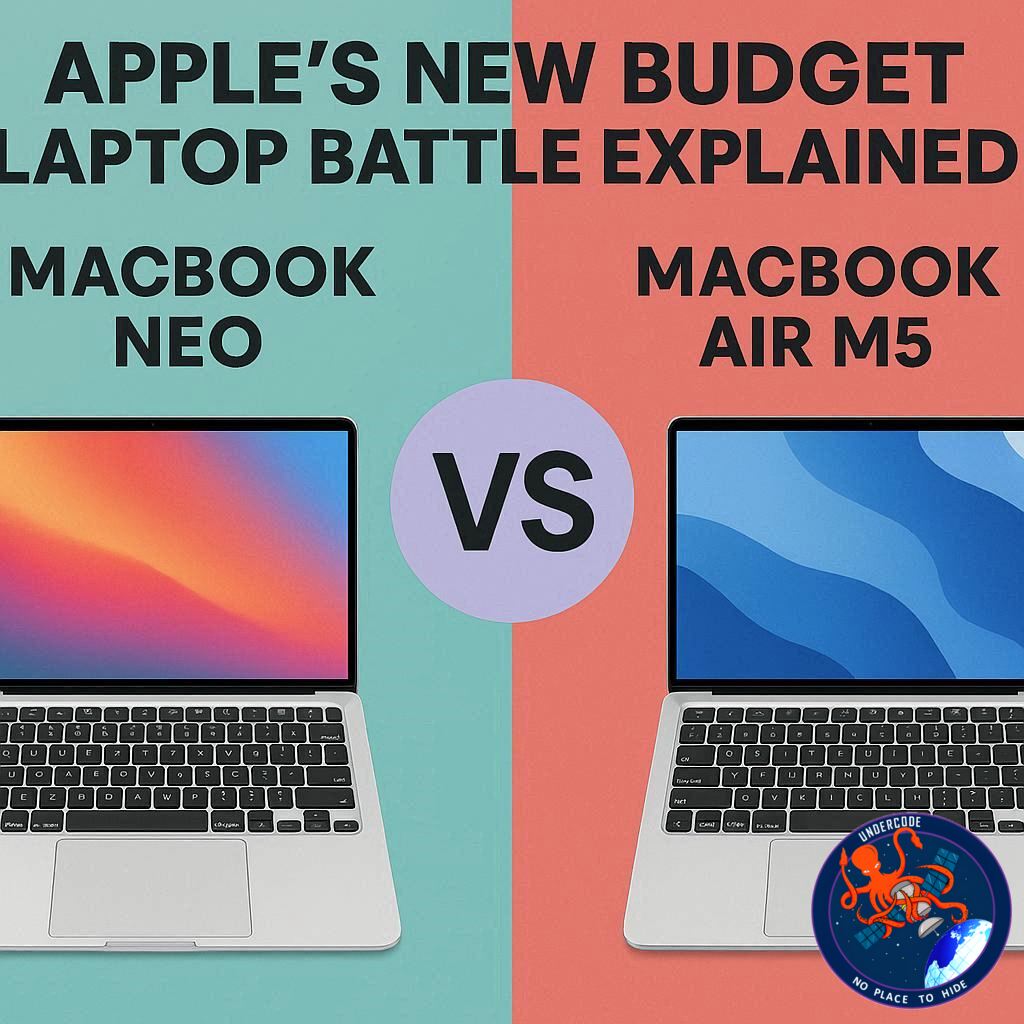
Introduction: Apple’s Most Affordable MacBook Era Begins
Apple’s laptop lineup has entered a new phase. For years, the MacBook Air represented the most accessible entry point into the Mac ecosystem. Now that role has changed. With the arrival of the MacBook Neo, Apple has introduced its cheapest MacBook ever, starting at just $599, dramatically reshaping the company’s laptop hierarchy.
At the same time, the MacBook Air M5 continues to represent Apple’s mainstream ultraportable machine, powered by its latest generation Apple Silicon chip. The Air remains sleek, powerful, and premium, but it now sits almost twice the price of the Neo.
This contrast raises an important question for consumers: is the MacBook Neo simply a cheaper alternative, or does it offer enough performance and quality to challenge the MacBook Air itself?
The comparison between these two laptops highlights Apple’s broader strategy. One model focuses on affordability and everyday computing, while the other continues to push performance and refinement. Understanding how these machines differ in design, display, performance, battery life, and long-term value is essential for deciding which one makes more sense for your needs.
Apple Introduces a New Budget Champion
Apple surprised many observers when it introduced the MacBook Neo as the most affordable MacBook ever released. Starting at $599, the Neo costs nearly half the price of the 13-inch MacBook Air M5, which begins at $1,099.
The aggressive pricing immediately positions the Neo as Apple’s true entry-level laptop. It is designed to attract students, casual users, and those who want a Mac experience without paying premium prices.
Despite the lower cost, Apple has not abandoned its design standards. The MacBook Neo still uses an aluminum chassis, keeping the device lightweight and durable while maintaining the familiar MacBook aesthetic. That decision alone prevents the Neo from feeling like a typical budget laptop.
However, the price difference reflects clear compromises in hardware specifications. The Neo features 8GB of RAM and 256GB of storage in its base configuration, while the MacBook Air M5 begins with 16GB of RAM and 512GB of storage. These differences signal that the Air is still intended for more demanding users.
Design Differences Reveal Two Distinct Tiers
The MacBook Air M5 continues Apple’s design legacy. Its thin profile, clean aluminum construction, and refined build quality remain among the best in the laptop industry. Apple did not change the design from the previous generation, and that is largely because the existing design is already widely praised.
The MacBook Neo also looks modern but clearly occupies a lower design tier. While it uses the same aluminum material, the Neo features thicker display bezels and lacks some of the visual refinement seen in the Air.
Apple offers the Neo in several colorful finishes, giving it a more youthful appearance that may appeal to students and casual buyers. It feels sturdy and portable, but side-by-side comparisons reveal the MacBook Air as the more polished machine.
Still, considering its price, the Neo delivers impressive design quality for a laptop in the $599 range.
Display Technology Shows Subtle Yet Important Differences
Both laptops include Liquid Retina displays with strong brightness levels of up to 500 nits, ensuring good visibility in most lighting conditions.
The MacBook Air M5 features a 13.6-inch display with a resolution of 2,560 × 1,664 pixels, providing crisp detail and excellent color reproduction. It also supports the P3 wide color gamut and True Tone technology, allowing the screen to adjust color temperature based on ambient lighting.
The MacBook Neo includes a slightly smaller 13-inch display with a resolution of 2,408 × 1,506 pixels. While still sharp and vibrant, it lacks the P3 color support and True Tone features found on the Air.
These omissions may not matter for casual users, but they become noticeable for creative professionals working with photography, video editing, or graphic design.
Another difference lies in the webcam placement. The MacBook Air uses a notch design to house its camera, while the Neo keeps a traditional bezel layout.
Performance: Desktop Silicon vs Mobile Chip Strategy
The biggest difference between these laptops lies in their processors.
The MacBook Air M5 runs on Apple’s M5 chip, a powerful desktop-class processor designed for high-performance laptops. With a 10-core CPU and 8-core GPU, it delivers strong multitasking capabilities, creative workflow performance, and efficient AI processing.
The MacBook Neo takes a very different approach. Instead of a traditional Mac processor, Apple equipped it with the A18 Pro chip, the same architecture used in its flagship iPhones.
This decision helps reduce cost while still delivering respectable performance for everyday tasks. Activities like email, web browsing, video calls, document editing, and light entertainment should run smoothly.
However, the gap becomes obvious in heavier workloads. Multitasking, professional software, and intensive computing tasks will favor the MacBook Air M5 by a wide margin.
Another limitation is memory. With only 8GB of RAM in the base configuration, the Neo may feel constrained over time as software becomes more demanding.
Battery Life Remains Surprisingly Competitive
Battery performance is one area where the MacBook Neo holds its ground.
Apple claims the MacBook Air M5 offers up to 18 hours of battery life, which aligns closely with previous MacBook Air models. Real-world testing typically shows around 15 hours of continuous web browsing, still enough to last a full workday.
The MacBook Neo is rated for up to 16 hours of video streaming and around 11 hours of web browsing. While slightly lower than the Air, it remains impressive for a budget laptop.
One small drawback is charging. Unlike the MacBook Air, the Neo does not support MagSafe charging and instead relies solely on USB-C.
Some regions also do not include a charger in the box, requiring users to supply their own 20W adapter.
Value Comparison Shows Two Very Different Buyers
Ultimately, the MacBook Neo and MacBook Air M5 target different audiences.
The Neo focuses on accessibility. It offers the core macOS experience at a price previously unheard of for a MacBook. For students, light users, and those switching from Chromebooks or budget Windows laptops, the Neo represents a compelling entry point.
The MacBook Air M5, on the other hand, remains the performance-focused ultrabook. Its stronger processor, higher memory configuration, better display features, and premium design make it more suitable for professionals and power users.
The price difference may seem large, but the Air delivers significantly more computing power.
What Undercode Say:
Apple’s introduction of the MacBook Neo signals a strategic shift that goes far beyond simply releasing a cheaper laptop. It represents a structural change in how Apple approaches the entry-level computing market.
For over a decade, Apple’s lowest-priced laptop was still relatively expensive compared with competitors. Even the MacBook Air line, despite its popularity, remained out of reach for many students and budget buyers. The Neo changes that equation entirely.
The decision to power the Neo with the A18 Pro chip is particularly interesting. Apple has effectively blurred the line between its mobile and desktop silicon ecosystems. By adapting an iPhone-class processor for macOS tasks, Apple reduces production costs while still delivering adequate performance.
This approach mirrors how Chromebooks and tablets have evolved. Most everyday users do not require workstation-level processing power. Web applications, cloud services, and lightweight productivity tools dominate modern computing workflows.
Apple appears to recognize this shift.
From a market strategy perspective, the Neo may function as Apple’s “Chromebook competitor.” Schools and universities represent a massive global laptop market, and Apple has historically struggled to compete with low-cost devices in that sector.
A $599 MacBook changes the conversation.
Another major factor is ecosystem expansion. Every new Mac user becomes a potential customer for Apple services, accessories, and future hardware upgrades. Even if the Neo generates smaller hardware profit margins, it could increase long-term revenue through the broader Apple ecosystem.
Meanwhile, the MacBook Air M5 maintains Apple’s position in the premium ultraportable category. It continues to deliver high performance, long battery life, and strong build quality.
This two-tier strategy resembles Apple’s approach in the iPhone market, where flagship models coexist with more affordable alternatives.
There is also an important psychological factor in pricing. When consumers see a MacBook priced at $599, the $1,099 Air suddenly appears more reasonable rather than expensive. This anchoring effect can influence purchasing decisions across the entire lineup.
However, the Neo is not without risks.
The use of 8GB RAM as the base configuration could limit the laptop’s lifespan, especially as AI features and heavier applications become standard in macOS. Apple may eventually face criticism if the device struggles with future software updates.
Another challenge involves perception. Apple’s brand has long been associated with premium quality and high performance. Introducing a budget Mac risks diluting that perception if the device fails to meet expectations.
Yet early signs suggest Apple carefully balanced cost and quality. The aluminum build, Retina display, and macOS support help ensure the Neo still feels like a genuine Mac.
Ultimately, the MacBook Neo may become one of Apple’s most important laptops in years. It expands the Mac ecosystem, challenges low-cost competitors, and introduces a new gateway into Apple computing.
If the strategy succeeds, the Neo could do for MacBooks what the iPhone SE did for smartphones: bring Apple technology to a much wider audience.
Fact Checker Results
✅ The MacBook Neo launches at $599, making it the cheapest MacBook ever introduced.
✅ The MacBook Air M5 includes stronger hardware such as a 10-core CPU and 16GB base RAM.
❌ The MacBook Neo matching MacBook Air performance is unlikely due to its mobile-class A18 Pro chip.
Prediction
The MacBook Neo could become one of Apple’s highest-selling laptops within the next few years, particularly in education markets. If Apple later introduces upgraded versions with 16GB RAM and improved displays, the Neo line may evolve into a dominant entry-level computing platform. Meanwhile, the MacBook Air will likely continue shifting toward the premium ultrabook category, widening the gap between casual users and professional Mac buyers.
▶️ Related Video (84% Match):
🕵️📝✔️Let’s dive deep and fact‑check.
References:
Reported By: www.techradar.com
Extra Source Hub (Possible Sources for article):
https://www.instagram.com
Wikipedia
OpenAi & Undercode AI
Image Source:
Unsplash
Undercode AI DI v2
Bing
🔐JOIN OUR CYBER WORLD [ CVE News • HackMonitor • UndercodeNews ]
📢 Follow UndercodeNews & Stay Tuned:
𝕏 formerly Twitter 🐦 | @ Threads | 🔗 Linkedin | 🦋BlueSky | 🐘Mastodon


