
Listen to this Post
Introduction
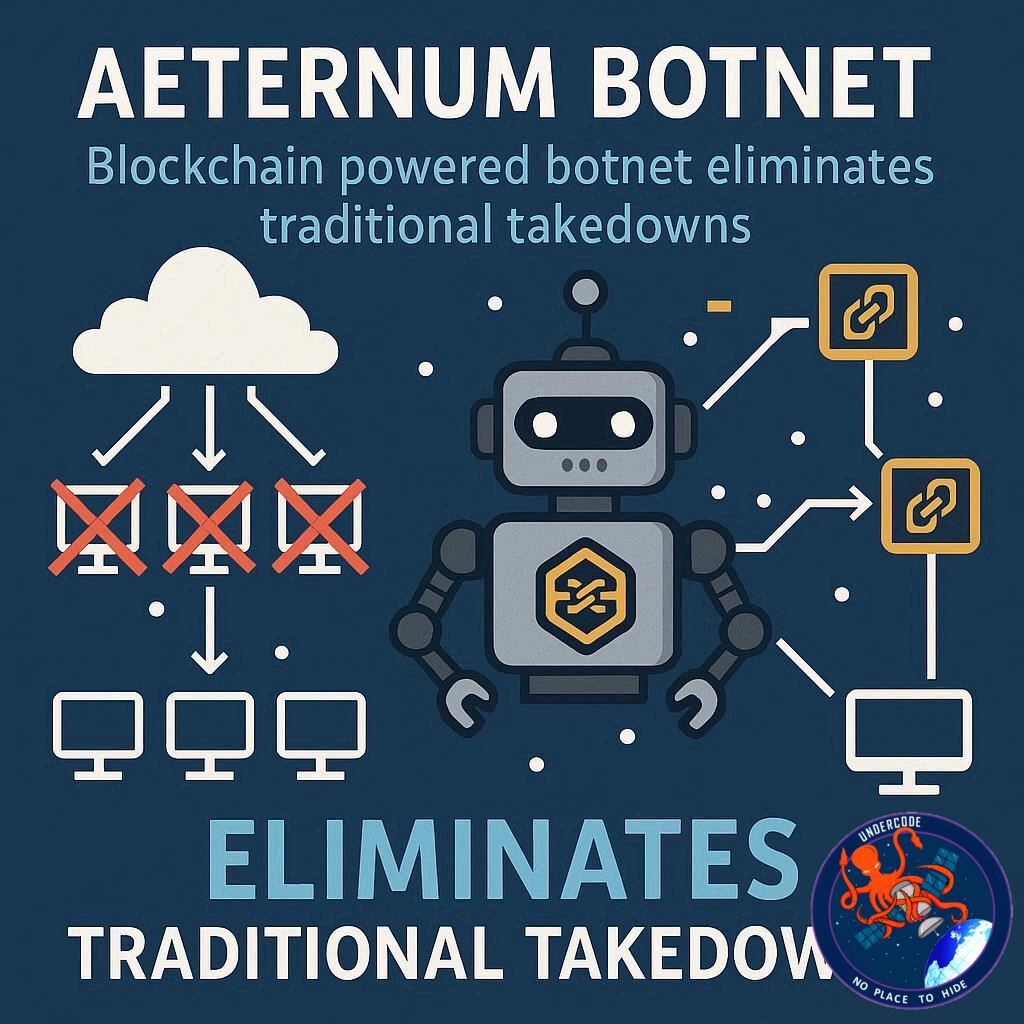
For years, cybersecurity experts have relied on a familiar strategy to dismantle botnets: identify their command-and-control servers and shut them down. This approach has proven effective against some of the most notorious malware networks in history. Once investigators seize the servers or domains controlling infected machines, the botnet quickly collapses. However, a newly discovered threat may fundamentally change that playbook. Researchers have identified a botnet loader called Aeternum C2 that uses blockchain technology to store and distribute commands, removing the centralized infrastructure defenders typically target. By embedding instructions directly on the Polygon blockchain, this system creates a decentralized and nearly indestructible command network that could redefine how botnets operate in the future.
The Traditional Weakness of Botnets
Historically, botnets depend on centralized command systems. These command-and-control servers act as the brains of the operation, distributing instructions to thousands or even millions of infected devices. Once security researchers locate these servers, law enforcement can seize them or domain registrars can shut them down. This tactic has dismantled several infamous cybercrime operations.
Major takedowns have targeted malware networks like Emotet, TrickBot, and QakBot. In each case, authorities focused on the infrastructure that allowed attackers to control infected systems. Once the central nodes were removed, the botnet could no longer receive commands, effectively neutralizing the threat.
This strategy has been a cornerstone of global cybersecurity operations. Yet it depends on a critical assumption: that botnets require centralized infrastructure to function. Aeternum C2 challenges that assumption entirely.
A Botnet That Lives on the Blockchain
Researchers at Qrator Research Lab discovered that Aeternum C2 stores its command instructions directly on the Polygon blockchain.
Instead of relying on servers or domain names, the operators embed instructions inside blockchain smart contracts. Once a command is written into the blockchain, it becomes permanently recorded and distributed across thousands of nodes worldwide.
This decentralized storage model removes a key vulnerability: there is no central server to shut down.
Infected systems simply query public RPC endpoints connected to the Polygon network. These endpoints allow the malware to retrieve instructions stored in the blockchain’s smart contracts. Because the data is replicated across the entire blockchain network, it cannot be removed or altered by taking down a single server.
The result is a command system that is effectively permanent.
How the Aeternum Control System Works
Screenshots of the attacker control panel reveal that Aeternum is written in native C++. The malware is available in both 32-bit and 64-bit versions, allowing it to run on a wide range of infected machines.
Operators manage infections through a web-based dashboard. Within this panel, they select a specific smart contract and define the command they want to issue.
Once the command is prepared, it is submitted as a blockchain transaction. After the transaction is confirmed on the Polygon network, the command becomes publicly accessible within the blockchain data.
Infected devices periodically poll the network to check for updates. Typically, new commands become available within two to three minutes after being posted.
This system allows attackers to control large numbers of infected machines without operating a single command server.
Multiple Smart Contracts for Different Malware Payloads
The Aeternum dashboard allows operators to maintain multiple smart contracts simultaneously.
Each contract can be tied to a specific malware payload or operation. Examples observed in the control interface included contracts labeled “Clipper,” “ps1,” and “putty.exe.”
These payloads represent different types of malicious activity, including:
Credential stealers that harvest login data
Clipboard hijackers that replace cryptocurrency wallet addresses
Remote access trojans that allow attackers to control victims’ computers
Cryptocurrency miners that secretly exploit system resources
DLL loaders capable of installing additional malware
Researchers observed at least 13 active smart contracts being used simultaneously within a single dashboard environment.
Tracking and Managing Infected Devices
Aeternum also includes features for monitoring infected systems.
One built-in function allows bots to send HTTP GET requests back to the operator. These requests include hardware identifiers and user-agent strings that help attackers identify each infected device.
This data enables operators to track infection campaigns and assign targeted tasks to specific machines.
For example, certain victims might receive credential-stealing malware while others may be assigned cryptocurrency mining tasks.
This level of granular control makes the botnet far more flexible and efficient for cybercriminal operations.
Low Operational Costs for Attackers
Another advantage for attackers is the extremely low cost of operating this infrastructure.
Because commands are written to the blockchain as transactions, they require small amounts of cryptocurrency to execute. Researchers estimate that roughly one dollar worth of Polygon’s native token can fund between 100 and 150 command transactions.
Unlike traditional botnets, there are no hosting fees, no server rentals, and no domain registrations required.
All an attacker needs is a cryptocurrency wallet and access to the botnet control panel.
This dramatically lowers the barrier to entry for cybercriminal groups.
Anti-Analysis Features Built Into the Malware
Aeternum also includes multiple mechanisms designed to evade cybersecurity analysis.
The loader performs checks to detect whether it is running inside a virtual machine environment. If the malware suspects it is being analyzed in a sandbox, it may terminate itself or alter its behavior to avoid detection.
Additionally, the developers integrated an antivirus scanning feature using the Kleenscan API. This allows operators to test new malware builds against dozens of antivirus engines before releasing them into the wild.
By verifying that the malware remains undetected, attackers can maximize the success rate of their campaigns.
A Fundamental Shift in Botnet Architecture
Security researchers warn that blockchain-based command systems represent a significant evolution in cybercrime infrastructure.
Even if security teams successfully remove the malware from infected devices, the underlying blockchain contracts remain active. These contracts can be reused or modified for future campaigns.
In other words, the command infrastructure cannot simply be seized or destroyed.
This resilience could force cybersecurity defenders to rethink how botnets are tracked and dismantled.
Traditional takedown strategies may no longer be enough.
What Undercode Say:
Blockchain Is Becoming a Cybercrime Infrastructure Layer
Aeternum C2 highlights a major trend emerging within underground cybercrime communities. Technologies originally built for decentralization and transparency are increasingly being repurposed as resilient infrastructure for illegal operations.
Blockchains like Polygon were designed to provide permanent, tamper-resistant records for financial and decentralized applications. Ironically, those same characteristics make them highly attractive for attackers seeking command systems that cannot be easily shut down.
This represents a shift from infrastructure ownership to infrastructure exploitation. Instead of maintaining servers, cybercriminals can simply use public decentralized networks as their command backbone.
The Real Threat Is Infrastructure Immunity
Traditional botnet takedowns work because defenders can identify a point of failure. A server can be seized. A domain can be suspended. A hosting provider can terminate services.
Blockchain-based command systems remove that single point of failure entirely.
Even if law enforcement identifies the attacker’s wallet address or smart contract, removing the data from the blockchain is practically impossible. The instructions are permanently embedded in the ledger.
This creates a situation where the infrastructure of the attack survives even if the attackers themselves disappear.
Detection Must Move to the Endpoint and Network Level
Because the command system cannot easily be removed, cybersecurity defenses must evolve.
Instead of focusing on shutting down infrastructure, security teams will likely need to focus more heavily on behavioral detection.
Network monitoring tools may need to identify unusual blockchain RPC traffic patterns from endpoints that normally would not communicate with decentralized networks.
Endpoint detection and response systems will also become critical in identifying suspicious loaders before they establish communication with blockchain-based command channels.
Cybercriminal Economics Are Changing
One of the most alarming aspects of the Aeternum model is cost efficiency.
Running a traditional botnet requires servers, domains, bulletproof hosting providers, and constant maintenance. This infrastructure can cost hundreds or thousands of dollars.
In contrast, Aeternum’s model costs only a few dollars in cryptocurrency.
This means even small criminal groups could deploy resilient botnets without significant financial investment.
The barrier to entry for cybercrime could become dramatically lower.
Blockchain Regulation May Enter Cybersecurity Discussions
While blockchain networks themselves are neutral technologies, their use in cybercrime could eventually trigger discussions around regulatory frameworks.
Authorities might begin exploring ways to monitor or restrict malicious use of smart contracts. However, enforcing such measures on decentralized networks will be extremely complex.
The decentralized nature that protects legitimate users also protects criminals.
This tension will likely become a major topic in cybersecurity policy debates.
Fact Checker Results
✅ The malware uses the Polygon blockchain to store botnet commands in smart contracts.
✅ Traditional botnets such as Emotet and TrickBot were disrupted through infrastructure takedowns.
❌ There is currently no confirmed evidence that Aeternum C2 has been used in large-scale global attacks yet.
Prediction
🔮 Blockchain-based command-and-control systems will likely become more common as cybercriminals search for infrastructure that cannot be seized.
⚠️ Security vendors will begin developing detection tools that specifically analyze blockchain communication patterns coming from enterprise networks.
🚨 Within the next few years, decentralized technologies could become a standard component in advanced botnet architectures if defensive strategies fail to adapt quickly.
🕵️📝✔️Let’s dive deep and fact‑check.
References:
Reported By: cyberpress.org
Extra Source Hub (Possible Sources for article):
https://www.reddit.com/r/AskReddit
Wikipedia
OpenAi & Undercode AI
Image Source:
Unsplash
Undercode AI DI v2
Bing
🔐JOIN OUR CYBER WORLD [ CVE News • HackMonitor • UndercodeNews ]
📢 Follow UndercodeNews & Stay Tuned:
𝕏 formerly Twitter 🐦 | @ Threads | 🔗 Linkedin | 🦋BlueSky | 🐘Mastodon


