
Listen to this Post
Introduction: The Shift Toward Centralized Game Development Power
Modern game development has grown far beyond the traditional model of artists and programmers working side by side on local machines. Studios now manage enormous virtual worlds, advanced visual technologies, and globally distributed teams collaborating across continents. As production complexity grows, the hardware infrastructure supporting these teams must evolve as well.
Many development studios still rely heavily on desk-bound workstations equipped with dedicated GPUs. While powerful, this traditional approach often creates inefficiencies. Hardware resources may sit idle in one location while other teams struggle with limited computing power. Maintaining consistent development environments across departments becomes increasingly difficult, and scaling infrastructure quickly can be expensive and operationally complex.
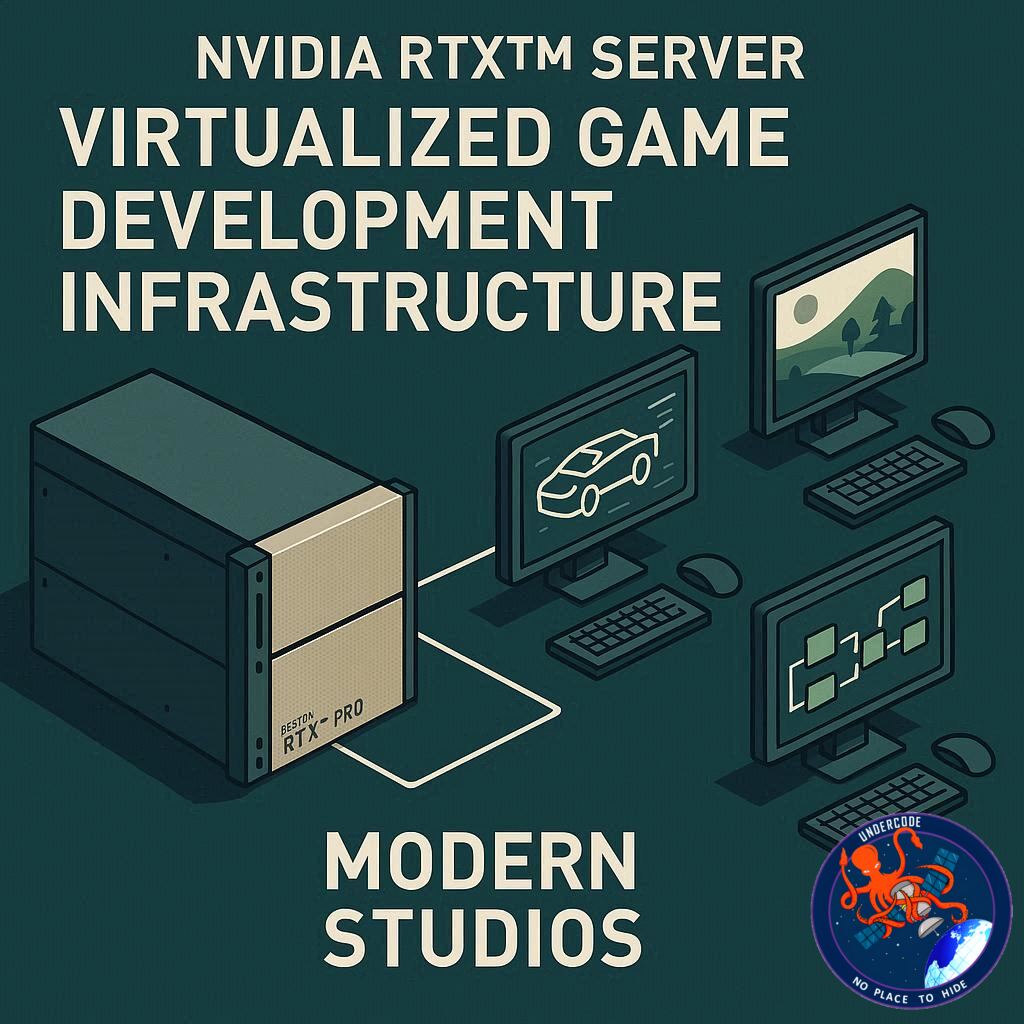
At the recent Game Developers Conference 2026 in San Francisco, NVIDIA introduced a new solution designed to modernize how studios manage computing power. The NVIDIA RTX PRO Server combines centralized GPU infrastructure with virtualization technology, enabling game studios to allocate high-performance graphics resources dynamically across artists, developers, AI researchers, and quality assurance teams.
Powered by the NVIDIA RTX PRO 6000 Blackwell Server Edition GPU and NVIDIA vGPU, this new system aims to bring workstation-level performance into the data center. The result is a flexible, scalable platform capable of supporting complex development pipelines while improving efficiency, security, and collaboration across teams.
Centralized GPU Infrastructure Changes the Development Workflow
Game development studios are scaling rapidly. Projects now involve massive asset libraries, real-time ray tracing pipelines, AI-driven tools, and continuous testing environments. However, the infrastructure supporting these processes has not always kept pace.
A frequent challenge arises when hardware resources are unevenly distributed. Workstations may remain underutilized in one department while another team waits hours for access to specialized hardware. Expanding QA capacity often requires purchasing additional machines, which can lead to excessive hardware sprawl across offices and studios.
The NVIDIA RTX PRO Server attempts to solve this by centralizing GPU resources within the data center. Instead of assigning a dedicated GPU to each workstation, studios can create virtual workstations powered by shared GPU infrastructure. These virtual environments deliver the same responsiveness and graphical performance expected from high-end workstations, but they can be dynamically allocated based on project needs.
This model allows studios to distribute computing power efficiently. Artists can access RTX-powered virtual machines for 3D modeling and generative AI workflows. Developers can run complex simulations and build environments without worrying about local hardware limitations. AI researchers can train and test models within the same infrastructure used by production teams.
Most importantly, this centralized approach helps maintain consistent development environments across departments. When everyone works within the same virtualized platform, debugging becomes easier and software conflicts are significantly reduced.
Optimizing Resource Utilization Through Dynamic Allocation
One of the most powerful advantages of centralized GPU infrastructure lies in improved hardware utilization. Traditional workstation setups often result in long periods of inactivity. A GPU that supports rendering tasks during the day may remain unused overnight.
With the RTX PRO Server, studios can dynamically shift workloads throughout the day. For example, during nighttime hours when artists and developers are offline, GPU resources can be reassigned to automated tasks such as AI training, large-scale simulations, or game testing processes.
When teams return to work the next morning, those same GPU resources can be instantly reallocated to interactive development tasks. This continuous utilization dramatically improves infrastructure efficiency while reducing idle computing capacity.
Quality assurance teams benefit significantly from this flexibility as well. Instead of relying on limited hardware for testing, QA teams can scale validation workloads quickly by spawning multiple virtual environments. These environments run on the same GPU architecture used in consumer gaming hardware such as the GeForce RTX 50 Series, ensuring accurate performance testing across various configurations.
Supporting Multiple Development Roles on a Unified Platform
The RTX PRO Server is designed to support the entire game development lifecycle through virtualization. Each team within a studio can access GPU resources tailored to their specific needs.
Artists can work with RTX-powered virtual workstations capable of handling complex 3D scenes and generative AI content creation. Developers can run coding environments and build pipelines that require consistent GPU performance. AI researchers can access large GPU memory pools for training and testing machine learning models.
Quality assurance teams can also simulate large-scale gameplay testing scenarios by running multiple game instances simultaneously. Because these environments operate on the same GPU architecture used in consumer graphics cards, testing results remain reliable and accurate.
This unified infrastructure reduces compatibility issues that often occur when different departments rely on different hardware configurations. Contractors and remote collaborators can also access the same GPU resources through secure virtual environments, improving collaboration across geographically distributed teams.
Advanced GPU Architecture Enables AI and Graphics Convergence
Artificial intelligence has become an integral part of modern game development. AI tools assist with coding, procedural content generation, animation, automated testing, and even live game operations.
To support these workflows, the RTX PRO 6000 Blackwell Server Edition GPU includes an impressive 96GB of GPU memory, allowing developers to run multiple high-performance applications simultaneously. This large memory capacity enables AI inference workloads to operate alongside real-time graphics rendering without sacrificing performance.
Another key feature is NVIDIA Multi-Instance GPU, which allows a single GPU to be divided into multiple isolated instances. Each instance receives dedicated memory, compute, and cache resources.
When combined with NVIDIA vGPU software, MIG allows studios to allocate GPU capacity securely across multiple users. In some configurations, a single RTX PRO 6000 GPU can support up to 48 concurrent users, dramatically increasing efficiency while maintaining strong performance isolation between workloads.
This architecture allows AI experimentation and production pipelines to coexist on the same infrastructure without requiring separate systems. Studios can run coding agents, train internal models, and deploy AI-assisted tools without building dedicated AI clusters for every team.
Enterprise-Ready Deployment for Large-Scale Game Studios
Unlike experimental infrastructure solutions that require specialized setups, RTX PRO Servers are designed for enterprise-grade deployment. Studios can integrate the platform into their existing IT environments using supported hypervisors and remote workstation systems.
This compatibility ensures that studios do not need to redesign their infrastructure to adopt the technology. Instead, they can gradually transition from individual workstations toward centralized GPU clusters within the data center.
Large game publishers already rely on NVIDIA virtualization technologies to support large-scale development pipelines. By extending this concept with more powerful GPUs and expanded virtualization capabilities, RTX PRO Servers aim to deliver the next step in scalable game development infrastructure.
Studios attending NVIDIA GTC 2026 can explore demonstrations of these workflows and see how centralized GPU platforms may shape the future of production pipelines.
What Undercode Say:
The introduction of centralized GPU infrastructure represents a significant turning point in how game development studios structure their technological backbone. Historically, creative industries have favored local workstation power because artists and developers demanded instant responsiveness. Latency concerns and network limitations made remote computing environments impractical.
However, the rapid evolution of cloud infrastructure, high-speed networking, and GPU virtualization technologies has fundamentally changed the equation. What once required a $10,000 workstation under a desk can now be delivered through a virtual machine powered by shared hardware in a data center.
NVIDIA’s RTX PRO Server is not merely a hardware upgrade. It reflects a broader industry shift toward infrastructure abstraction. Instead of thinking about physical machines, studios begin thinking in terms of compute capacity pools.
This model mirrors trends already seen in enterprise computing and software development, where cloud-native architectures replaced fixed server deployments. Game development appears to be entering a similar transformation phase.
Another critical factor driving this change is the explosive growth of AI tools in production pipelines. AI-assisted asset generation, code completion systems, and automated QA frameworks demand enormous computational resources. Running these workloads on isolated hardware creates inefficiencies and operational complexity.
By integrating AI workloads directly into the same GPU infrastructure used for rendering and simulation, studios reduce friction between experimentation and production. Developers can train models, run inference, and integrate results directly into their pipelines without switching environments.
There is also a strategic advantage in maintaining consistent hardware environments across teams. In large studios, debugging performance issues can become extremely difficult when artists, engineers, and testers all operate on different GPU architectures or driver configurations.
Centralized infrastructure eliminates this inconsistency. Every developer effectively works on the same machine configuration, regardless of location. This standardization accelerates troubleshooting and improves reliability during production cycles.
Another overlooked benefit is security. Game development projects often involve highly confidential intellectual property. Storing assets and source code locally across hundreds of workstations increases the risk of leaks or data breaches. Virtualized workstations keep sensitive files within the data center while allowing remote access through controlled environments.
From a financial perspective, GPU pooling could significantly reduce hardware costs. Instead of purchasing hundreds of high-end GPUs for individual workstations, studios can deploy a smaller number of powerful server GPUs that are dynamically shared across users.
However, adoption will depend heavily on network infrastructure quality. Real-time graphics work demands low latency, and any lag between user input and screen response could disrupt creative workflows. Studios must invest in high-performance networking and remote workstation technologies to ensure the experience remains seamless.
The broader implication is clear: game development infrastructure is slowly moving toward a hybrid model combining on-premise GPU clusters, virtualization platforms, and cloud-based expansion when necessary.
NVIDIA’s RTX PRO Server is positioned directly at the center of this transition. If studios successfully adopt centralized GPU systems, the traditional workstation model may gradually become obsolete for large-scale production environments.
Fact Checker Results
✅ NVIDIA introduced RTX PRO Server infrastructure during the Game Developers Conference in San Francisco.
✅ The RTX PRO 6000 Blackwell Server Edition GPU includes 96GB of memory designed for AI and graphics workloads.
✅ NVIDIA Multi-Instance GPU technology allows GPU partitioning to support multiple simultaneous users.
Prediction
📊 Centralized GPU virtualization will likely become a standard infrastructure model for AAA studios within the next decade.
📊 AI-assisted development tools will increase demand for shared GPU clusters rather than individual workstations.
📊 Hybrid data-center pipelines combining GPU virtualization and cloud expansion will dominate future game production workflows.
▶️ Related Video (84% Match):
🕵️📝✔️Let’s dive deep and fact‑check.
References:
Reported By: blogs.nvidia.com
Extra Source Hub (Possible Sources for article):
https://www.github.com
Wikipedia
OpenAi & Undercode AI
Image Source:
Unsplash
Undercode AI DI v2
Bing
🔐JOIN OUR CYBER WORLD [ CVE News • HackMonitor • UndercodeNews ]
📢 Follow UndercodeNews & Stay Tuned:
𝕏 formerly Twitter 🐦 | @ Threads | 🔗 Linkedin | 🦋BlueSky | 🐘Mastodon


