
Listen to this Post
 Introduction: Elon Musk’s Expanding Tech Empire Is Reshaping Multiple Industries
Few companies are reshaping modern transportation and technology as aggressively as Tesla and its affiliated ventures. From electric vehicle infrastructure and electric trucking to space exploration and underground transportation networks, the ecosystem surrounding Elon Musk’s companies continues to expand at a breathtaking pace.
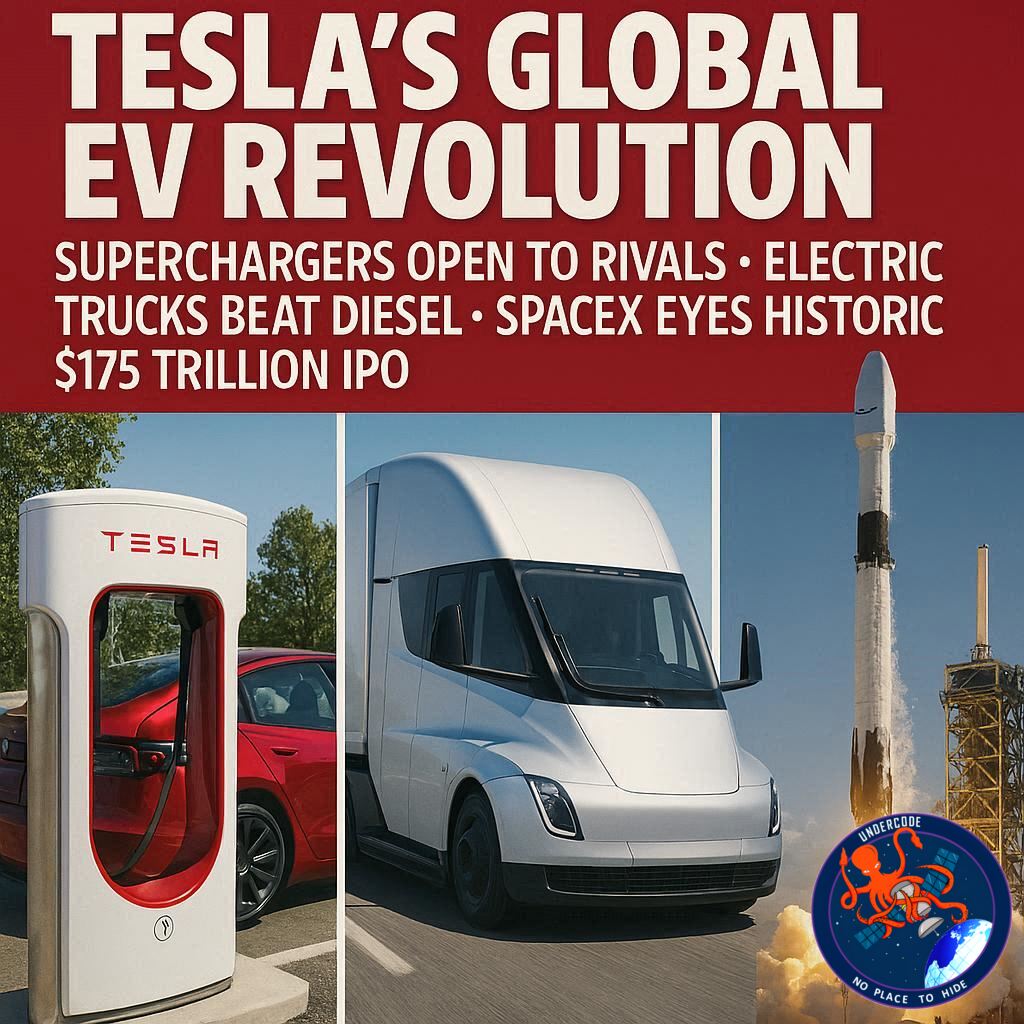
Recent developments highlight how these companies are pushing boundaries simultaneously across several industries. Tesla has begun opening its powerful Supercharging network to non-Tesla vehicles in Malaysia, signaling a growing commitment to universal EV charging access. Meanwhile, Tesla’s Semi truck is demonstrating remarkable efficiency gains over traditional diesel trucks in real-world logistics testing in Texas. At the same time, SpaceX may be preparing one of the largest stock market debuts in history with a potential valuation of $1.75 trillion.
Together, these developments illustrate a coordinated push toward electrification, infrastructure expansion, and technological disruption. From city tunnels to long-haul freight and global EV charging networks, Musk-led companies are steadily building systems that could redefine how people move on Earth—and eventually beyond it.
Tesla Expands Its Supercharging Network to New Markets
Tesla operates the most extensive fast-charging network for electric vehicles in the world. For years, the company restricted access to Tesla drivers only, creating an exclusive ecosystem that helped Tesla owners enjoy unmatched charging reliability and convenience.
However, the company has gradually begun opening this network to vehicles made by other automakers. The latest step in this strategy occurred in Malaysia, where Tesla launched several Supercharger sites that can now be used by non-Tesla EV owners.
The expansion marks the first time Tesla has made its Supercharging network accessible to other EV brands in the country. The move is expected to significantly improve charging accessibility for the growing number of electric vehicles on Malaysian roads.
New Supercharger Locations Across Malaysia
Tesla recently opened a Supercharging station at Pavilion KL Mall in Kuala Lumpur that provides eight charging stalls capable of delivering speeds up to 250 kilowatts. These high-power chargers allow compatible EVs to gain substantial driving range in a short amount of time.
In addition to the Kuala Lumpur site, Tesla is also opening several additional charging stations across the country. A four-stall Supercharger site is now available in Shah Alam, while another four-stall station has opened at IOI City Mall. Tesla has also introduced a six-stall Supercharger site in Gamuda Cove Township.
These installations significantly expand the charging infrastructure available to electric vehicle owners in Malaysia and help reduce one of the major barriers to EV adoption: limited charging access.
Making Electric Vehicle Ownership Easier
Tesla’s strategy of opening its charging network to other manufacturers is intended to simplify EV ownership regardless of the brand drivers choose. Many EV owners rely heavily on home charging or third-party charging networks, which can sometimes be less reliable or slower.
While charging at home remains the most convenient method for daily driving, long-distance travel still requires dependable fast-charging stations along highways and urban centers.
Tesla’s network has built a reputation for reliability and high performance. Allowing other EV drivers to access this system helps create a more cohesive electric mobility ecosystem.
Tesla’s Charging Network Opens to Competitors
Tesla began opening its charging network in the United States in 2024 when Ford became the first automaker to gain access. The partnership was announced jointly by Tesla CEO Elon Musk and Ford CEO Jim Farley.
Since then, many other manufacturers have joined the program. Companies such as Rivian, Lucid, and major legacy automakers like General Motors now allow their EV customers to charge using Tesla’s infrastructure.
This shift reflects a broader industry trend toward standardized charging access and interoperability between competing brands.
Some Growing Pains Remain
Although the expansion benefits EV drivers overall, there are still logistical challenges when non-Tesla vehicles use Tesla chargers.
Tesla’s charging cables and stall designs were originally optimized for Tesla vehicles. As a result, some non-Tesla vehicles may find cable lengths slightly restrictive depending on their charging port placement.
However, Tesla’s newer V4 Supercharger design aims to address these issues. The V4 stations feature longer cables and more flexible stall designs, making them easier to use for a wider range of vehicles.
As these new chargers become more common, compatibility challenges are expected to decline.
Tesla Semi Pilot Program Expands to Texas
Beyond passenger vehicles, Tesla is also pushing electrification in the freight industry. The company recently expanded its Tesla Semi pilot program to Texas, where logistics company Mone Transport has been testing the electric truck in real-world operations.
Mone Transport specializes in cross-border freight between the United States and Mexico, making it an ideal environment for evaluating long-distance trucking performance.
The company reported operating the Tesla Semi for more than 4,700 miles during the test period.
Tesla Semi Demonstrates Exceptional Efficiency
The test results from Mone Transport were particularly impressive. The Tesla Semi achieved an efficiency rating of 1.64 kilowatt-hours per mile, outperforming Tesla’s official target of 1.7 kilowatt-hours per mile.
This efficiency advantage represents a dramatic improvement over traditional diesel trucks.
Typical Class 8 diesel trucks average between six and seven miles per gallon. When converted into energy-equivalent terms, these vehicles consume approximately 5.5 kilowatt-hours per mile—meaning the Tesla Semi uses roughly three to four times less energy.
In addition to energy savings, electric trucks eliminate tailpipe emissions entirely.
Consistent Performance Across Pilot Programs
The results reported by Mone Transport align with findings from other companies participating in Tesla’s pilot program.
ArcBest’s ABF Freight division tested the truck over nearly 4,500 miles and achieved an average efficiency of 1.55 kilowatt-hours per mile across diverse routes. The test included a challenging climb over the 7,200-foot Donner Pass.
PepsiCo, which operates the largest Tesla Semi fleet, recorded an efficiency rate of 1.7 kilowatt-hours per mile in testing conducted by the North American Council for Freight Efficiency.
Additional companies participating in trials have reported similar results. DHL achieved 1.72 kilowatt-hours per mile, while Saia reported 1.73 kilowatt-hours per mile.
Lower Costs and Environmental Benefits
These efficiency gains translate directly into lower operating costs for logistics companies. Electric trucks require less energy per mile and generally have fewer moving parts than diesel engines, which reduces maintenance requirements.
When combined with zero emissions, the Tesla Semi presents a compelling case for companies seeking both financial savings and sustainability improvements.
As production increases and charging infrastructure expands, electric freight transport could become far more common across major logistics networks.
Tesla Builds Charging Infrastructure for Electric Trucks
Tesla is already preparing infrastructure to support widespread Semi deployment. The company recently launched the first public Semi Megacharger station in Los Angeles.
These high-capacity charging stations are designed specifically for heavy-duty electric trucks.
Tesla initially plans to expand this infrastructure along major West Coast freight routes before eventually extending the network across the United States.
SpaceX May Be Preparing a Historic Stock Market Debut
While Tesla continues advancing electric transportation, another Musk-led company may soon shake up the financial world.
SpaceX is reportedly considering an initial public offering that could become the largest IPO in history.
According to reports, the company is evaluating a listing on the Nasdaq stock exchange, although the New York Stock Exchange is also competing to host the offering.
A Potential $1.75 Trillion Valuation
Sources familiar with the discussions suggest SpaceX could aim for a valuation of approximately $1.75 trillion.
If achieved, that valuation would place the company among the most valuable publicly traded firms in the United States.
At current market comparisons, such a valuation could make SpaceX the sixth-largest company in the country by market capitalization.
Fast-Tracking Entry Into the Nasdaq-100
Nasdaq is reportedly proposing a rule change designed to accelerate the inclusion of massive newly listed companies into the Nasdaq-100 index.
Under the proposed “Fast Entry” rule, companies with sufficiently large market capitalizations could join the index in less than one month after going public.
Normally, companies must wait up to a year before becoming eligible for major indexes such as the Nasdaq-100 or the S&P 500.
Index inclusion is extremely valuable because many institutional investors buy stocks automatically through index-tracking funds.
The Boring Company Expands the Vegas Loop
Another Musk-related venture, The Boring Company, is continuing to expand its underground transportation network in Las Vegas.
The company recently completed a new tunnel using its Prufrock-2 tunnel boring machine.
The tunnel measures approximately 2.28 miles, making it the longest single tunnel segment constructed so far within the Vegas Loop system.
Massive Engineering Effort Behind the Tunnel
Constructing the tunnel required moving roughly 68,000 cubic yards of soil. The excavation process relied on a continuous conveyor belt stretching nearly 4.8 miles and powered by six motors generating a combined 825 horsepower.
The tunnel is the fourth constructed near the Westgate Las Vegas area and marks another milestone in the growing underground transportation network.
Vegas Loop Successfully Handles Major Events
The Las Vegas Convention Center Loop segment has already proven useful during large events.
During the 2026 CONEXPO-CON/AGG construction trade show, the system transported approximately 82,000 passengers across the convention center campus.
The event itself attracted more than 140,000 construction professionals from 128 countries.
The Vegas Loop is intended to eventually expand across the entire city, connecting key tourist destinations and transportation hubs.
What Undercode Says:
A Strategic Ecosystem Rather Than Separate Projects
What stands out about these announcements is that they are not isolated developments. Instead, they represent pieces of a larger strategic ecosystem being built across multiple industries.
Tesla’s Supercharging expansion, electric freight transport, SpaceX’s financial ambitions, and The Boring Company’s infrastructure projects all point toward an integrated future of mobility and energy.
Each project reinforces the others.
Charging Infrastructure Is the Real Competitive Advantage
Opening Tesla’s charging network to competitors might appear generous, but it is also strategically brilliant.
Infrastructure historically determines winners in transportation revolutions. Oil pipelines defined the petroleum era, rail networks defined early industrial expansion, and highways enabled mass automotive adoption.
By allowing competitors onto its network, Tesla effectively positions itself as the backbone of the EV ecosystem.
This move could transform Tesla from merely an automaker into a global energy infrastructure provider.
Electric Freight Could Be a Trillion-Dollar Disruption
The freight industry represents one of the largest untapped markets for electrification.
Long-haul trucking consumes enormous amounts of fuel annually, and logistics companies constantly seek ways to reduce costs.
If Tesla’s efficiency claims continue to hold in large-scale deployments, the economic incentive alone could drive rapid adoption.
Energy savings of three to four times compared to diesel trucks could translate into billions of dollars in operational savings across the global freight industry.
SpaceX’s IPO Could Redefine the Space Economy
A potential $1.75 trillion valuation for SpaceX would signal a profound shift in how investors view the commercial space industry.
For decades, space exploration was dominated by government agencies. Today, private companies are leading many of the most ambitious initiatives.
If SpaceX goes public at that valuation, it could trigger massive investment flows into space-related technologies, including satellite networks, launch services, and lunar infrastructure.
Infrastructure Is Musk’s Real Long-Term Strategy
Looking across Tesla, SpaceX, and The Boring Company reveals a consistent theme: infrastructure.
Superchargers build the backbone of electric transportation. Megachargers enable electric freight. Rocket launch systems and satellite networks form the foundation of the modern space economy. Underground tunnels address urban transportation bottlenecks.
These projects may appear unrelated, but they all revolve around building critical systems that others will depend on.
The Risk Factor Investors Cannot Ignore
Despite the impressive progress, risks remain.
Scaling the Tesla Semi program requires massive battery production and reliable megacharging networks.
Opening Superchargers to competitors could potentially increase congestion unless infrastructure expands quickly enough.
And a SpaceX IPO at a $1.75 trillion valuation would place enormous pressure on the company to deliver sustained growth in the space industry.
Nevertheless, the trajectory suggests that Musk’s companies are attempting to dominate not just individual products, but entire technological ecosystems.
🔍 Fact Checker Results
Verified Expansion of Tesla Superchargers
✅ Tesla has been gradually opening its Supercharger network to non-Tesla vehicles since 2024.
Confirmed Tesla Semi Efficiency Data
✅ Multiple pilot programs report energy efficiency around 1.5–1.7 kWh per mile.
SpaceX IPO Still Not Official
❌ SpaceX has not officially confirmed an IPO timeline or final valuation.
📊 Prediction
If Tesla continues expanding its charging infrastructure globally while simultaneously deploying electric freight trucks, the company could become the central energy platform for the EV era. Within the next decade, Tesla may generate as much revenue from charging networks, energy infrastructure, and logistics technology as it does from vehicle sales themselves. Meanwhile, if SpaceX proceeds with a public listing near the reported $1.75 trillion valuation, it could ignite the largest wave of private investment in the commercial space industry since the dawn of the satellite age.
🕵️📝✔️Let’s dive deep and fact‑check.
References:
Reported By: www.teslarati.com
Extra Source Hub (Possible Sources for article):
https://www.linkedin.com
Wikipedia
OpenAi & Undercode AI
Image Source:
Unsplash
Undercode AI DI v2
Bing
🔐JOIN OUR CYBER WORLD [ CVE News • HackMonitor • UndercodeNews ]
📢 Follow UndercodeNews & Stay Tuned:
𝕏 formerly Twitter 🐦 | @ Threads | 🔗 Linkedin | 🦋BlueSky | 🐘Mastodon


