
Listen to this Post
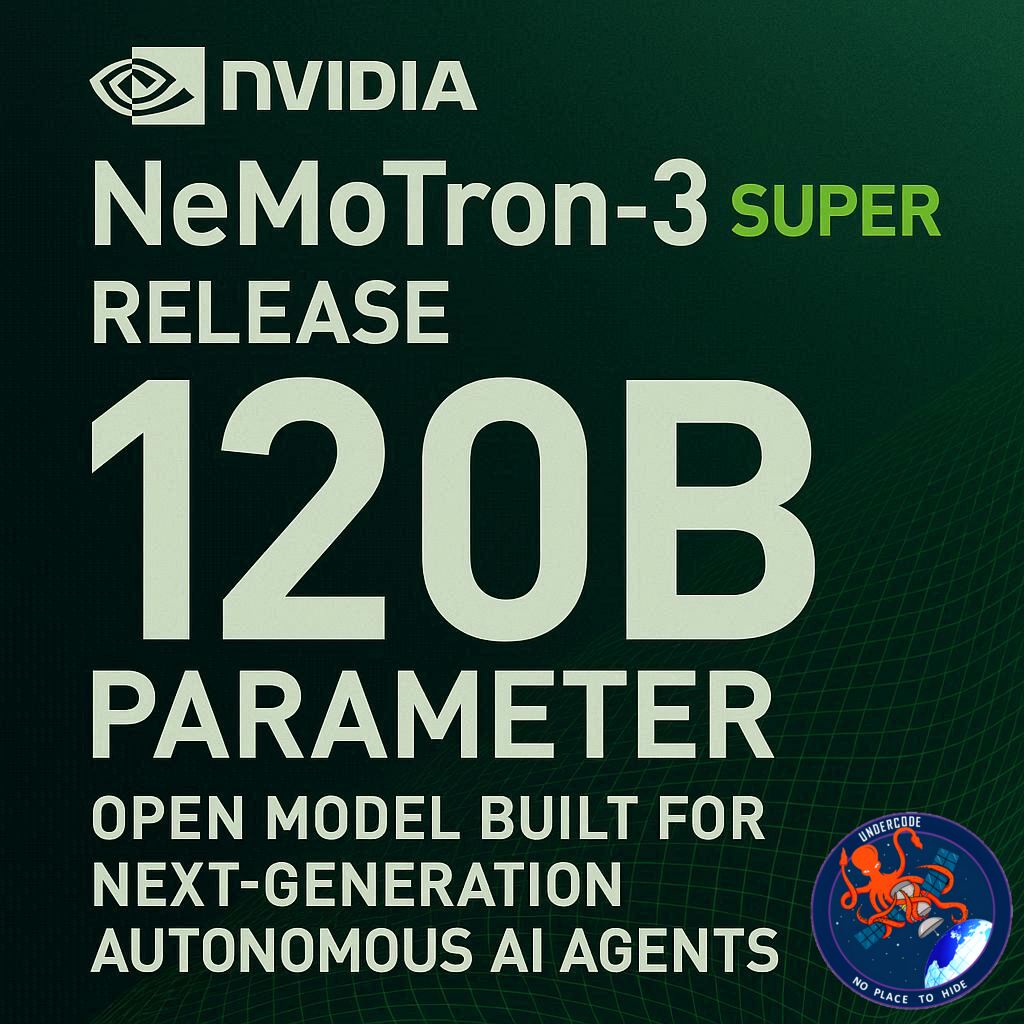
Introduction: A Strategic Leap Toward Scalable Agentic AI
Artificial intelligence is rapidly evolving beyond simple chatbots and into complex, autonomous systems capable of performing multi-step reasoning, research, coding, and decision-making. As organizations increasingly deploy AI agents to automate workflows and conduct sophisticated analysis, the demand for models that can reason deeply while remaining efficient has intensified. Responding to this shift, NVIDIA has introduced Nemotron 3 Super, a massive open AI model designed specifically for agent-driven applications.
Released today, Nemotron 3 Super features 120 billion parameters, though only 12 billion parameters remain active during inference, enabling exceptional efficiency without sacrificing capability. The model is engineered to power complex multi-agent systems, delivering strong reasoning performance while reducing the computational burden that typically limits large-scale AI deployments. With a 1-million-token context window, hybrid architecture innovations, and open-weight availability, Nemotron 3 Super aims to provide developers, researchers, and enterprises with a powerful platform for building autonomous AI systems that operate across vast datasets and extended workflows.
This release signals a broader transformation in how AI models are designed. Instead of focusing purely on conversational intelligence, Nemotron 3 Super targets agentic workflows, where AI systems collaborate, analyze large volumes of information, and autonomously execute tasks. By addressing major challenges such as context overload and reasoning costs, NVIDIA positions this model as a cornerstone technology for next-generation AI infrastructure.
Overview of Nemotron 3 Super’s Architecture and Capabilities
Nemotron 3 Super is engineered to handle the demanding requirements of multi-agent AI environments, where multiple AI systems interact to solve complex problems. The model combines a large parameter base with an efficiency-focused architecture that activates only a fraction of its parameters during inference. This design dramatically reduces operational cost while maintaining high reasoning accuracy.
One of its most notable features is the 1-million-token context window, allowing AI agents to maintain extremely long memory chains. In practical terms, this means an agent can process massive documents, entire codebases, or extensive workflow histories without losing track of its objectives. Traditional AI systems often struggle with such workloads because they must repeatedly resend contextual data during interactions. Nemotron 3 Super mitigates this issue by retaining full workflow states, reducing both token consumption and reasoning errors.
The model is already being adopted by several AI-native platforms. The AI search platform Perplexity AI has integrated Nemotron 3 Super into its ecosystem, allowing users to access the model for search tasks and as part of a broader orchestration system involving multiple AI models. Meanwhile, software development tools such as CodeRabbit and Greptile are integrating the model into AI coding agents designed to analyze and improve software projects.
Beyond software engineering, the model is gaining traction in scientific research environments. Organizations such as Edison Scientific and Lila Sciences are deploying Nemotron 3 Super to power advanced research agents capable of conducting literature reviews, performing data science analysis, and exploring molecular research data.
Enterprise Deployment Across Major Technology Platforms
Enterprise technology companies are also adopting Nemotron 3 Super to automate specialized workflows. Telecommunications giant Amdocs, analytics firm Palantir Technologies, semiconductor design software leader Cadence Design Systems, engineering software company Dassault Systèmes, and industrial technology provider Siemens are among those exploring deployments.
In these environments, the model can automate tasks ranging from cybersecurity orchestration to semiconductor design optimization and manufacturing process analysis. By embedding advanced reasoning capabilities into enterprise systems, companies can deploy AI agents capable of monitoring operations, diagnosing issues, and generating solutions without constant human intervention.
Addressing the Two Major Challenges in Multi-Agent AI Systems
As companies transition from chatbots to sophisticated agent ecosystems, two major challenges frequently arise.
Context Explosion
Multi-agent workflows generate far more data than standard conversational AI systems. Each interaction often requires the AI to resend its full reasoning history, tool outputs, and intermediate decisions. This creates what researchers call context explosion, where token usage can increase up to 15 times compared to traditional chat interactions.
Such large context streams increase operational costs and introduce a new risk known as goal drift, where AI agents lose alignment with the original task due to fragmented reasoning chains.
Nemotron 3 Super addresses this issue through its million-token context capacity, allowing agents to keep full workflow memory without repeatedly reconstructing context.
The Thinking Tax
Another challenge is the computational cost of reasoning. Multi-agent systems must analyze problems continuously at each step of a workflow. Using large models for every small subtask dramatically increases latency and expense.
By activating only 12 billion parameters out of 120 billion, Nemotron 3 Super reduces inference costs while preserving the reasoning ability necessary for complex tasks.
Hybrid Architecture Driving Performance Gains
Nemotron 3 Super introduces a hybrid Mixture-of-Experts (MoE) architecture designed to maximize efficiency and accuracy simultaneously.
Several technological innovations power this architecture:
Hybrid Neural Layers
The model integrates Mamba layers, which significantly improve memory and computational efficiency, alongside traditional transformer layers responsible for advanced reasoning capabilities.
Selective Parameter Activation
Through its MoE design, only a small portion of the model’s parameters activate during inference, drastically reducing compute requirements.
Latent MoE Technology
This technique allows the system to engage multiple expert subnetworks while maintaining the cost equivalent of a single expert activation. The result is improved prediction accuracy with minimal computational overhead.
Multi-Token Prediction
Instead of predicting one word at a time, the model forecasts multiple future tokens simultaneously, enabling inference speeds up to three times faster than conventional models.
When deployed on the NVIDIA Blackwell Platform, Nemotron 3 Super operates using NVFP4 precision, which reduces memory consumption while delivering inference speeds up to four times faster compared to FP8 precision on the NVIDIA Hopper Architecture.
Open Weights and Research Transparency
A major highlight of this release is NVIDIA’s decision to publish the model with open weights under a permissive license. Developers can deploy Nemotron 3 Super locally on workstations, within enterprise data centers, or through cloud infrastructure.
The training process also demonstrates a commitment to transparency. The model was trained using synthetic datasets generated by advanced reasoning models, totaling more than 10 trillion tokens across pre-training and post-training phases.
NVIDIA has released detailed training methodologies, reinforcement learning environments, and evaluation recipes. Researchers can further refine the model using the NVIDIA NeMo platform, enabling customization for specialized applications.
Practical Applications in Agentic AI Systems
Nemotron 3 Super is optimized to perform as a component within complex AI agent ecosystems rather than as a standalone conversational model.
In software development, an AI agent powered by Nemotron 3 Super can ingest an entire codebase into its context window. This allows the system to generate new code, debug issues, and refactor programs while maintaining a full understanding of the project structure.
In financial analysis, the model can process thousands of pages of reports simultaneously. This eliminates the need for repeated reasoning across multiple conversation threads, dramatically improving efficiency when analyzing corporate filings, market data, or risk assessments.
In cybersecurity, the model’s accurate tool-calling capabilities enable AI systems to navigate massive function libraries and execute automated responses to threats. Such reliability is essential in high-stakes environments where incorrect actions could disrupt operations or compromise security.
Global Availability and Deployment Ecosystem
Nemotron 3 Super is accessible through multiple AI platforms and cloud providers. Developers can access the model via build.nvidia.com, as well as through infrastructure services including Hugging Face and OpenRouter.
Enterprise deployments are also expanding through partnerships with major cloud platforms such as Google Cloud, Oracle, Amazon Web Services, and Microsoft Azure.
Additionally, NVIDIA cloud partners including CoreWeave, Crusoe, Nebius, and Together AI are enabling scalable inference environments for organizations deploying agentic AI.
What Undercode Say:
The Strategic Importance of Agent-Optimized AI Models
The release of Nemotron 3 Super reflects a critical shift in artificial intelligence development. For years, the industry focused primarily on chat-based AI experiences, where models interacted directly with users. However, the real economic value of AI lies not in chat interfaces but in autonomous systems capable of performing work independently.
Agentic AI represents that next stage.
In this model, AI systems operate like digital workers. They search information, analyze data, run software tools, and coordinate with other AI agents to accomplish complex objectives. Such systems require three capabilities that many current models struggle with: long-term memory, consistent reasoning, and computational efficiency.
Nemotron 3 Super addresses all three.
The million-token context window solves a major bottleneck that has slowed agent adoption. Many AI workflows break down when models forget earlier reasoning steps or lose track of large datasets. By keeping entire workflows in memory, the model can maintain continuity across long tasks such as research, coding, and strategic analysis.
The hybrid architecture is equally important. Traditional transformer models become extremely expensive as they scale. NVIDIA’s mixture-of-experts strategy effectively separates model size from computational cost, allowing a 120-billion-parameter system to operate with the efficiency of a much smaller model.
Another interesting dimension is NVIDIA’s decision to release the model with open weights. This move contrasts with the increasingly closed ecosystems emerging among major AI labs. Open access enables enterprises to run powerful models internally, which is crucial for industries dealing with sensitive data such as finance, healthcare, and government.
There is also a broader competitive narrative here. Companies like OpenAI, Anthropic, and Google DeepMind dominate consumer AI conversations. NVIDIA’s approach, however, targets the infrastructure layer of AI, focusing on models that power enterprise systems rather than consumer chatbots.
This strategy aligns with NVIDIA’s core business in accelerated computing hardware. By designing AI models optimized for its own platforms, such as Blackwell GPUs, NVIDIA strengthens the entire ecosystem surrounding its hardware.
The rise of agent-focused models like Nemotron 3 Super also suggests that the future AI landscape may consist of multiple specialized models working together, rather than a single all-purpose model.
In that world, orchestration platforms will become as important as the models themselves. Systems will coordinate dozens of specialized AI agents, each responsible for research, reasoning, coding, or planning tasks.
Nemotron 3 Super appears designed precisely for this architecture.
If adoption grows as expected, the model could play a key role in the emerging AI workforce paradigm, where autonomous agents operate alongside human teams, managing complex digital processes in real time.
Fact Checker Results
✅ Nemotron 3 Super is a 120-billion-parameter model with only 12 billion active parameters during inference.
✅ The model supports a 1-million-token context window designed for large multi-agent workflows.
✅ NVIDIA released the model with open weights and detailed training methodology for developers and researchers.
Prediction
📊 Autonomous multi-agent AI systems will become a dominant enterprise software architecture within the next five years.
📊 Open-weight models like Nemotron 3 Super will accelerate private AI deployments across regulated industries.
📊 NVIDIA’s integration of AI models with its GPU ecosystem could further strengthen its leadership in the global AI infrastructure market.
▶️ Related Video (72% Match):
🕵️📝✔️Let’s dive deep and fact‑check.
References:
Reported By: blogs.nvidia.com
Extra Source Hub (Possible Sources for article):
https://www.medium.com
Wikipedia
OpenAi & Undercode AI
Image Source:
Unsplash
Undercode AI DI v2
Bing
🔐JOIN OUR CYBER WORLD [ CVE News • HackMonitor • UndercodeNews ]
📢 Follow UndercodeNews & Stay Tuned:
𝕏 formerly Twitter 🐦 | @ Threads | 🔗 Linkedin | 🦋BlueSky | 🐘Mastodon


