
Listen to this Post
Introduction: A Budget MacBook That Shook the Market
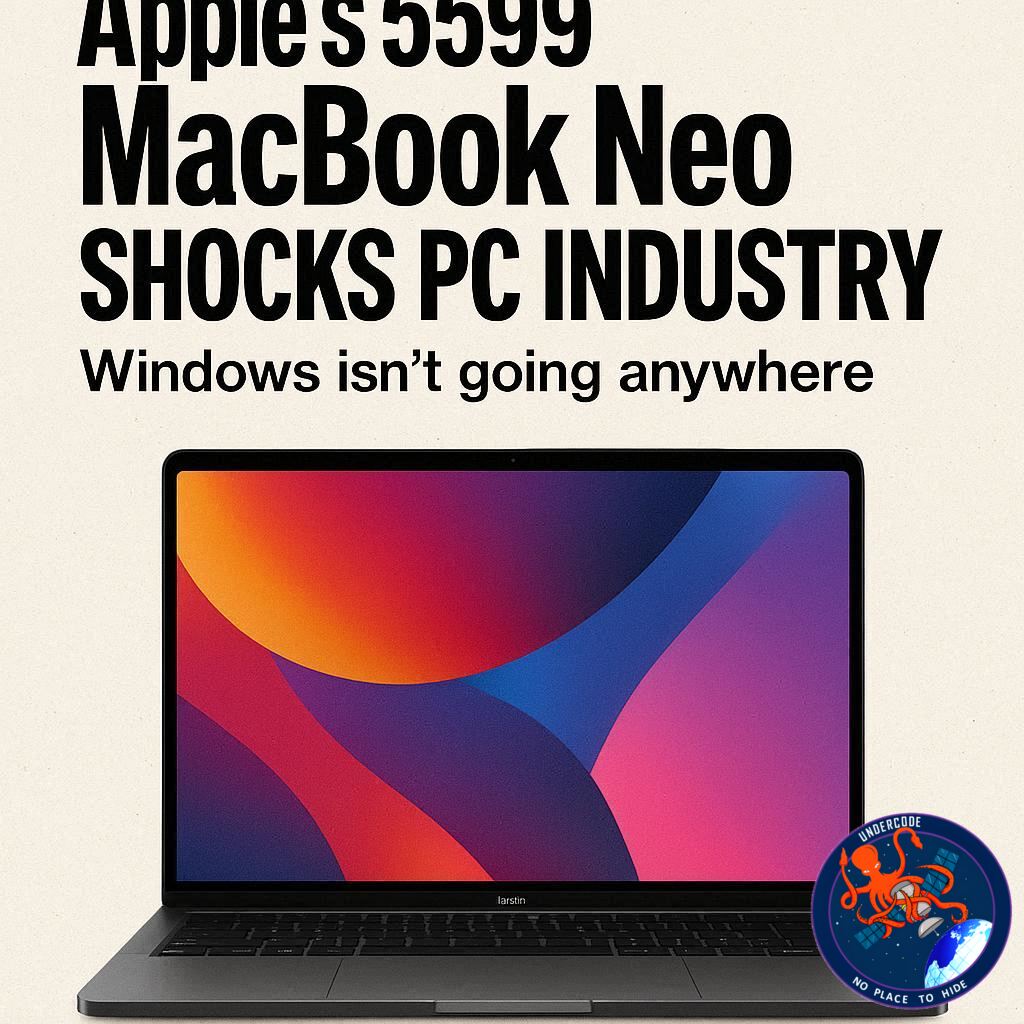
For years, Apple laptops have carried a reputation for premium pricing and polished design. Devices like the MacBook Air and MacBook Pro have dominated conversations about performance and build quality, but they have rarely competed in the true budget segment. That changed with the introduction of the MacBook Neo, a $599 laptop that immediately captured attention across the technology industry.
Even before the first reviews appeared online, analysts and tech enthusiasts were already debating its impact. Would Apple finally disrupt the affordable laptop market dominated by Windows machines? Could a $599 MacBook force millions of users to switch ecosystems? Or would it simply join the crowded mid-range laptop space without changing the bigger picture?
Early reactions from PC manufacturers suggest that the launch certainly made waves. However, while the device surprised the industry, it may not reshape the market as dramatically as some headlines suggest.
Early Predictions About the MacBook Neo
Before the MacBook Neo even reached reviewers, two key predictions were already circulating among industry observers.
The first prediction focused on the laptop’s hardware limitations. With only 8GB of RAM and no upgrade options, many experts believed memory capacity would become a bottleneck for heavier workloads. Some early review units confirmed this concern. Even popular tech creators like Marques Brownlee acknowledged that the laptop’s memory configuration could restrict certain tasks such as advanced productivity workflows or professional creative work.
The second prediction was broader and more strategic. While the MacBook Neo’s aggressive price point would challenge Windows laptops in the same category, it was unlikely to drastically reduce the market share of Windows-based machines. The reasoning behind this expectation was simple: the PC ecosystem is massive, diverse, and deeply entrenched.
As it turns out, that prediction appears to be holding true.
ASUS Reacts: A Shock to the Entire Market
The impact of Apple’s new laptop became a topic of discussion during the Q4 2025 earnings call of ASUSTeK Computer. During the call, Chief Financial Officer Nick Wu addressed questions about the potential influence of the MacBook Neo on the global PC market.
Wu confirmed that Apple’s decision to launch such an affordable laptop surprised many companies across the industry. He described the move as “a shock to the entire market,” primarily because Apple has historically maintained premium pricing across its Mac lineup.
However, the broader message from ASUS was not one of panic or concern. Instead, Wu explained that the industry had already begun evaluating how to respond.
According to him, PC manufacturers had been aware of the product months before its official launch and had already started internal preparations. After the laptop became publicly available, ASUS examined its specifications more closely and concluded that the device also had some clear limitations.
Limitations in the Budget MacBook
One of the most frequently discussed limitations of the MacBook Neo is its fixed memory configuration.
The device includes only 8GB of RAM, and unlike many Windows laptops, the memory cannot be upgraded later. For users who run demanding software, manage large datasets, or rely on heavy multitasking, this limitation could significantly affect performance.
Wu suggested that the laptop may not be intended as a direct replacement for traditional productivity machines. Instead, Apple might be positioning the Neo as a device designed primarily for lighter workloads such as browsing, media consumption, and casual productivity.
That positioning could limit its ability to replace the average Windows productivity laptop used by businesses and professionals.
The PC Ecosystem Is Already Preparing a Response
Perhaps the most important takeaway from the ASUS earnings call was not Apple’s pricing strategy but the response of the wider PC ecosystem.
Wu explained that PC manufacturers and upstream partners are already discussing strategies to compete with Apple’s new laptop. This includes collaboration with major technology companies such as Microsoft, Intel, and AMD.
These companies play a crucial role in shaping the Windows laptop ecosystem. From operating systems to processors and chip architectures, their cooperation determines how new PC designs emerge.
According to Wu, the industry expects manufacturers to release competing laptops with similar pricing and design ambitions.
In other words, the MacBook Neo may not dominate the market, but it will likely spark competition that benefits consumers.
The Reality of the Global PC Market
To understand why Apple’s new laptop is unlikely to overthrow the Windows ecosystem, it helps to look at the broader market landscape.
According to estimates from Gartner, the global PC industry shipped approximately 270 million computers in 2025. That massive volume reflects a highly competitive marketplace where multiple manufacturers share demand across different price ranges.
The estimated market share distribution looked roughly like this:
• Lenovo – 27.2%
• HP – 21.3%
• Dell – 15.3%
• Apple – 9.2%
• ASUS – 6.9%
Even after several years of strong performance from Apple’s M-series processors and widespread praise for MacBooks, Apple still holds less than 10 percent of the total PC market.
That statistic highlights an important reality: the Windows ecosystem remains incredibly large and resilient.
The PC Market Is Recovering
Another key trend shaping the industry is the recovery of global PC demand after the slowdown that followed the pandemic-era surge.
Gartner estimates that global PC shipments increased by roughly 9 percent year over year. Several factors are contributing to this renewed growth.
Corporate PC refresh cycles are replacing aging hardware across many organizations. Businesses are upgrading systems to support newer operating systems and improved security requirements.
There is also a significant wave of operating system upgrades, particularly related to new Windows versions and compatibility requirements.
At the same time, the emergence of AI-focused computers has generated new interest in high-performance hardware.
Gaming hardware demand also remains strong, keeping the PC ecosystem vibrant across multiple segments.
The Real Problem Facing PC Manufacturers
Despite the attention surrounding Apple’s new budget laptop, ASUS executives emphasized that the biggest challenge facing PC manufacturers is not competition from Apple.
Instead, the real concern is the rising cost of hardware components.
During the earnings call, Wu revealed that memory prices had increased dramatically in a short period. Between the fourth quarter and the first quarter alone, memory costs rose by more than 100 percent.
Supply constraints are expected to continue for several years, potentially lasting until 2027.
These shortages are largely driven by increasing demand for semiconductor resources across multiple industries.
AI servers and data centers require enormous amounts of memory and computing hardware. This demand competes directly with consumer electronics manufacturing.
At the same time, expanding semiconductor production capacity takes years, which means supply cannot immediately catch up with demand.
As a result, PC manufacturers must constantly balance component costs and final laptop pricing to remain competitive.
Why Apple’s Move Could Benefit Consumers
Although the launch of the MacBook Neo surprised the market, it may ultimately benefit consumers.
Historically, Apple has influenced the design and quality standards of laptops across the entire industry.
When Apple introduced high-resolution Retina displays, many Windows laptops eventually followed with improved screens.
Apple’s trackpad design also pushed the industry toward more responsive precision touchpads.
More recently, Apple’s custom silicon chips accelerated interest in ARM-based computing across the Windows ecosystem.
The MacBook Neo could trigger a similar ripple effect in the budget laptop segment.
Manufacturers may begin prioritizing better design, improved materials, and stronger overall user experience for laptops in the $600 price range.
What Undercode Say:
The launch of the MacBook Neo represents less of a revolution and more of a strategic signal to the entire PC industry. Apple is not attempting to dominate the budget market overnight. Instead, it is redefining expectations within that price category.
Historically, the $600 laptop market has been dominated by compromises. Devices in this range often sacrifice build quality, display quality, or battery life in order to hit aggressive price targets. Apple’s entry into this segment challenges that pattern.
Even if the Neo itself is not perfect, it changes the perception of what a $599 laptop should look and feel like. Consumers now see a machine with Apple’s design language, macOS integration, and respectable performance within that price bracket.
This shift forces Windows manufacturers to rethink product strategy. Hardware specifications alone are no longer enough. Many Windows laptops already offer better specs on paper than Apple devices at similar prices. Yet they often lack the design consistency and brand clarity that make MacBooks desirable.
Branding and simplicity have always been Apple’s strengths. Consumers instantly recognize a MacBook. The product line is easy to understand. In contrast, many Windows laptops suffer from confusing naming conventions and overwhelming configuration options.
Take for example the Lenovo Yoga Pro 7i Aura Edition. It is an excellent machine in terms of hardware and performance. However, its long and complicated name illustrates a broader industry problem. Consumers struggle to identify which models deliver the best value.
The MacBook Neo may therefore influence not only hardware design but also marketing strategy.
Another interesting implication involves ARM-based computing. Apple’s custom chips have already proven that ARM architecture can deliver impressive efficiency and performance in laptops. If a budget MacBook proves successful, it could accelerate ARM adoption across the Windows ecosystem as well.
Companies working with processors from Intel and AMD will likely continue pushing performance improvements, while new ARM competitors may emerge in response.
Ultimately, the biggest winner in this situation could be the consumer.
Competition tends to produce better products, stronger innovation, and more attractive pricing. If PC manufacturers respond aggressively, the $600 laptop segment may soon offer machines with better materials, longer battery life, and improved user experiences.
In that sense, the MacBook Neo may not destroy the Windows ecosystem, but it could force the industry to evolve faster.
Fact Checker Results
✅ Apple’s share of the global PC market remains under 10 percent according to industry estimates.
✅ ASUS executives did describe Apple’s $599 MacBook launch as a “shock” to the market.
❌ There is no evidence that the MacBook Neo alone will significantly reduce Windows laptop market share.
Prediction
🔮 The next two years will likely see a wave of redesigned Windows laptops targeting the $599 to $799 range.
🔮 Manufacturers will focus more on build quality, branding, and battery efficiency to compete with Apple’s appeal.
🔮 The budget laptop segment may become one of the most competitive areas of the entire PC industry.
🕵️📝✔️Let’s dive deep and fact‑check.
References:
Reported By: www.windowslatest.com
Extra Source Hub (Possible Sources for article):
https://www.medium.com
Wikipedia
OpenAi & Undercode AI
Image Source:
Unsplash
Undercode AI DI v2
Bing
🔐JOIN OUR CYBER WORLD [ CVE News • HackMonitor • UndercodeNews ]
📢 Follow UndercodeNews & Stay Tuned:
𝕏 formerly Twitter 🐦 | @ Threads | 🔗 Linkedin | 🦋BlueSky | 🐘Mastodon


