
Listen to this Post
Introduction: A Platform Reborn—And Crushed by Bots
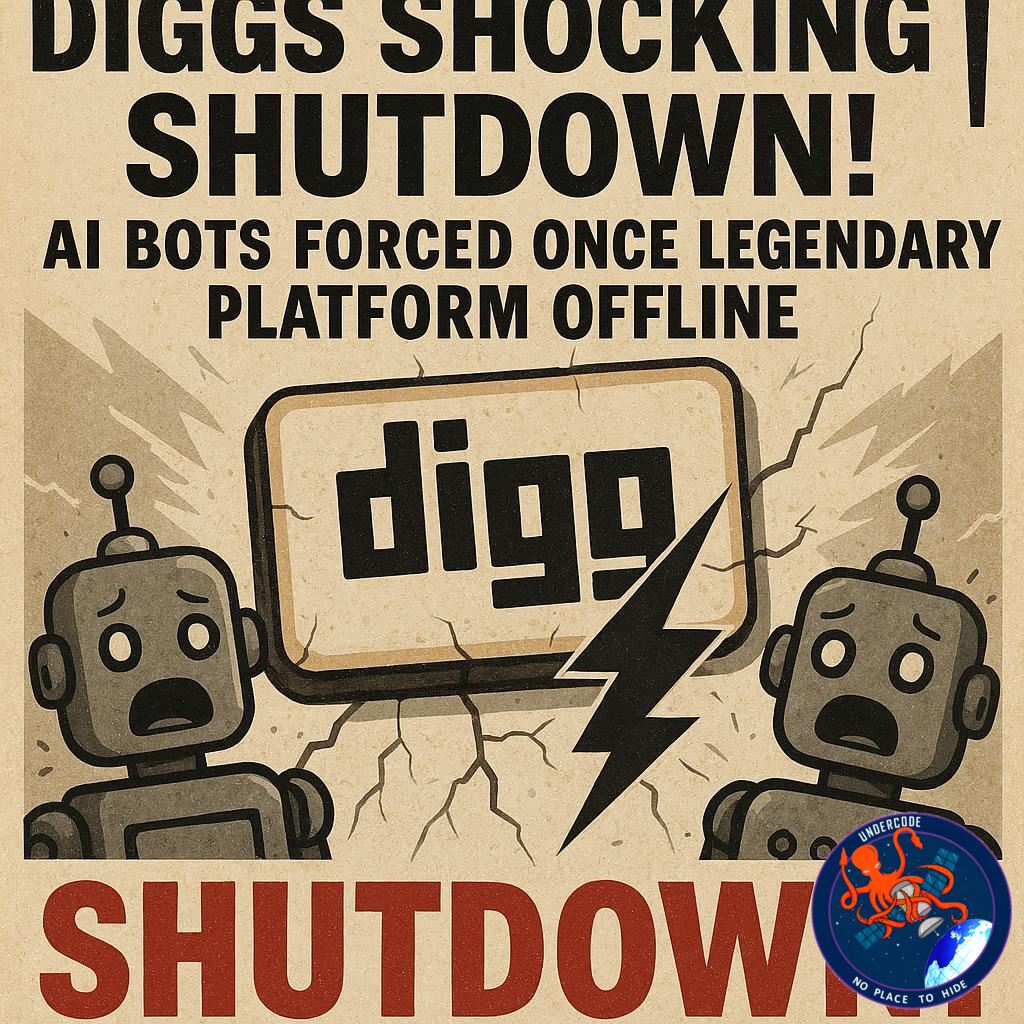
The internet has witnessed many comeback stories, but few have been as dramatic—and short-lived—as the latest revival of Digg. Once considered a pioneer of social news aggregation, the platform recently attempted a highly anticipated return to relevance. However, only months after relaunching its public beta, the company abruptly shut down operations again.
According to Digg’s CEO, Justin Mezzell, the cause was not a lack of users or interest, but an overwhelming wave of automated accounts and AI-driven spam. The scale of the problem was so severe that the team decided to temporarily take the platform offline entirely.
This sudden collapse highlights a growing challenge facing online communities: the rapid rise of sophisticated bots capable of mimicking human behavior. Digg’s failure to contain them has reignited debates about the future of social platforms and whether genuine online communities can survive in an era dominated by artificial intelligence.
The Long Road Back for Digg
Founded in 2004 by Kevin Rose, Digg quickly became one of the most influential websites on the early internet. Its concept was simple but powerful: users submitted links to interesting content, and the community voted stories up or down.
At its peak, Digg was a major force in shaping internet culture. Popular stories could receive massive traffic boosts, and being “dugg” often meant instant visibility across the web.
However, the platform’s influence began to decline in the early 2010s due to controversial redesigns and increasing competition from sites like Reddit. In 2012, Digg was sold, and its assets changed hands multiple times over the next decade, gradually fading from mainstream attention.
The story took a surprising turn in 2025 when Kevin Rose partnered with Alexis Ohanian—the co-founder of Reddit—to reacquire the platform from a digital advertising company. Their goal was ambitious: rebuild Digg as a modern community platform capable of competing with today’s social networks.
A Carefully Planned Relaunch
After reacquiring Digg, the team spent months developing a new version of the platform. The relaunch began with a closed beta designed to test the infrastructure and community dynamics.
Early messaging from the company emphasized a major priority: rebuilding trust in online communities.
Modern social networks face widespread issues with spam, fake accounts, and coordinated manipulation campaigns. Digg’s new strategy was designed to directly confront these problems.
The company introduced a system of “trust signals,” which combined multiple verification mechanisms to identify genuine users and discourage automated spam.
Some communities even considered requiring proof of product ownership before allowing members to post. This approach aimed to ensure that participants were real people with legitimate interests rather than anonymous bots.
For a brief moment, it seemed like the strategy might work.
The Bot Problem No One Expected
Unfortunately, reality proved far more complicated.
Shortly after the beta launch, Digg began detecting suspicious activity. Automated accounts appeared within hours, many designed specifically to exploit the site’s influence on search engine rankings.
SEO spammers quickly realized that links posted on Digg still carried valuable authority in Google search results.
As a result, the platform became a magnet for spam networks attempting to manipulate search rankings.
According to CEO Justin Mezzell, the scale of the attack was unlike anything the team anticipated. Tens of thousands of accounts were banned within a short period.
Despite deploying internal moderation tools and partnering with external security vendors, the flood of automated accounts continued.
The bots were not simple scripts—they were advanced AI agents capable of posting comments, voting on content, and interacting with other users in ways that closely resembled human behavior.
When Trust Collapses, Communities Collapse
The core problem, Mezzell explained, was not just the presence of bots but the erosion of trust.
Community platforms rely heavily on authentic engagement. Votes, comments, and discussions only have value if they represent genuine opinions from real people.
When automated accounts dominate the conversation, the entire system becomes meaningless.
If users cannot trust that upvotes are real or that discussions involve actual participants, the fundamental purpose of a community platform disappears.
This realization ultimately forced Digg’s leadership to take drastic action: shutting the platform down and preparing for yet another rebuild.
Digg Is Not Dead—Just Resetting
Despite the shutdown, the Digg team insists this is not the end.
Instead, they are planning what they call a “hard reset.” The company will drastically reduce its workforce and rethink the platform’s strategy from the ground up.
Rather than trying to compete directly with established platforms like Reddit, Digg now aims to reinvent itself with a completely different approach.
A key part of this reboot involves the return of founder Kevin Rose, who will join the company full-time starting in April.
Rose will continue advising venture capital firm True Ventures, but Digg will become his primary focus once again.
For many longtime fans of the platform, Rose’s return represents a symbolic moment—a chance for the original visionary to guide the platform’s next chapter.
Diggnation Continues the Conversation
While the platform itself is offline, the community surrounding Digg is not disappearing entirely.
The company confirmed that the Digg-related podcast, Diggnation, will continue releasing monthly episodes.
These podcasts will serve as a bridge between the old platform and whatever version of Digg eventually emerges from the current rebuild.
What Undercode Says:
The AI Bot Crisis Is Larger Than Digg
Digg’s shutdown should not be viewed as an isolated failure. Instead, it reflects a rapidly expanding crisis affecting the entire internet ecosystem.
Automated accounts have existed for years, but recent advancements in artificial intelligence have dramatically increased their sophistication. Modern bots can generate human-like comments, engage in discussions, and coordinate voting patterns across thousands of accounts.
This evolution has created an environment where distinguishing real users from AI agents is becoming increasingly difficult.
Platforms that depend on democratic systems—such as upvotes, likes, and comments—are particularly vulnerable to this type of manipulation.
The Economic Incentive Behind Spam
One reason bot networks are so persistent is the strong financial incentive behind them.
Search engine optimization remains a multi-billion-dollar industry. If a spammer can manipulate search rankings by posting links on a trusted platform, the potential profit can be enormous.
Even a small improvement in search visibility can translate into thousands—or sometimes millions—of dollars in advertising revenue.
Because of this, attackers are willing to deploy large-scale automated systems to exploit any platform that carries search authority.
Digg’s legacy reputation likely made it an especially attractive target.
Why Smaller Platforms Are at Greater Risk
Large platforms like Reddit or major social networks have massive moderation teams and sophisticated AI detection systems.
Smaller platforms, however, often lack these resources.
When Digg relaunched, it faced a difficult reality: it had the historical reputation of a major site but the operational scale of a startup.
This imbalance made it a prime target for automated attacks.
Bots could overwhelm the platform faster than the moderation infrastructure could adapt.
The Trust Economy of Online Communities
Online communities are built on what can be called a “trust economy.”
Users invest time and attention into discussions because they believe they are interacting with real people.
Once that trust erodes, engagement drops rapidly.
This is why Mezzell’s statement—“trust is the product”—captures the core issue.
For social platforms, authenticity is not just a feature. It is the entire value proposition.
The Future May Require Identity Verification
Digg’s earlier idea of requiring proof of product ownership hints at a larger trend: stronger identity verification.
Many experts now believe that future community platforms may require some form of real-world verification to prevent bot infiltration.
This could include device authentication, verified purchases, or blockchain-based identity systems.
While these approaches raise privacy concerns, they may become necessary if AI bots continue to grow more advanced.
The Real Question: Can the Open Internet Survive?
Digg’s collapse highlights a deeper question about the future of the open internet.
For decades, the web thrived on openness and accessibility. Anyone could create an account and participate in online communities.
However, AI-driven automation threatens that model.
If bots become indistinguishable from humans, platforms may be forced to introduce stricter identity systems that fundamentally change how online communities operate.
Digg’s current struggle may therefore represent an early glimpse into a much larger transformation across the digital landscape.
🔍 Fact Checker Results
Verified Statements About Digg’s Shutdown
✅ Digg temporarily shut down its new platform after discovering large-scale bot activity during its beta phase.
Confirmed Leadership Changes
✅ Founder Kevin Rose is officially returning to the company to help guide the next reboot.
Broader Industry Context
✅ AI-generated spam and automated accounts have become a major challenge for platforms across the internet, including communities like Reddit and others.
📊 Prediction
The Rise of “Anti-Bot” Internet Platforms
Over the next five years, social platforms will likely invest heavily in anti-automation technologies. Behavioral biometrics, AI-driven detection models, and identity verification systems may become standard features for community sites.
Community Platforms Will Shift Toward Private Spaces
Open platforms like Digg may increasingly transition toward semi-private communities where entry requires verification or membership credentials. This could dramatically reshape how information spreads online.
Digg’s Next Version Could Become an Experiment
If the next version of Digg successfully solves the bot problem, it could become a test case for a new generation of social platforms—ones built specifically to defend against AI manipulation rather than simply react to it.
🕵️📝✔️Let’s dive deep and fact‑check.
References:
Reported By: 9to5mac.com
Extra Source Hub (Possible Sources for article):
https://www.github.com
Wikipedia
OpenAi & Undercode AI
Image Source:
Unsplash
Undercode AI DI v2
Bing
🔐JOIN OUR CYBER WORLD [ CVE News • HackMonitor • UndercodeNews ]
📢 Follow UndercodeNews & Stay Tuned:
𝕏 formerly Twitter 🐦 | @ Threads | 🔗 Linkedin | 🦋BlueSky | 🐘Mastodon


