
Listen to this Post
Introduction: When AI Supercharges Cybercrime
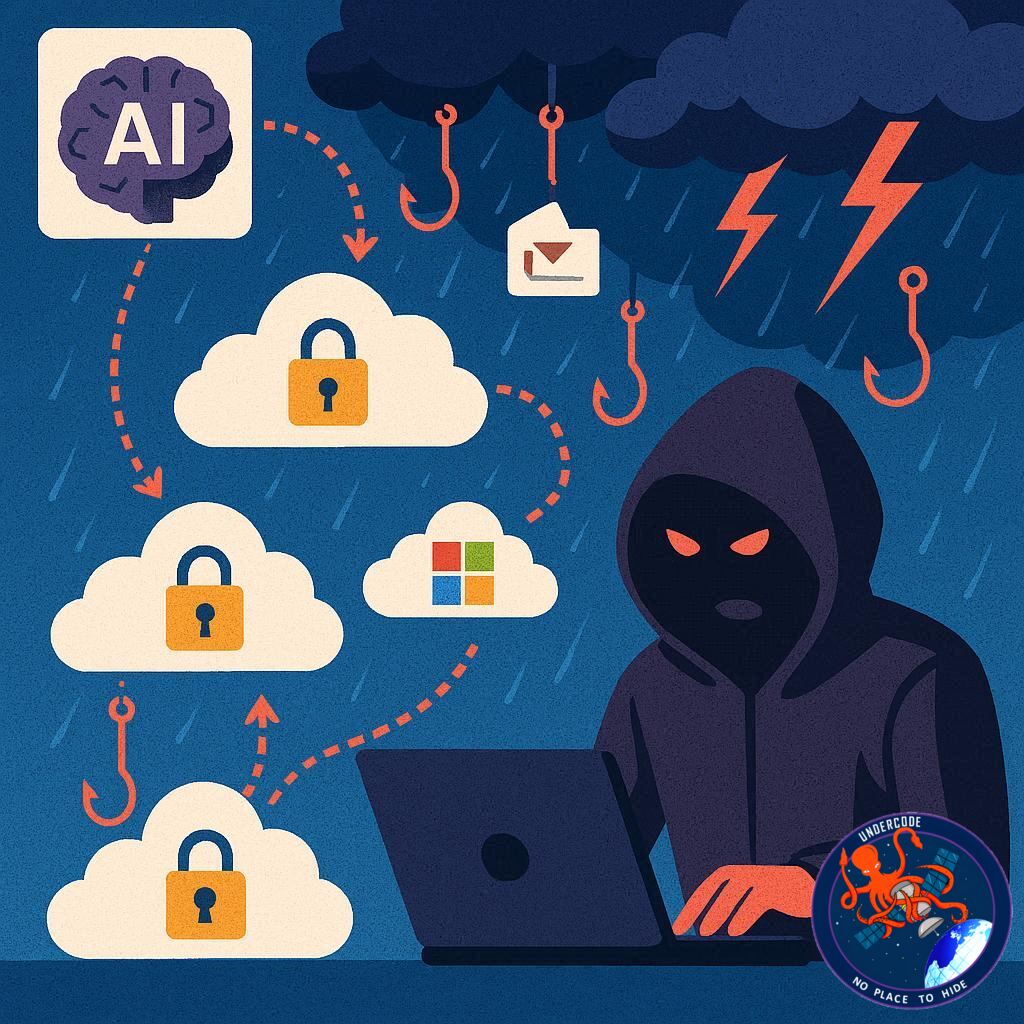
A new wave of phishing attacks is rewriting the rules of cybercrime. What was once a numbers game driven by repetitive spam has evolved into something far more dangerous: highly customized, AI-generated attacks that scale at unprecedented speed. In this latest campaign, hundreds of organizations have already been compromised, exposing a critical weakness in cloud authentication systems and signaling a broader shift in how attackers operate in the age of artificial intelligence.
The Campaign Unfolds
The attack campaign, uncovered by Huntress, reveals a coordinated phishing effort leveraging infrastructure tied to Railway. Despite being linked to a relatively small threat actor operating from around a dozen IP addresses, the scale of impact has been staggering.
Initially, the campaign infected a few dozen victims per day. However, by early March, the tempo dramatically increased, evolving into a high-speed operation compromising hundreds of organizations within weeks. Researchers described the surge as explosive, with attack efficiency reaching unusually high levels.
Unlike traditional phishing campaigns that reuse templates, this operation stood out due to its diversity. Each phishing email appeared unique, with no repeated domains or identical messaging. This strongly suggests the use of AI tools to generate tailored lures at scale. These ranged from convincing email messages to QR codes and manipulated file-sharing links, all designed to trick users into granting access.
Exploiting Microsoft Authentication
At the heart of the campaign lies a clever abuse of authentication workflows within Microsoft cloud services. Specifically, attackers exploited device authentication flows intended for smart TVs, printers, and similar devices.
This method allows attackers to obtain valid OAuth tokens without requiring passwords or even multi-factor authentication. Once acquired, these tokens can grant access to user accounts for up to 90 days, creating a significant window for exploitation.
The implications are severe. Even organizations with strong password policies and MFA protections found themselves vulnerable due to this overlooked pathway.
Widespread Impact Across Industries
The attack did not target a single sector. Instead, it spread broadly across industries, affecting construction firms, law offices, nonprofits, real estate agencies, manufacturers, financial institutions, healthcare providers, and even government organizations.
Huntress reported 344 confirmed victims among its own customers. However, researchers believe this represents only a fraction of the total impact, estimating that thousands of organizations may have been affected globally.
To mitigate the damage, Huntress implemented an unprecedented defensive measure: deploying conditional access policy updates across 60,000 Microsoft cloud tenants to block suspicious traffic originating from Railway-linked domains.
Railway Infrastructure as a Weapon
The attackers leveraged Railway’s Platform-as-a-Service environment to build and deploy phishing infrastructure rapidly. Designed to simplify development for non-coders, the platform inadvertently enabled malicious actors to spin up credential-harvesting systems with ease.
By combining compromised domains with AI-generated phishing content, the attackers successfully bypassed many traditional email security filters. The use of constantly changing templates and infrastructure made detection significantly harder.
In response, Railway acknowledged the abuse and acted by banning associated accounts and blocking malicious domains. However, the company admitted that its fraud detection systems struggled to catch the campaign early due to the attackers’ ability to avoid common detection signals.
A New Era of “Vibe-Coded” Cybercrime
One of the most striking aspects of this campaign is its sophistication relative to the threat actor’s size. The use of AI to generate unique phishing lures and scalable infrastructure mirrors techniques typically associated with advanced persistent threats or state-sponsored groups.
Yet, this was not a nation-state operation. Instead, it highlights how generative AI is empowering smaller cybercriminals, often referred to as “script kiddies,” to operate at a much higher level than before.
Security experts warn that this trend will continue. AI tools are lowering the barrier to entry, enabling less experienced attackers to execute highly effective campaigns with minimal technical expertise.
What Undercode Say:
The Real Threat Is Not Scale, It’s Adaptability
The most dangerous aspect of this campaign is not just the number of victims, but the adaptability of the attack model. AI-generated phishing eliminates one of the key weaknesses defenders relied on: pattern recognition. Traditional security tools depend heavily on identifying repeated indicators, but when every attack is unique, detection becomes exponentially harder.
OAuth Exploitation Is a Silent Killer
This campaign exposes a critical blind spot in cloud security: OAuth token abuse. Organizations often focus on passwords and MFA, assuming they are sufficient. However, token-based authentication introduces persistent access risks that are rarely monitored with the same intensity. A compromised token can quietly bypass multiple layers of defense.
Cloud Platforms Are Becoming Double-Edged Swords
Platforms like Railway are designed for innovation and accessibility, but their ease of use also benefits attackers. The same features that allow developers to deploy applications quickly also enable threat actors to build malicious infrastructure at scale. This dual-use nature of cloud services is becoming a major challenge for cybersecurity.
AI Is Shifting the Balance Toward Attackers
Defenders are often constrained by compliance, privacy concerns, and internal policies when adopting AI. Attackers, on the other hand, operate without restrictions. This asymmetry gives cybercriminals a significant advantage, allowing them to experiment, iterate, and scale faster than defensive teams can respond.
Detection Must Move Beyond Static Rules
Security strategies must evolve beyond signature-based detection. Behavioral analysis, anomaly detection, and real-time response mechanisms are no longer optional. Organizations need to monitor how authentication flows are used, not just whether they succeed.
Free-Tier Abuse Is a Growing Problem
The campaign also highlights a systemic issue: the abuse of free-tier services. Without stricter validation and monitoring, attackers can easily create accounts, deploy infrastructure, and launch attacks before being detected. This is not unique to Railway and reflects a broader industry-wide vulnerability.
Speed Is the New Weapon
The rapid escalation of this campaign demonstrates that speed itself is now a weapon. Attackers can launch, adapt, and scale campaigns faster than ever before. Defensive strategies that rely on slow response cycles are increasingly ineffective in this environment.
The Future of Phishing Is Hyper-Personalized
AI enables attackers to craft messages that are context-aware and highly convincing. This moves phishing beyond generic scams into targeted psychological manipulation. The result is a higher success rate and a greater likelihood of bypassing human skepticism.
Fact Checker Results
✅ The campaign compromised hundreds of organizations using AI-generated phishing techniques.
✅ Attackers exploited Microsoft’s device authentication flow to obtain OAuth tokens without passwords or MFA.
❌ There is no confirmed evidence that Railway’s own AI tools were directly used in generating the phishing content.
Prediction:
The next phase of cyberattacks will see AI-driven phishing campaigns become fully autonomous 🤖, capable of adapting in real time based on victim responses.
Cloud service providers will introduce stricter identity verification and monitoring for free-tier users 🔐 to combat infrastructure abuse.
Organizations will increasingly shift toward zero-trust architectures and continuous authentication models to reduce reliance on static credentials ⚠️
🕵️📝✔️Let’s dive deep and fact‑check.
References:
Reported By: cyberscoop.com
Extra Source Hub (Possible Sources for article):
https://www.twitter.com
Wikipedia
OpenAi & Undercode AI
Image Source:
Unsplash
Undercode AI DI v2
Bing
🔐JOIN OUR CYBER WORLD [ CVE News • HackMonitor • UndercodeNews ]
📢 Follow UndercodeNews & Stay Tuned:
𝕏 formerly Twitter 🐦 | @ Threads | 🔗 Linkedin | 🦋BlueSky | 🐘Mastodon


