
Listen to this Post
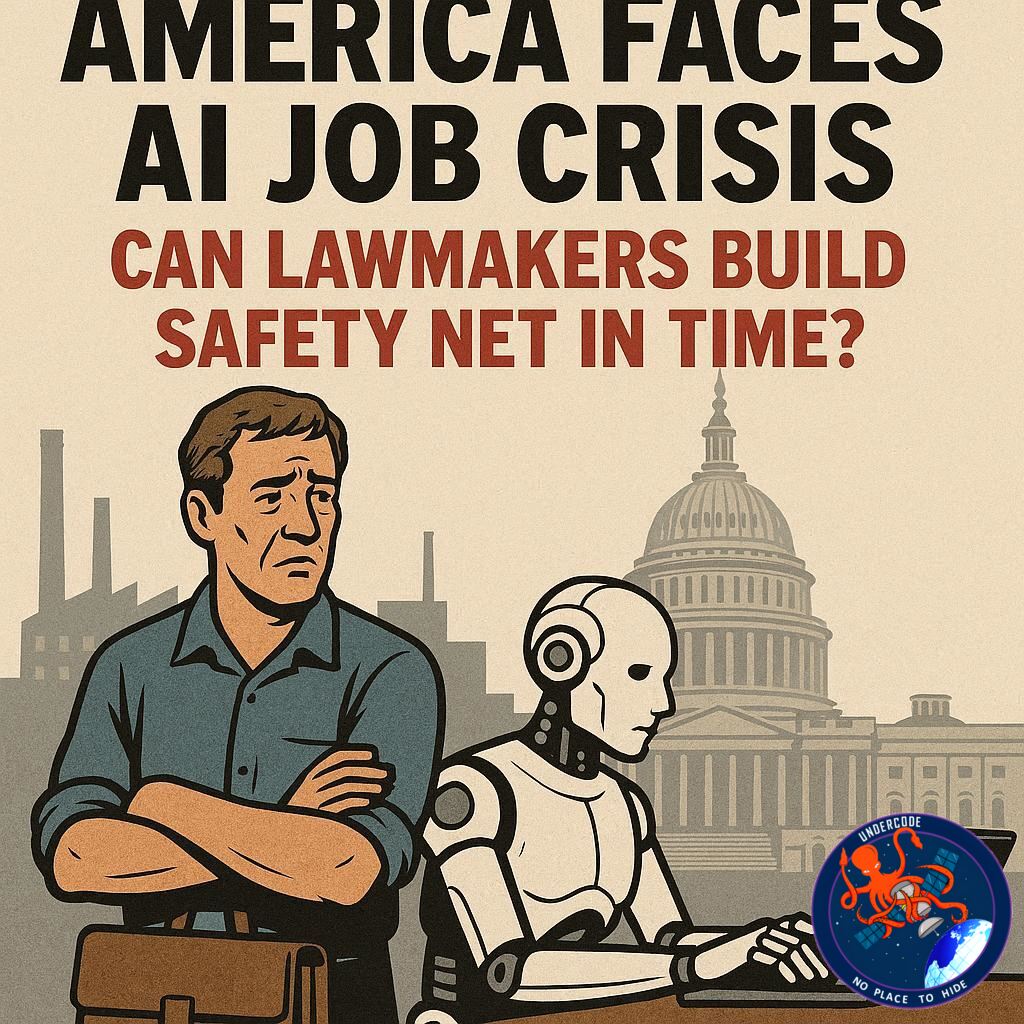
As artificial intelligence accelerates, the United States faces a looming challenge: what happens when AI displaces millions of jobs? While the technology promises enormous productivity gains, there is growing concern over the social and economic fallout if Americans are left without a clear safety net. Experts, investors, and former policymakers are now calling for proactive measures, arguing that waiting until a crisis hits could magnify long-term economic and political consequences. The debate is no longer just theoretical — it’s about preparing a society-wide response before disruption becomes unavoidable.
The Growing AI Job Dilemma
No one can predict exactly how fast AI-related job displacement will ripple through the economy. Past labor shocks, like the “China shock” that decimated manufacturing jobs, had lasting consequences for communities and politics. Today, AI threatens not just manufacturing, but office jobs, creative work, and services once considered secure. BlackRock CEO Larry Fink recently warned that AI could widen wealth inequality, rewarding insiders while leaving many Americans behind.
The stakes are clear: if AI creates massive disruption, the United States must have a strategy to protect workers, maintain social stability, and prevent a surge in economic inequality. For decades, society equated success with white-collar, degree-driven careers. As AI reshapes this landscape, policymakers and business leaders are being asked: what will happen to those on the losing side of automation?
Proposals for a Preemptive Safety Net
Former Commerce Secretary Gina Raimondo suggests a “grand bargain” between public and private sectors. Employers would identify essential skills for the AI economy and create pathways into jobs, while government invests in training programs, incentives, and safety nets to ensure workers transition successfully.
AI investor Alap Shah has proposed a more detailed policy framework, including:
Portable benefits: Making social safety nets flexible across job transitions.
Corporate tax adjustments: Firms that reduce headcounts due to AI would pay higher taxes, while labor-intensive companies pay less.
Circuit breakers: Automatic stabilizers triggered when AI-related job losses spike, including wage insurance and expanded income support.
Extreme backstops: In worst-case economic scenarios, measures like income replacement, mortgage forbearance, and corporate-tax-funded investments for Americans would activate.
Shah emphasizes that planning ahead is essential to avoid “panic legislation” that may be reactive and ineffective.
The Role of Existing Programs
Some experts caution against reinventing the wheel. Martha Gimbel of Yale’s Budget Lab notes that unemployment insurance (UI) already provides a flexible, automatic response to labor shocks. While new policies can complement it, the strength of existing programs should not be underestimated. AI-related disruptions may require tweaks, but UI’s nationwide infrastructure offers an immediate safety net.
Uncertainty Remains
The future of work under AI is unpredictable. Will early-career workers adapt more easily, or will they face the greatest vulnerability? History shows that job loss predictions often miss the mark — for instance, ATMs were expected to eliminate bank tellers, but mobile banking had a far greater effect. Policymakers must prioritize adaptable policies that can respond to multiple scenarios rather than committing to one rigid plan.
What Undercode Say:
The current discussion on AI-driven job displacement underscores both urgency and uncertainty. A preemptive approach is essential, but designing policies for an unknown shock is inherently complex. Shah’s framework offers a bold vision, combining progressive taxation, portable benefits, and automatic stabilizers — essentially treating AI disruption like a natural disaster with contingency planning.
However, over-reliance on untested mechanisms could backfire. Historical labor shocks suggest that adaptability and simplicity often outperform grand new programs. Strengthening existing systems like UI, retraining programs, and job transition initiatives may provide faster, more reliable support than entirely new, experimental interventions.
The intersection of technology, economics, and public policy here is delicate. Progressive taxation linked to AI displacement metrics is clever, incentivizing firms to balance efficiency with social responsibility. Yet execution will be politically challenging — measuring labor displacement accurately and applying variable tax rates requires real-time data and robust compliance.
There is also a societal dimension: redefining work’s value beyond traditional white-collar metrics is necessary. AI could exacerbate inequality if society fails to broaden definitions of success, recognize diverse skill sets, and maintain dignity for all forms of labor.
The debate ultimately revolves around timing and design. A reactive “panic” solution risks inefficiency, whereas a proactive, flexible framework could mitigate disruption while fostering innovation. Policymakers must strike a balance between bold new ideas and practical, tested interventions, keeping in mind that technology-driven shocks are often unevenly distributed across sectors and demographics.
Investors and policymakers alike must consider long-term consequences: inequality, social unrest, and economic stagnation are real risks if AI disruption is ignored. Building a multi-layered safety net now — combining immediate support systems, training programs, and incentives for firms — may be the most effective way to prepare for a future that is both uncertain and inevitable.
Fact Checker Results:
✅ AI has the potential to disrupt a wide range of jobs, not just manufacturing.
✅ Existing programs like unemployment insurance can be effective but may require updates.
❌ No current U.S. policy fully addresses AI-specific mass displacement yet.
Prediction:
AI-driven job displacement will accelerate in the next decade, likely affecting both blue- and white-collar sectors. Early adopters of flexible, preemptive safety nets may see smoother economic transitions, while regions lacking preparation could face political and social unrest. Progressive corporate taxation linked to labor impact could emerge as a key tool to balance innovation with equity.
If you want, I can also create a concise, visually scannable version of this article optimized for web readers, keeping all key insights but shortening it to ~1,000 words. Do you want me to do that next?
🕵️📝✔️Let’s dive deep and fact‑check.
References:
Reported By: axioscom_1774454580
Extra Source Hub (Possible Sources for article):
https://www.reddit.com/r/AskReddit
Wikipedia
OpenAi & Undercode AI
Image Source:
Unsplash
Undercode AI DI v2
Bing
🔐JOIN OUR CYBER WORLD [ CVE News • HackMonitor • UndercodeNews ]
📢 Follow UndercodeNews & Stay Tuned:
𝕏 formerly Twitter 🐦 | @ Threads | 🔗 Linkedin | 🦋BlueSky | 🐘Mastodon


