
Listen to this Post
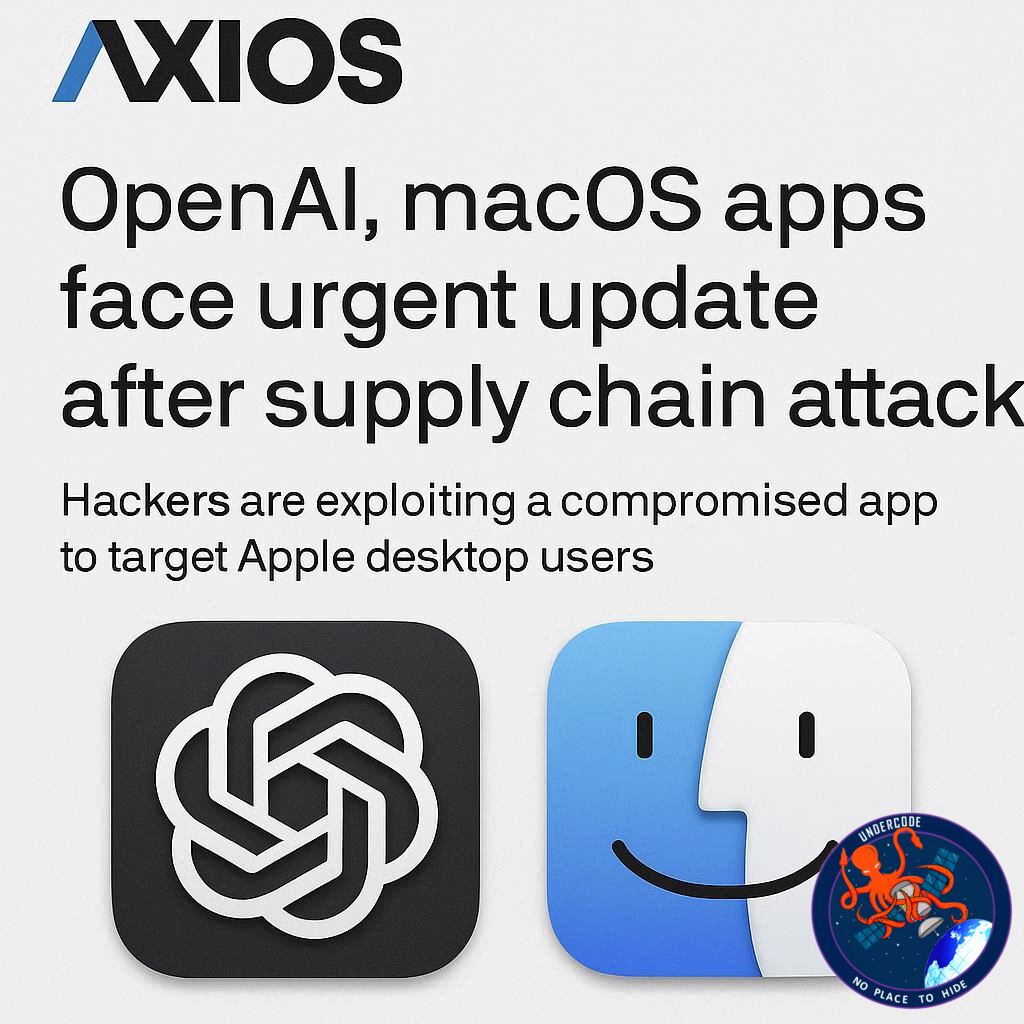
Introduction: A Quiet Threat With Wide Consequences
A seemingly brief security incident has triggered a significant response from OpenAI, forcing macOS users to update their applications. What appeared to be a short-lived compromise in an open-source library has exposed deeper vulnerabilities within modern software supply chains. Even though no direct breach of user data has been confirmed, the ripple effects have been serious enough for OpenAI to revoke and replace critical security certificates. This incident highlights how even trusted tools can become entry points for large-scale risk.
Summary of the Incident
OpenAI has announced that all macOS users must update to the latest version of its applications following a security concern tied to a supply chain attack involving the Axios JavaScript library. The issue stems from a broader compromise in late March, when attackers managed to inject malicious code into two versions of Axios, a widely used open-source library relied upon by millions of developers and applications worldwide.
The attackers, identified as a North Korean hacking group, gained access by targeting the lead maintainer of Axios through social engineering techniques. By compromising the maintainer’s personal system, they were able to take control of both npm and GitHub accounts associated with the project. This allowed them to publish malicious versions of Axios that remained active for approximately three hours before being detected and removed.
Despite the short exposure window, the scale of Axios usage meant the impact could have been far-reaching. The library sees tens of millions of downloads weekly, and its integration into countless downstream applications increases the likelihood of indirect exposure. Security researchers noted that such attacks can cascade across ecosystems, affecting software that developers may not even realize depends on the compromised component.
OpenAI’s involvement comes from its internal GitHub workflow used to sign macOS application certificates. During the compromised period, this workflow downloaded and executed one of the malicious Axios versions. While OpenAI reported no evidence that user data, internal systems, or intellectual property were accessed or altered, the mere possibility that the signing process was exposed led to immediate action.
The company stated that the signing certificate was likely not exfiltrated due to several mitigating factors, including execution timing and workflow sequencing. However, out of caution, OpenAI has decided to treat the certificate as compromised. As a result, it is revoking the affected certificate and issuing a new one, requiring users to update their applications before the revocation deadline.
Older versions of OpenAI’s macOS apps will gradually lose functionality and become unsupported once the certificate is fully revoked. The company has set a deadline of May 8 for this transition, giving users a limited window to update. OpenAI also mentioned that this timeline could be accelerated if any malicious activity is detected.
To address the issue, OpenAI has worked with a third-party digital forensics and incident response firm to investigate the incident. The root cause was traced back to a misconfiguration in its GitHub workflow, which has since been corrected. Additionally, OpenAI coordinated with Apple to prevent malicious actors from using the compromised certificate to distribute fraudulent applications.
This incident follows closely on the heels of other open-source security breaches, including attacks targeting tools like Trivy. These events collectively underscore a growing trend of attackers focusing on upstream components to maximize downstream impact.
What Undercode Say: The Real Risk Lies in the Chain, Not the Link
The OpenAI Axios incident is not about a single compromised library. It is about the fragile trust model that modern software development depends on. Open-source ecosystems are built on layers of dependencies, often invisible to the end developer. When one layer is compromised, the effect spreads silently and rapidly.
The most concerning aspect is how little time attackers need to create meaningful exposure. In this case, just three hours of malicious package availability was enough to trigger a global response from a major AI company. This demonstrates that traditional detection and response timelines may not be sufficient in the era of automated pipelines and continuous integration.
Another key takeaway is the role of automation. OpenAI’s GitHub workflow automatically fetched and executed dependencies as part of its certificate-signing process. While automation improves efficiency, it also removes human oversight at critical moments. A single misconfiguration allowed malicious code to enter a sensitive environment without manual verification.
The decision by OpenAI to revoke its certificate despite no confirmed breach is a strong signal. It shows a shift toward proactive security, where potential risk is treated with the same seriousness as confirmed compromise. This approach may become standard practice, especially for companies managing high-trust systems like software signing.
The involvement of state-linked actors adds another layer of complexity. These groups are not just looking for immediate financial gain. They are probing systems, testing weaknesses, and building long-term access strategies. Supply chain attacks offer them a high return on investment because they can impact multiple targets through a single entry point.
The broader ecosystem is also under pressure. With libraries like Axios being downloaded millions of times weekly, even a small window of compromise can have exponential consequences. Developers often trust these packages implicitly, rarely verifying their integrity beyond basic version checks.
There is also a growing pattern of targeting maintainers rather than systems. Social engineering remains one of the most effective attack vectors. By compromising a trusted individual, attackers bypass technical defenses entirely. This shifts the security burden from infrastructure to human behavior, which is inherently harder to control.
OpenAI’s collaboration with Apple to block misuse of the compromised certificate is another important detail. It highlights the need for cross-company coordination in responding to modern threats. No single organization can fully mitigate these risks alone.
The incident also raises questions about dependency transparency. Many organizations lack clear visibility into their software supply chains. Without this visibility, identifying exposure during incidents becomes slow and uncertain.
Ultimately, this event reinforces a simple but critical truth. Security is no longer just about protecting your own code. It is about understanding and securing everything your code depends on, directly or indirectly.
Fact Checker Results
✅ OpenAI confirmed no evidence of user data or system compromise
⚠️ Malicious Axios versions were live for a limited but impactful time window
❌ No proof that the signing certificate was actually stolen or misused
Prediction
The frequency of supply chain attacks will continue to rise as attackers focus on high-impact entry points 🔍
Companies will increasingly adopt zero-trust principles for dependencies and automated workflows 🔐
Security responses will become faster and more aggressive, even without confirmed breaches ⚡
🕵️📝✔️Let’s dive deep and fact‑check.
References:
Reported By: cyberscoop.com
Extra Source Hub (Possible Sources for article):
https://www.reddit.com/r/AskReddit
Wikipedia
OpenAi & Undercode AI
Image Source:
Unsplash
Undercode AI DI v2
Bing
🔐JOIN OUR CYBER WORLD [ CVE News • HackMonitor • UndercodeNews ]
📢 Follow UndercodeNews & Stay Tuned:
𝕏 formerly Twitter 🐦 | @ Threads | 🔗 Linkedin | 🦋BlueSky | 🐘Mastodon


