
Listen to this Post
Introduction
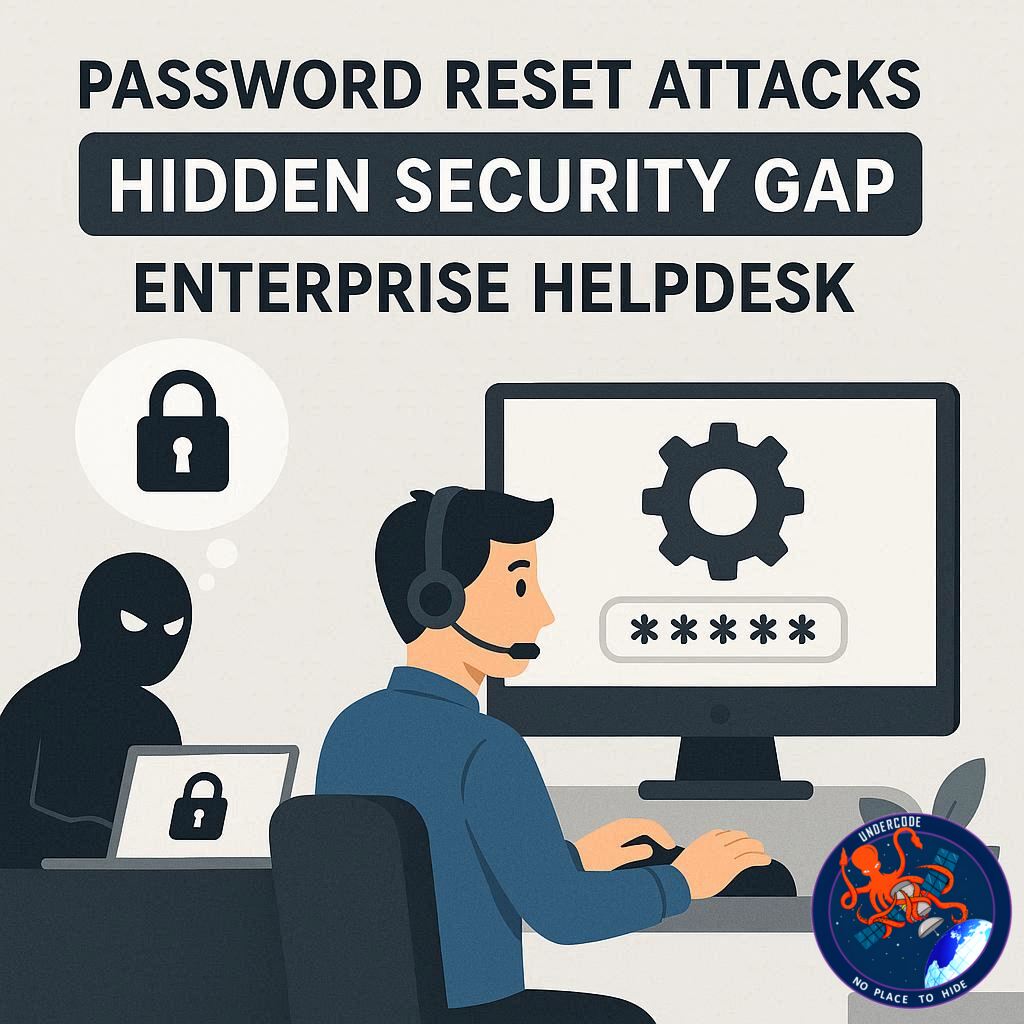
Password reset systems were designed to make life easier for users and reduce pressure on IT support teams, but they have also quietly become one of the most exploited entry points in modern cyberattacks. While organizations invest heavily in multi-factor authentication and advanced perimeter defenses, attackers increasingly bypass these protections by targeting a much simpler weakness: human verification at the helpdesk. What appears to be a routine support request can, under the right conditions, turn into a full-scale security breach with devastating financial and operational consequences.
Summary of the Original
Research from Forrester estimates that each password reset costs organizations approximately $70, making it one of the most frequent and expensive helpdesk operations. To reduce this burden, many companies have adopted self-service password reset (SSPR) tools, allowing users to recover access without IT intervention. However, helpdesk teams continue to process a large volume of resets due to enrollment issues, edge cases, and user errors. This ongoing reliance on support staff creates a persistent security risk, as attackers often target the password reset process as an entry point into corporate systems. If they successfully convince a helpdesk agent to reset a password, they can bypass multi-factor authentication and gain direct access to accounts.
A major example occurred during the April 2025 cyberattack on UK retailer Marks & Spencer, where attackers linked to the Scattered Spider group allegedly impersonated an employee and contacted a third-party service desk. Through social engineering, they secured a password reset, gaining legitimate credentials without exploiting any technical vulnerability. Once inside, they accessed Active Directory systems and extracted the NTDS.dit file containing password hashes for domain users. These hashes were later cracked offline, allowing attackers to expand access across the network. Over time, they moved laterally using normal administrative tools and legitimate login behavior, avoiding detection. Eventually, ransomware was deployed, disrupting payments, logistics, and e-commerce operations, forcing M&S to suspend online services for several days and causing significant financial losses.
The article emphasizes that these attacks are difficult to detect because they appear as routine helpdesk interactions. From the support team’s perspective, the request looks legitimate, which makes social engineering particularly effective. To mitigate this risk, organizations are encouraged to implement stronger identity verification systems, such as one-time codes sent to trusted devices or integrations with identity providers like Duo or Okta. Unlike traditional methods, these systems ensure that even convincing attackers cannot complete a reset without access to the user’s verified device or authentication factor.
The article also highlights best practices such as encouraging self-service password resets, using secure temporary credentials, monitoring reset activity for anomalies, and training helpdesk staff to follow strict verification procedures. Tools like Specops Secure Service Desk and Specops Password Policy are presented as solutions that help enforce consistent identity verification and block compromised passwords, reducing both security risk and operational load.
What Undercode Say:
The password reset process is no longer a simple IT support function.
It has become a primary attack surface for modern threat actors.
Attackers do not always need malware or zero-day exploits.
They often rely on human trust and procedural weaknesses instead.
Helpdesk teams are now operating as frontline security defenders.
But many organizations still treat them as administrative support.
This mismatch creates a structural vulnerability in enterprise security.
The Marks & Spencer incident shows how small procedural gaps escalate quickly.
A single successful social engineering call can bypass MFA entirely.
Once inside, attackers behave like legitimate users to avoid detection.
This makes traditional perimeter security tools less effective.
Active Directory remains a high-value target in enterprise environments.
Credential theft from NTDS.dit demonstrates deep systemic exposure.
Offline cracking of password hashes removes real-time detection opportunities.
Lateral movement inside networks often looks like normal activity.
That is why detection must shift from perimeter to behavior analysis.
Self-service password reset reduces workload but not necessarily risk.
If poorly adopted, SSPR simply shifts risk elsewhere in the system.
Helpdesk verification processes vary widely between organizations.
Inconsistency is exactly what attackers exploit during impersonation.
Strong identity verification must be standardized, not optional.
One-time passcodes improve security but depend on device integrity.
Integration with identity providers strengthens authentication chains.
However, usability friction can still push users back to helpdesk calls.
Security improvements must balance convenience and adoption rates.
Monitoring reset patterns can reveal early signs of compromise attempts.
Repeated resets may indicate either user struggle or attacker probing.
Helpdesk training becomes a critical security investment, not optional training.
Every agent interaction is effectively a security checkpoint.
Organizations underestimate how scalable social engineering attacks are.
Attackers can automate reconnaissance before contacting support.
The weakest link is often process design, not technology itself.
Security tools cannot fully compensate for weak verification workflows.
Zero trust principles should extend into helpdesk operations.
Identity should never be assumed, only verified continuously.
The cost of a reset is minor compared to breach impact.
Financial losses from downtime can reach millions within days.
Security strategy must treat password reset as high-risk infrastructure.
Future attacks will likely increase focus on service desk manipulation.
Fact Checker Results
✔ Password resets are widely recognized as a major helpdesk cost and risk factor.
✔ Social engineering remains a proven method for bypassing technical security controls.
✔ Real-world breaches often involve credential theft followed by lateral movement inside networks.
Prediction
Password reset attacks will become more automated and targeted as attackers refine social engineering techniques.
Helpdesk verification will increasingly shift toward device-bound and biometric authentication methods.
Organizations that fail to standardize identity verification across support channels will face higher breach frequency and longer recovery times.
🕵️📝✔️Let’s dive deep and fact‑check.
References:
Reported By: www.bleepingcomputer.com
Extra Source Hub (Possible Sources for article):
https://www.pinterest.com
Wikipedia
OpenAi & Undercode AI
Image Source:
Unsplash
Undercode AI DI v2
Bing
🔐JOIN OUR CYBER WORLD [ CVE News • HackMonitor • UndercodeNews ]
📢 Follow UndercodeNews & Stay Tuned:
𝕏 formerly Twitter 🐦 | @ Threads | 🔗 Linkedin | 🦋BlueSky | 🐘Mastodon


