
Listen to this Post
Introduction
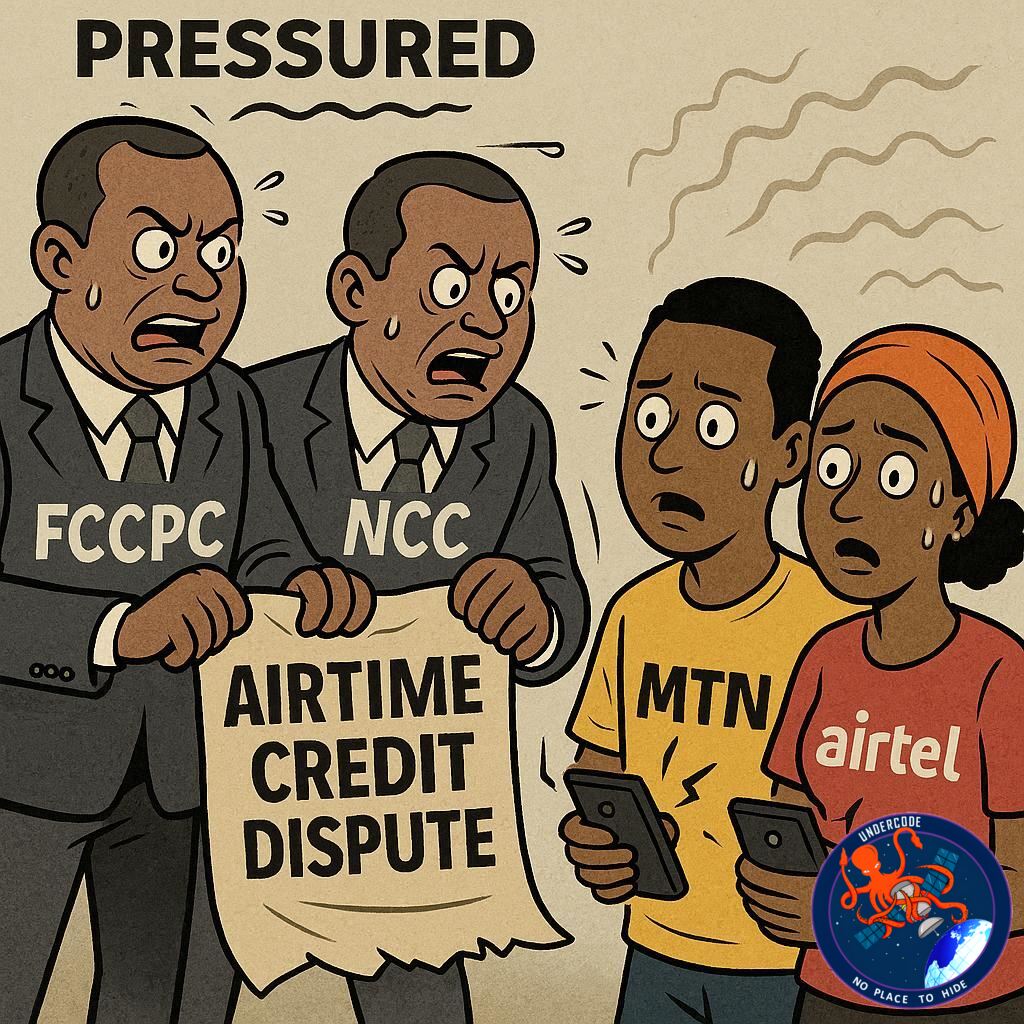
Nigeria’s telecom industry is facing renewed pressure as a regulatory dispute between two major government agencies threatens the stability of the country’s booming airtime credit market. Millions of users of major telecom networks such as MTN and Airtel depend on airtime credit services for communication and day-to-day flexibility. However, uncertainty caused by overlapping authority claims between the Federal Competition and Consumer Protection Commission (FCCPC) and the Nigerian Communications Commission (NCC) is now raising serious concerns.
Industry leaders warn that unless the conflict is resolved quickly, consumers, businesses, and investor confidence could all suffer long-term consequences.
Telecom Sector Calls for Urgent Resolution
Stakeholders in Nigeria’s telecommunications industry have urged both the FCCPC and NCC to immediately settle their ongoing disagreement over who has regulatory control over the airtime credit market.
The appeal came after interim injunctions were issued by Federal High Courts in Lagos and Abuja. These court orders reportedly stopped interference in the operations of licensed Value Added Service (VAS) providers, including Nairtime Nigeria Limited and members of the Wireless Application Service Providers Association of Nigeria (WASPA).
These providers play an important role in enabling airtime credit services that many Nigerians use regularly.
Overlapping Powers Spark Industry Tension
Chairman of the Association of Licensed Telecom Operators of Nigeria (ALTON), Gbenga Adebayo, explained that the crisis is rooted in conflicting claims of authority between the FCCPC and the NCC.
According to Adebayo, the airtime credit market in Nigeria is worth between N300 billion and N400 billion every year. This makes it one of the more valuable segments of the telecom ecosystem.
He argued that the NCC remains the legally recognized regulator of telecommunications under the Nigerian Communications Act and therefore should have clear oversight in the matter.
Court Orders Yet No Stability
Despite court protection for licensed operators, the market remains uncertain.
Adebayo said the issue is no longer just about regulation. It has become a wider test of Nigeria’s ability to maintain a predictable business environment.
He noted that businesses holding valid licenses are still operating under pressure, while consumers face uncertainty about the future availability of services they rely on daily.
Earlier Warnings Ignored
ALTON reportedly informed the NCC as far back as August 2025 about growing concerns over FCCPC regulations.
The association warned that some of the new rules appeared to clash with an existing Memorandum of Understanding between both agencies.
That lack of coordination is now being blamed for the legal disputes and market instability currently affecting the sector.
Millions Depend on Airtime Credit
Adebayo stressed that airtime credit is not merely a telecom product. For many Nigerians, it functions as a quick emergency financial tool.
Small traders, artisans, transport workers, and micro-business owners often use short-term airtime advances to stay connected and continue daily business activities.
In a country where access to formal loans remains difficult for many people, even small airtime advances can be economically important.
If these services are interrupted, the impact can be immediate.
Investor Confidence Under Threat
Industry observers also fear the dispute could send the wrong signal to local and foreign investors.
Nigeria’s telecom sector requires continuous investment in towers, broadband systems, fiber networks, and digital innovation. Investors usually examine how governments manage disputes before committing capital.
If regulatory lines remain unclear, investors may view the environment as risky and shift attention to more stable markets.
NCC Also Tackling SIM Fraud
In a separate development, the NCC recently introduced a Telecoms Identity Risk Management System (TIRMS).
The platform is designed to reduce fraud linked to mobile phone numbers and improve trust in digital services.
With phone numbers now central to banking, authentication, and service access, stronger telecom regulation has become even more important.
What Undercode Say:
This dispute highlights a common problem in developing digital economies: multiple regulators trying to control fast-growing sectors without clear coordination.
Nigeria’s telecom industry is one of Africa’s largest success stories. But success attracts power struggles. When agencies overlap, businesses become trapped between rules, licenses, court actions, and political uncertainty.
The airtime credit market may sound small from the outside, but it is deeply connected to real consumer behavior. Many users do not treat airtime credit as luxury spending. They use it as survival infrastructure.
That means disruptions could hit the informal economy hardest.
The bigger danger is reputational. Investors often forgive taxes, bureaucracy, and infrastructure problems if rules are clear. But when two regulators fight publicly over authority, confidence drops quickly.
Nigeria is competing for digital capital not only against African nations, but globally. Regulatory confusion weakens that position.
The smart solution is not choosing winners between agencies. It is building a single coordinated framework where consumer protection and telecom regulation work together.
If resolved properly, this crisis could become a model for future regulatory cooperation.
If ignored, it may become another warning sign for businesses entering Nigeria’s digital market.
Consumers ultimately pay the price whenever institutions fail to align.
Strong telecom growth requires strong governance.
The courts may slow the conflict temporarily, but only policy clarity can solve it permanently.
This is now bigger than airtime credit.
It is about trust.
Fact Checker Results
✅ Courts reportedly issued interim injunctions protecting licensed VAS providers.
✅ Airtime credit market value was cited between N300 billion and N400 billion annually.
❌ Final regulatory authority has not been conclusively settled in the reported dispute.
Prediction
🔮 Pressure will likely force FCCPC and NCC into negotiations or federal mediation.
🔮 Telecom operators may demand a single regulatory roadmap for digital credit services.
🔮 Investors will closely watch the outcome before expanding telecom financing in Nigeria.
🕵️📝Let’s dive deep and fact‑check.
References:
Reported By: www.legit.ng
Extra Source Hub (Possible Sources for article):
https://www.quora.com/topic/Technology
Wikipedia
OpenAi & Undercode AI
Image Source:
Unsplash
Undercode AI DI v2
Bing
🔐JOIN OUR CYBER WORLD [ CVE News • HackMonitor • UndercodeNews ]
📢 Follow UndercodeNews & Stay Tuned:
𝕏 formerly Twitter 🐦 | @ Threads | 🔗 Linkedin | 🦋BlueSky | 🐘Mastodon


