
Listen to this Post
🧭 Introduction: A Quiet Cyber War Spreading Across Continents
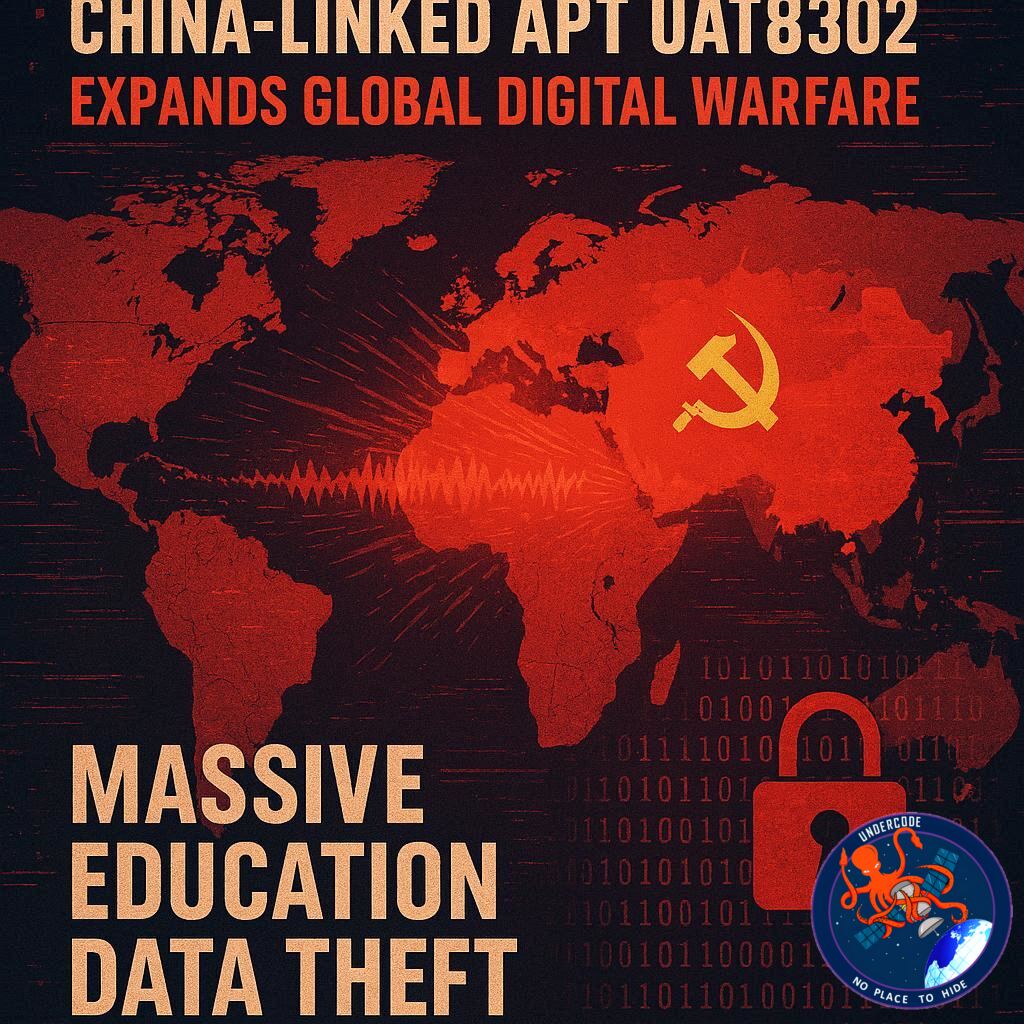
A growing wave of advanced cyber operations is quietly reshaping the global threat landscape, with state-linked actors and criminal groups targeting governments and massive educational ecosystems. Recent intelligence highlights a China-linked advanced persistent threat group, UAT-8302, expanding its operations across South America and Southeastern Europe using highly customized malware tools. At the same time, a separate but equally alarming breach claim by the group ShinyHunters alleges one of the largest education data leaks in recent history, impacting thousands of institutions. Together, these incidents reveal an accelerating convergence between espionage-driven cyber operations and large-scale data exploitation.
🧾 Cyber Espionage and Massive Education Data Breach Claims
China-linked APT group UAT-8302 has been actively targeting South American government institutions since late 2024, gradually extending its operations into Southeastern Europe throughout 2025. Security researchers report that the group deploys custom-built malware, including a tool known as NetDraft, specifically designed for post-exploitation activities after initial system compromise. These activities suggest a highly structured cyber-espionage framework focused on long-term infiltration rather than quick attacks.
In parallel, the cybercriminal group ShinyHunters has claimed responsibility for a massive data breach involving approximately 280 million records. The data allegedly originates from 8,809 educational institutions, including schools, universities, and online learning platforms. The compromised dataset reportedly includes sensitive personal information such as names, email addresses, internal messages, and enrollment records. The breach is said to have exploited data export functionalities within Instructure’s Canvas platform, raising serious concerns about cloud-based education infrastructure security.
Both incidents highlight different but interconnected dimensions of modern cyber threats. On one side, state-aligned espionage groups are refining long-term infiltration tactics against government networks. On the other, financially motivated hacking collectives are targeting large centralized data ecosystems for mass exploitation. The overlap between strategic cyber warfare and large-scale data theft is becoming increasingly difficult to separate in today’s digital environment.
Security analysts warn that the increasing sophistication of malware tools like NetDraft reflects a shift toward modular cyber weapons capable of adapting during operations. Meanwhile, the scale of the alleged education breach demonstrates how vulnerable centralized learning platforms have become, especially when serving thousands of institutions through unified systems.
🧠 What Undercode Say: Deep Strategic Breakdown of a Growing Cyber Conflict
🌐 Expanding Cyber Geography of UAT-8302 Operations
The operational expansion of UAT-8302 from South America into Southeastern Europe indicates a deliberate geopolitical targeting strategy rather than opportunistic hacking.
This shift suggests reconnaissance-driven campaigns aimed at institutions with political or administrative value.
Such patterns align with long-term intelligence gathering objectives rather than immediate financial gain.
🧩 Malware Evolution and the Role of NetDraft
NetDraft represents a new generation of post-exploitation malware designed to maintain persistence inside compromised systems.
Its functionality likely includes stealth data extraction, lateral movement, and long-term system monitoring.
This level of customization indicates access to significant development resources and structured cyber command operations.
🏫 Education Systems as High-Value Data Ecosystems
The alleged ShinyHunters breach highlights how education platforms have become concentrated repositories of sensitive identity data.
With thousands of institutions relying on shared platforms like Canvas, a single vulnerability can scale into global exposure.
This creates systemic risk where one compromised service can cascade across multiple countries simultaneously.
⚔️ Convergence of Cybercrime and Cyber Espionage Techniques
Although UAT-8302 and ShinyHunters differ in motivation, both demonstrate increasingly similar technical approaches.
Espionage groups are adopting commercial-grade malware techniques, while cybercriminals are leveraging state-level exploitation strategies.
This convergence blurs traditional distinctions between political cyber operations and financial cybercrime.
🔐 Infrastructure Dependency as a Critical Weak Point
The reliance on centralized digital education and government platforms creates single points of failure across entire regions.
Attackers are no longer targeting isolated systems but ecosystem-level infrastructures.
This shift dramatically increases the impact radius of each successful breach or infiltration.
📊 Data as a Strategic Weapon
Stolen data from education systems is no longer just personal information but a long-term intelligence asset.
Combined datasets can be used for identity profiling, recruitment targeting, and social engineering campaigns.
This transforms data breaches into strategic intelligence events rather than isolated cyber incidents.
🧭 Long-Term Implications for Cyber Defense Strategy
Defensive frameworks must evolve beyond perimeter security toward continuous behavioral monitoring.
Static defense systems are increasingly ineffective against adaptive malware like NetDraft.
Real-time threat intelligence sharing between nations and institutions becomes essential.
🧨 Hidden Risk of Normalized Large-Scale Breaches
The frequency of massive breach claims risks normalizing cyber incidents at unprecedented scale.
When hundreds of millions of records are exposed, public perception may begin to underestimate severity.
This psychological shift can reduce institutional urgency in implementing stronger defenses.
🧬 Hybrid Threat Ecosystem Emergence
The blending of state-sponsored tactics and criminal monetization strategies signals a hybrid threat ecosystem.
Future cyberattacks may no longer be clearly attributable to a single category of actor.
This ambiguity complicates both legal accountability and international response coordination.
🔍 Fact Checker Results
Claimed attribution of UAT-8302 to China-linked operations is consistent with multiple threat intelligence patterns but not independently publicly verified.
The ShinyHunters breach claim relies on self-reported data and requires external confirmation from affected institutions.
No confirmed official disclosure has yet validated the full scale of the 280 million record dataset leak.
📊 Prediction
Cyber operations like those attributed to UAT-8302 are likely to intensify across politically sensitive regions over the next 12–18 months.
Education platforms will increasingly become prime targets due to their centralized data structures and weak segmentation defenses.
Future breaches will likely combine espionage and financial motives, creating hybrid cyber campaigns with both strategic and monetary objectives.
🕵️📝Let’s dive deep and fact‑check.
References:
Reported By: x.com
Extra Source Hub (Possible Sources for article):
https://www.facebook.com
Wikipedia
OpenAi & Undercode AI
Image Source:
Unsplash
Undercode AI DI v2
Bing
🔐JOIN OUR CYBER WORLD [ CVE News • HackMonitor • UndercodeNews ]
📢 Follow UndercodeNews & Stay Tuned:
𝕏 formerly Twitter 🐦 | @ Threads | 🔗 Linkedin | 🦋BlueSky | 🐘Mastodon


