
Listen to this Post
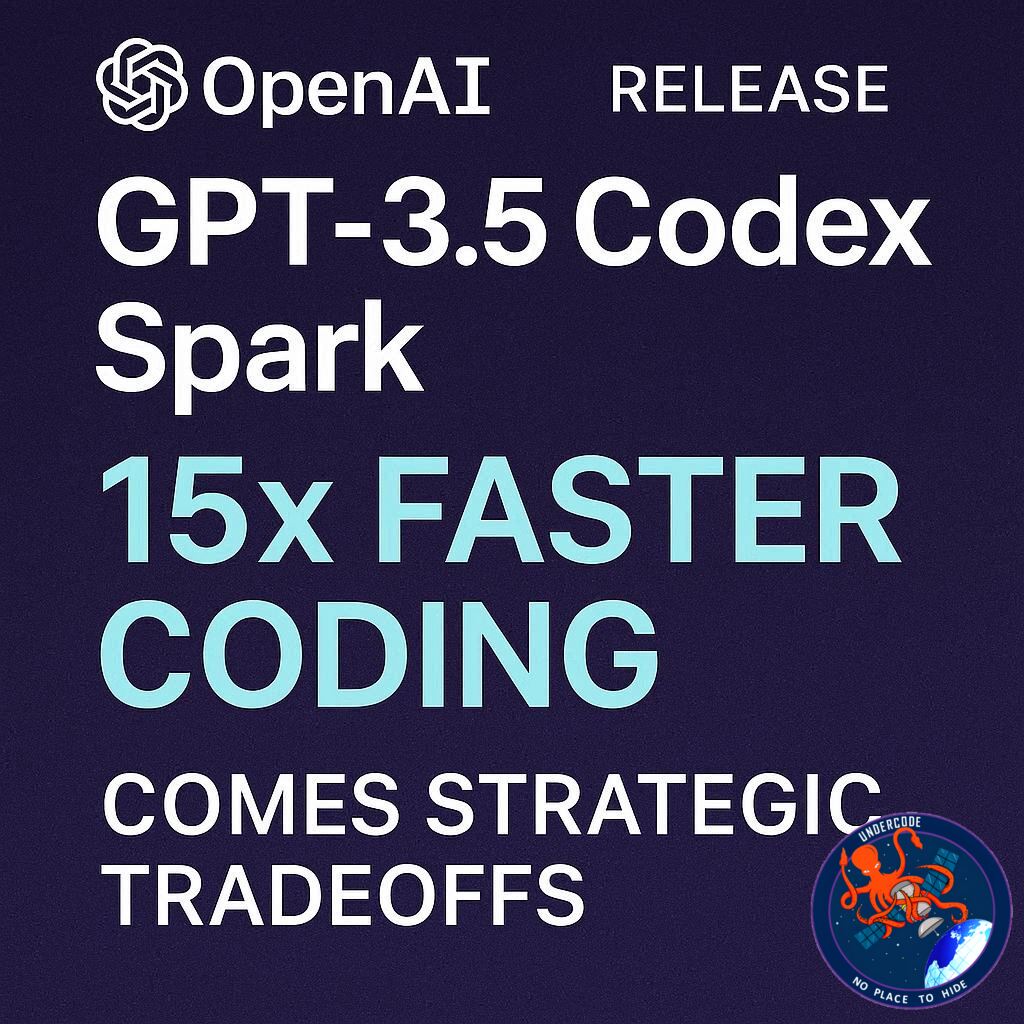
Introduction: A New Era of Real-Time AI Coding Acceleration
The race to dominate AI-assisted software development has entered a new phase, where speed is no longer just a benefit, but a defining feature. OpenAI has introduced GPT-5.3-Codex-Spark, a model engineered to dramatically reduce latency and transform how developers interact with code generation tools. While the promise of 15x faster performance sounds revolutionary, the reality is more nuanced. This release reflects a broader shift toward real-time collaboration between humans and AI, but it also raises important questions about accuracy, reliability, and security in high-speed environments.
Main Summary: Speed, Responsiveness, and the Evolution of Codex
OpenAI continues to aggressively expand its Codex ecosystem, following closely behind the release of GPT-5.3-Codex and a dedicated Codex Mac application. With GPT-5.3-Codex-Spark, the company introduces a smaller, faster model specifically designed for real-time coding workflows. Unlike traditional AI coding agents that operate in slower, batch-style processes, Spark focuses on immediate responsiveness, enabling developers to interact with AI in a fluid, conversational manner.
The model reportedly delivers code generation up to 15 times faster than its predecessor, while maintaining sufficient capability for practical development tasks. This improvement is supported by significant latency reductions across the system, including an 80% decrease in client-server roundtrip overhead, a 50% faster time-to-first-token, and a 30% reduction in per-token processing delays. These optimizations allow developers to iterate rapidly, making quick adjustments and receiving near-instant feedback.
A key innovation behind this performance leap is the use of Cerebras WSE-3 chips, a unique wafer-scale architecture that integrates massive compute power into a single processor. Unlike traditional chips that are divided into multiple smaller units, this design enables tighter data flow and faster inference speeds. Additionally, the introduction of persistent WebSocket connections minimizes communication delays, further enhancing real-time responsiveness.
Codex-Spark is not intended to replace GPT-5.3-Codex, but rather to complement it. While the base model excels in long-running, complex tasks requiring deep reasoning, Spark is optimized for short, iterative interactions. It supports interruption and redirection mid-task, making it ideal for developers who frequently refine their instructions on the fly. However, this focus on speed comes with limitations. The model prioritizes lightweight edits and does not automatically execute tests unless explicitly instructed.
Access to Codex-Spark is initially restricted to Pro-tier users paying $200 per month, with usage limits during the preview phase. OpenAI’s typical rollout strategy suggests that broader access may follow, but for now, the feature remains exclusive.
Despite its impressive speed, the model underperforms GPT-5.3-Codex on established benchmarks such as SWE-Bench Pro and Terminal-Bench 2.0. It also falls short in cybersecurity capability, failing to meet the threshold that qualifies the base model as “high capability” in OpenAI’s internal framework. This introduces a critical trade-off: while Spark accelerates development workflows, it may also increase the risk of errors or vulnerabilities if used without careful oversight.
OpenAI envisions a future where Codex operates in dual modes, combining real-time interaction with long-horizon reasoning. In this hybrid system, developers could remain engaged in fast, interactive loops while delegating complex tasks to background agents. Over time, these modes are expected to merge, creating a more seamless and adaptive AI coding experience.
What Undercode Say: Speed Without Precision Is a Double-Edged Sword
The release of GPT-5.3-Codex-Spark signals a philosophical shift in AI development, prioritizing interaction speed over raw intelligence. This decision reflects a deeper understanding of developer psychology. In real-world workflows, momentum often matters more than perfection. Waiting several minutes for a response disrupts focus, while instant feedback keeps creativity flowing. Spark is clearly designed to preserve that cognitive rhythm.
However, this optimization introduces a subtle but dangerous risk. Faster output does not inherently mean better output. In fact, accelerating a less capable model can amplify mistakes at scale. A developer relying too heavily on rapid iterations may unknowingly propagate flawed logic across a codebase before proper validation occurs. The absence of automatic testing further compounds this issue, placing more responsibility on the human operator.
The reliance on Cerebras hardware is another strategic signal. OpenAI is not just improving models, it is reshaping infrastructure to eliminate bottlenecks. This suggests that future competition in AI will be as much about hardware innovation as it is about algorithmic advancement. Speed is becoming an ecosystem advantage, not just a model feature.
There is also a clear segmentation strategy emerging. OpenAI is effectively creating two developer personas: one that values speed and iteration, and another that prioritizes accuracy and depth. By offering both options, the company avoids forcing a compromise, but it also introduces complexity into decision-making. Developers must now actively choose the right tool for each task, rather than relying on a single, all-purpose model.
The cybersecurity limitation is particularly noteworthy. In an era where software vulnerabilities can have massive consequences, deploying a faster but less secure model introduces real-world risks. This is not just a technical concern, it is a trust issue. Organizations may hesitate to adopt Spark in production environments without robust safeguards.
At a broader level, Codex-Spark reflects the ongoing evolution of AI from a tool into a collaborator. The ability to interrupt, redirect, and refine in real time mirrors human pair programming. Yet, unlike a human collaborator, the AI lacks true contextual awareness and accountability. This gap becomes more pronounced as speed increases, making it easier to overlook critical flaws.
Ultimately, Spark is not a replacement for intelligence, but an accelerator of workflow. Its value depends entirely on how it is used. In the hands of experienced developers, it can dramatically enhance productivity. In less controlled environments, it risks becoming a source of rapid, compounding errors.
Fact Checker Results
✅ GPT-5.3-Codex-Spark is significantly faster, with up to 15x speed improvements confirmed.
❌ The model does not surpass GPT-5.3-Codex in accuracy or benchmark performance.
✅ Cybersecurity capability is lower compared to the base model, as acknowledged by OpenAI.
Prediction
⚡ Real-time AI coding will become the industry standard within 2 years.
⚠️ Hybrid models combining speed and deep reasoning will dominate future development tools.
🚀 Hardware-driven AI acceleration, like wafer-scale chips, will reshape competitive dynamics.
▶️ Related Video (88% Match):
🕵️📝Let’s dive deep and fact‑check.
References:
Reported By: www.zdnet.com
Extra Source Hub (Possible Sources for article):
https://www.instagram.com
Wikipedia
OpenAi & Undercode AI
Image Source:
Unsplash
Undercode AI DI v2
Bing
🔐JOIN OUR CYBER WORLD [ CVE News • HackMonitor • UndercodeNews ]
📢 Follow UndercodeNews & Stay Tuned:
𝕏 formerly Twitter 🐦 | @ Threads | 🔗 Linkedin | 🦋BlueSky | 🐘Mastodon


