
Listen to this Post
Introduction
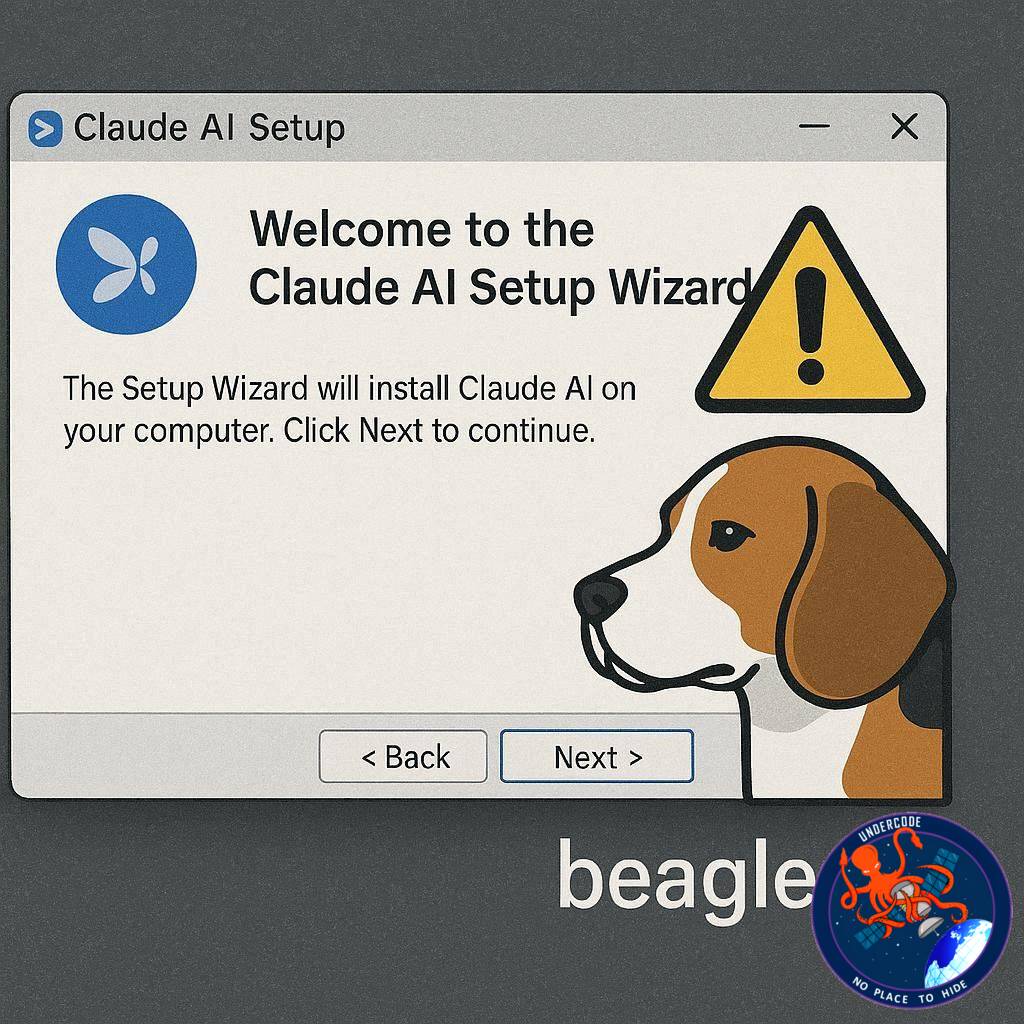
Cybercriminals are once again exploiting the massive popularity of artificial intelligence platforms to trick users into infecting their own systems. This time, attackers are abusing interest in Anthropic’s Claude AI chatbot by distributing a malicious Windows installer through a fake website designed to imitate the legitimate Claude brand. The campaign demonstrates how threat actors increasingly rely on branding, trust manipulation, and social engineering rather than software vulnerabilities to compromise victims.
Researchers uncovered a fraudulent domain, claude-pro[.]com, that delivers a trojanized installer containing a newly documented malware backdoor called “Beagle.” What initially appeared to security analysts as a familiar PlugX-style intrusion operation eventually revealed itself as a more advanced and customized attack chain involving DLL sideloading, encrypted payloads, shellcode decryption, and in-memory execution techniques.
The attack highlights a growing cybersecurity problem surrounding AI-themed scams. As public demand for AI assistants explodes, threat actors are rapidly building fake websites, counterfeit applications, and malicious installers that imitate trusted AI brands. Users searching for AI tools through search engines or advertisements are becoming prime targets for malware distribution campaigns.
Fake Claude Website Used to Spread Malware
Attackers created a convincing fake website that visually resembles the official Claude AI platform. Unlike the real service, however, the fraudulent site focuses almost entirely on persuading visitors to download a file named “Claude-Pro-windows-x64.zip.” Researchers reported that the archive size is approximately 505 MB, likely intended to make the package appear legitimate and professional.
According to the investigation, the operators behind the campaign likely relied on malvertising campaigns or search engine poisoning to drive victims toward the fake domain. This means users searching online for Claude AI downloads may unknowingly encounter sponsored malicious results or manipulated search rankings that redirect them to the fraudulent installer.
The success of the operation depends heavily on social engineering rather than exploiting unpatched vulnerabilities. Victims voluntarily download and execute the installer because they believe they are obtaining legitimate AI software. This approach remains highly effective because many users associate well-known AI brands with trust and innovation, lowering their suspicion levels during installation.
Inside the downloaded archive, researchers discovered an MSI installer containing several key components required for the infection chain. These included NOVupdate.exe, a malicious DLL file named avk.dll, and an encrypted payload file used later in the attack process.
NOVupdate.exe appears to be a signed updater connected to G DATA security software. Threat actors abused this trusted executable by manipulating it into loading a rogue DLL from the local directory. This technique is known as DLL sideloading, a common method attackers use to bypass security protections while executing malicious code under the appearance of legitimate software activity.
In DLL sideloading attacks, a legitimate signed application unknowingly loads an attacker-controlled library because the expected DLL file has been replaced or planted within the application’s working directory. Since the executable itself is trusted and digitally signed, many security products initially fail to identify the malicious behavior.
Researchers from Sophos noted that the infection chain initially resembled traditional PlugX malware operations due to its reuse of familiar sideloading patterns. However, deeper analysis showed that the attackers had modified the technique substantially to deploy an entirely different payload.
One particularly deceptive detail involved the installer delivering an actual functioning version of Claude software alongside the malware. This camouflage tactic helps reduce user suspicion because the application appears to install correctly and function normally after execution. Victims may therefore remain unaware that their systems have already been compromised.
Once activated, the malicious DLL decrypts embedded shellcode that launches DonutLoader, an open-source in-memory loader frequently used in advanced malware campaigns. DonutLoader enables attackers to execute payloads directly in memory, making detection significantly more difficult for traditional antivirus solutions.
Researchers also identified additional malware samples uploaded to VirusTotal during 2026 that reused the same XOR encryption key found in this campaign. One sample from March reportedly contained shellcode associated with the AdaptixC2 framework, suggesting possible links to broader malware development efforts.
Further investigation uncovered related domains impersonating major cybersecurity vendors including Trellix, CrowdStrike, and SentinelOne. This indicates that the operators may be experimenting with multiple fake-brand campaigns rather than focusing solely on Claude-themed lures.
Despite these overlaps, researchers warned that shared code patterns alone are not enough to definitively attribute all samples to the same threat actor. Malware developers frequently recycle open-source tools, loaders, encryption routines, and infection methods across different campaigns, making attribution increasingly complex.
What Undercode Say:
The fake Claude malware campaign represents a major shift in how cybercriminals are exploiting the AI boom. In previous years, threat actors mainly impersonated banking institutions, cloud providers, or software vendors. Today, artificial intelligence brands have become the new psychological attack surface because users are actively searching for AI tools with urgency and curiosity.
This campaign demonstrates how effective AI-themed social engineering can be. Many users are still unfamiliar with official distribution channels for AI products. Unlike traditional software ecosystems that rely on centralized app stores, AI tools often exist across websites, APIs, browser extensions, downloadable clients, and experimental beta portals. That confusion creates ideal conditions for phishing and malware operations.
The use of DLL sideloading also shows that older attack techniques remain extremely relevant when combined with modern branding tactics. Attackers do not necessarily need zero-day exploits when legitimate signed binaries can be weaponized to bypass trust mechanisms already built into Windows environments.
Another critical detail is the inclusion of a real working Claude installation alongside the malicious payload. This dramatically increases the success rate of the infection because users see exactly what they expected after installation. Security warnings become psychologically easier to ignore when the software appears functional.
The use of DonutLoader is another indicator that attackers are prioritizing stealth and memory-based execution. Traditional antivirus solutions remain heavily dependent on file-based scanning methods. In-memory loaders help attackers avoid leaving easily detectable artifacts on disk, reducing the effectiveness of many legacy endpoint protection systems.
The discovery of domains themed around security companies like CrowdStrike and SentinelOne is especially interesting. It suggests attackers are not simply targeting casual AI users but may also be exploring ways to compromise IT professionals, researchers, and enterprise administrators who trust familiar cybersecurity brands.
This campaign also highlights how search engines remain one of the largest malware distribution platforms on the internet. Malvertising and poisoned search results continue to generate enormous success rates because users inherently trust top-ranked results. Many victims never verify domains carefully before downloading software.
The operation further demonstrates how malware ecosystems increasingly reuse modular open-source components. DonutLoader, AdaptixC2-related shellcode, XOR encryption routines, and DLL sideloading methods are all examples of techniques that can be rapidly adapted across campaigns. This lowers development costs for attackers while making attribution more difficult for defenders.
Another concerning trend is the blending of legitimate software infrastructure with malicious payload delivery. By abusing signed executables associated with trusted vendors, attackers exploit weaknesses in application trust chains rather than directly attacking operating system vulnerabilities.
The rise of AI-related malware campaigns is likely only beginning. As AI adoption grows across enterprises, schools, governments, and personal devices, attackers will continue leveraging AI branding to lure victims. Fake ChatGPT clients, counterfeit Claude installers, malicious Gemini tools, and rogue AI browser extensions are expected to become increasingly common.
Organizations should therefore prioritize user awareness training specifically around AI-related phishing and fake software downloads. Many employees may incorrectly assume that any AI-branded tool appearing online is legitimate.
Security teams should also strengthen defenses against DLL sideloading by implementing application allowlisting, behavioral monitoring, and memory execution detection. Trusting signed binaries alone is no longer sufficient protection.
The campaign additionally reinforces the importance of downloading software only from official vendor domains. Users searching through advertisements or unofficial download portals dramatically increase their exposure to malware operations like this one.
Another notable aspect is how threat actors are capitalizing on hype cycles. Every major technology trend eventually becomes a social engineering opportunity. Cryptocurrency, NFTs, remote work tools, and now generative AI have all experienced waves of malware impersonation campaigns shortly after mainstream adoption.
The Beagle backdoor itself may represent a growing family of customized payloads designed specifically for AI-themed malware delivery operations. If attackers continue refining these techniques, future variants could include credential theft, browser session hijacking, ransomware deployment, or enterprise network persistence capabilities.
Defenders should pay close attention to campaigns that mix legitimate software execution with malicious sideloading because these attacks often evade traditional signature-based detection methods. Behavioral analytics and endpoint telemetry will become increasingly important in identifying suspicious loader activity.
The broader cybersecurity industry may also need to reconsider how trust is established online. Visual branding alone is no longer enough for users to determine legitimacy. Domain verification, signed installer validation, and secure distribution ecosystems will become critical in the AI era.
Ultimately, the fake Claude malware operation is not just another phishing campaign. It represents a convergence of AI hype, trusted software abuse, memory-based execution, and sophisticated social engineering tactics that reflect the next generation of malware distribution strategies.
Fact Checker Results
✅ Researchers did identify a fake Claude-themed website distributing malware through a trojanized Windows installer.
✅ The attack chain used DLL sideloading with a signed executable and malicious DLL to deploy the Beagle backdoor.
❌ There is currently no public evidence conclusively linking all related samples and fake-brand domains to a single threat actor.
Prediction
🔮 AI-themed malware campaigns will increase dramatically as generative AI platforms become mainstream consumer and enterprise tools.
🔮 Threat actors will likely expand beyond fake installers into malicious browser extensions, AI plugins, and counterfeit productivity integrations.
🔮 Future attacks may combine AI branding with ransomware deployment, credential theft, and cloud account compromise operations targeting businesses worldwide.
🕵️📝Let’s dive deep and fact‑check.
References:
Reported By: cyberpress.org
Extra Source Hub (Possible Sources for article):
https://www.quora.com/topic/Technology
Wikipedia
OpenAi & Undercode AI
Image Source:
Unsplash
Undercode AI DI v2
Bing
🔐JOIN OUR CYBER WORLD [ CVE News • HackMonitor • UndercodeNews ]
📢 Follow UndercodeNews & Stay Tuned:
𝕏 formerly Twitter 🐦 | @ Threads | 🔗 Linkedin | 🦋BlueSky | 🐘Mastodon


