
Listen to this Post
Introduction
Rising Wave of Coordinated Cyber Attacks Across Critical Systems
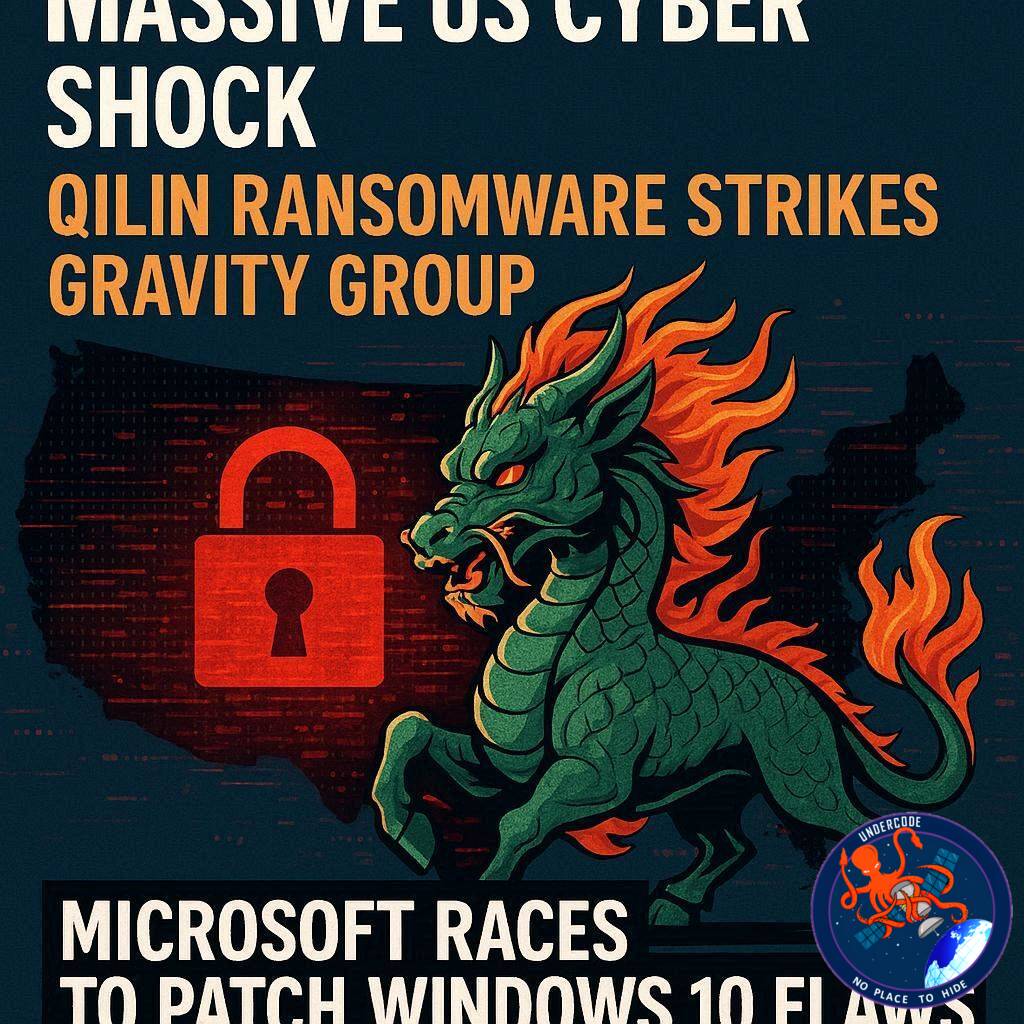
Cybersecurity tensions escalated sharply as new reports confirmed that the Gravity Group in the United States was targeted by the Qilin ransomware operation, resulting in encrypted systems and operational disruption. While the attack appears geographically contained, the implications highlight a broader trend of increasingly sophisticated ransomware campaigns focusing on high-value corporate infrastructure. At the same time, Microsoft released a significant Windows 10 security update addressing multiple vulnerabilities, signaling that defensive responses are now moving in parallel with fast-evolving cyber threats. The convergence of active ransomware deployment and urgent patch cycles reflects a digital environment where both attackers and defenders are accelerating their strategies in real time.
Incident
Gravity Group Targeted in Coordinated Ransomware Strike
Cybersecurity monitoring accounts reported that the Gravity Group in the United States was compromised in a ransomware attack attributed to the Qilin group. The intrusion led to encrypted internal systems, restricting access to critical operational data and disrupting normal business functions. Early indicators suggest that the attack primarily impacted US-based infrastructure rather than spreading globally.
Qilin Ransomware Continues Its Aggressive Expansion Pattern
Qilin, a known ransomware operator, has been increasingly active in targeting corporate and institutional networks. Its tactics typically involve infiltrating systems, exfiltrating sensitive data, and deploying encryption payloads that lock victims out of their own environments. This latest incident aligns with its established operational pattern of high-pressure extortion campaigns.
Limited Geographic Impact Reported
Initial assessments indicate that the disruption appears largely confined to the United States. There is currently no verified evidence suggesting widespread international spillover. However, cybersecurity analysts caution that ransomware campaigns often evolve after initial containment, sometimes expanding laterally across interconnected networks.
Operational Disruption and Data Encryption Confirmed
The primary impact of the attack has been confirmed as data encryption, which renders affected systems unusable without decryption keys held by the attackers. This has caused temporary operational disruptions for Gravity Group, affecting workflows, communication systems, and internal data access.
Microsoft Issues Critical Windows 10 Security Update
In a parallel development, Microsoft released Windows 10 KB5087544 for ESU and LTSC users. The update addresses multiple security flaws identified in May 2026, including vulnerabilities affecting system integrity and remote access components.
Remote Desktop and Secure Boot Improvements
The update also resolves issues related to Remote Desktop warning displays and enhances Secure Boot functionality. These improvements are aimed at strengthening system authentication layers and reducing exposure to boot-level attacks.
Regional System Adjustments Included in Patch
Microsoft additionally incorporated updates supporting Egypt’s daylight saving time changes, demonstrating that even operational and regional system configurations remain part of ongoing system maintenance cycles.
Cybersecurity Environment Under Dual Pressure
The simultaneous occurrence of ransomware attacks and large-scale patch releases reflects a dual-pressure environment. Organizations are forced to defend against active threats while also rapidly applying patches to prevent exploitation of known vulnerabilities.
Rising Dependence on Timely Patch Management
The incident reinforces the importance of timely software updates. Delays in patch adoption often create exploitable windows that ransomware groups are quick to target.
Growing Sophistication of Threat Actors
Groups like Qilin continue to refine their methods, combining encryption-based attacks with psychological pressure tactics such as data leak threats, increasing the complexity of incident response strategies.
What Undercode Says:
Escalation of Targeted Corporate Cyber Warfare
The Gravity Group incident is not an isolated disruption but part of a broader escalation in corporate-targeted cyber warfare. Ransomware operators are no longer random opportunists; they are structured entities that prioritize high-value organizations with predictable operational dependencies. The fact that the attack remained geographically contained does not reduce its strategic significance. Instead, it suggests precision targeting, where attackers focus on specific infrastructure nodes rather than wide-area disruption.
Qilin’s Strategic Evolution in Ransomware Economics
Qilin’s operational model reflects a shift in ransomware economics from volume-based attacks to high-impact, selective infiltration. This evolution allows attackers to maximize ransom pressure while minimizing exposure. By encrypting data and potentially exfiltrating sensitive information, groups like Qilin increase leverage over victims. The Gravity Group case highlights how such actors increasingly operate like digital extortion corporations with structured workflows and negotiation strategies.
Microsoft’s Patch Cycle as Reactive Defense Infrastructure
Microsoft’s release of KB5087544 illustrates the reactive nature of modern cybersecurity defense. Despite continuous improvements, patch cycles often follow discovery rather than prevent exploitation. The inclusion of fixes for Remote Desktop and Secure Boot indicates that attackers continue to probe foundational system layers. This reinforces the reality that operating systems remain persistent battlegrounds where legacy features and modern security expectations collide.
Interdependence Between Exploits and Patch Delays
A critical factor exposed by this incident is the dependency loop between vulnerability disclosure and patch deployment. Cybercriminal groups exploit the delay between patch release and user adoption. Even when updates are available, organizations frequently postpone installation due to operational concerns. This creates a predictable attack window that ransomware operators actively monitor and exploit with increasing efficiency.
Structural Weakness in Enterprise Cyber Readiness
Many enterprises still rely on fragmented cybersecurity frameworks that lack real-time threat response capabilities. The Gravity Group disruption suggests that even organizations with awareness of ransomware threats can fall victim if segmentation, monitoring, and rapid response mechanisms are insufficient. This highlights a structural weakness rather than an isolated technical failure.
Geopolitical Implications of Localized Cyberattacks
Although the attack is currently reported as US-focused, ransomware incidents often carry geopolitical implications. Even localized disruptions can affect global supply chains, particularly if affected companies operate in interconnected markets. Cyberattacks of this nature increasingly function as pressure instruments within broader economic and strategic competition frameworks.
Future Outlook of Ransomware Operational Models
The trajectory of ransomware groups suggests a continued shift toward hybrid operations combining encryption, data theft, and long-term extortion strategies. Future attacks are likely to become more persistent and adaptive, potentially integrating AI-driven reconnaissance techniques. Organizations will need to transition from reactive patching to predictive threat modeling to remain resilient.
🔍 Fact Checker Results
The Gravity Group attack is attributed to Qilin ransomware based on cybersecurity reporting, but attribution in ransomware cases can evolve over time.
Microsoft’s KB5087544 update is a real type of cumulative security patch cycle consistent with Windows 10 ESU and LTSC maintenance patterns.
No verified evidence currently confirms that the Qilin incident spread beyond the United States at the time of reporting.
📊 Prediction
Expansion of Ransomware Targeting Precision Infrastructure
Cybersecurity trends suggest that ransomware groups like Qilin will increasingly focus on mid-to-large scale corporate entities with high operational dependency on digital systems. Attacks are expected to become more selective, reducing noise while maximizing financial pressure.
Acceleration of Zero-Day Exploitation Windows
The gap between vulnerability discovery and patch deployment will likely remain a key exploitation window. Attackers are expected to invest more heavily in automated scanning systems that identify unpatched environments within hours of disclosure.
Increased Integration of Data Leaks and Psychological Pressure
Future ransomware campaigns are predicted to rely less on pure encryption and more on dual-extortion models involving data leaks. This shift increases reputational risk for victims, making negotiations more complex and recovery more costly.
🕵️📝Let’s dive deep and fact‑check.
References:
Reported By: x.com
Extra Source Hub (Possible Sources for article):
https://www.medium.com
Wikipedia
OpenAi & Undercode AI
Image Source:
Unsplash
Undercode AI DI v2
Bing
🔐JOIN OUR CYBER WORLD [ CVE News • HackMonitor • UndercodeNews ]
📢 Follow UndercodeNews & Stay Tuned:
𝕏 formerly Twitter 🐦 | @ Threads | 🔗 Linkedin | 🦋BlueSky | 🐘Mastodon


