
Listen to this Post
Introduction
For decades, the tech industry has chased one impossible dream: dramatically increasing computer speed without creating dangerous levels of heat or massive power consumption. Traditional semiconductor technology pushed modern computing to incredible heights, but engineers have struggled with a painful reality. Faster processing usually means more electricity, more heat, and eventually, physical limits that chips cannot overcome.
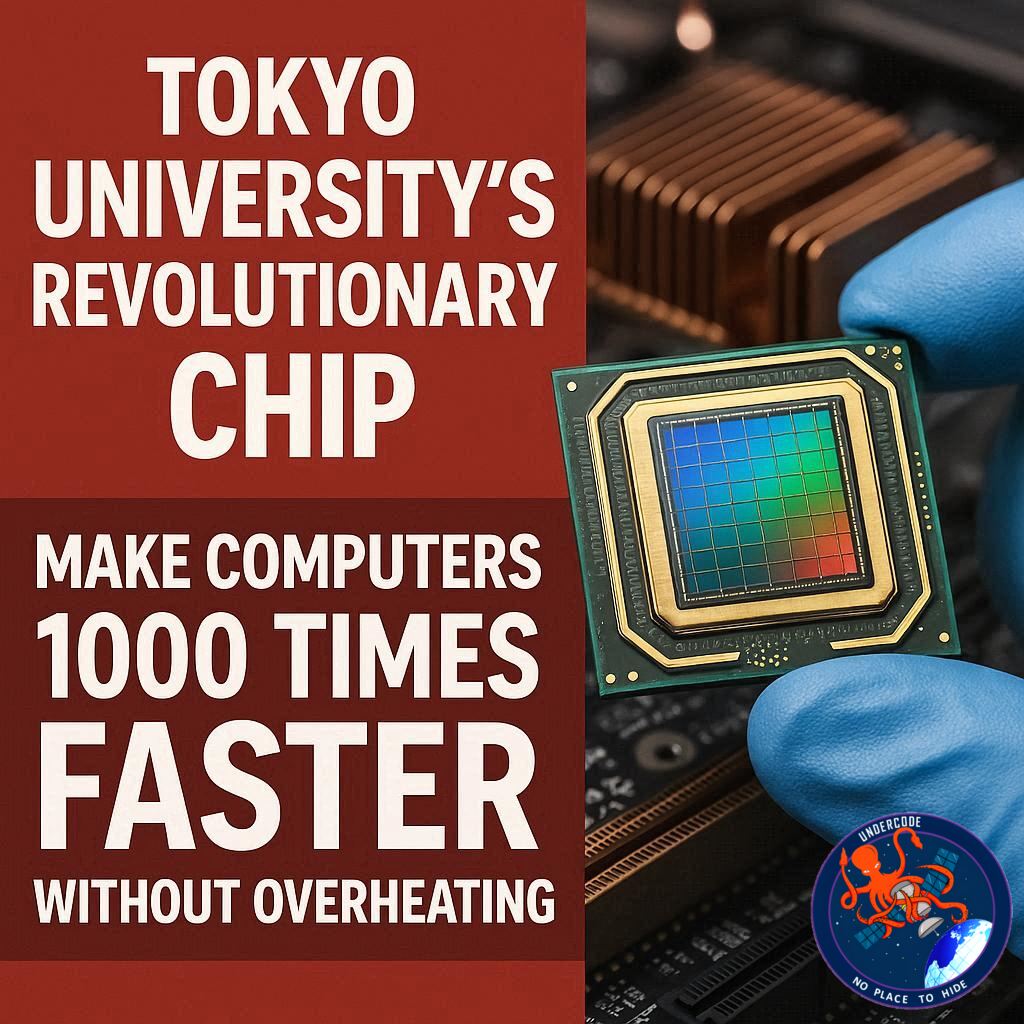
Now, a research team led by the The University of Tokyo may have found a breakthrough that could redefine the future of computing itself. Their newly developed semiconductor device reportedly processes information up to 1,000 times faster than current technologies while generating far less heat. Even more impressive, the system remained stable after more than 100 billion operations.
The implications are enormous. Artificial intelligence, cloud computing, data centers, gaming, scientific simulations, and even consumer electronics could all be transformed by this advancement. Researchers believe the technology may eventually allow tasks that currently take an hour to complete in just a single second.
The findings were published in the prestigious scientific journal Science, drawing global attention from researchers and semiconductor companies eager to solve the growing energy crisis caused by modern computing infrastructure.
A New Era Beyond Traditional Semiconductors
Modern computers operate using bits represented by “0” and “1.” These bits are controlled through tiny electronic components known as transistors. For years, improving computing performance depended largely on making these transistors smaller and faster.
However, the industry reached a major wall during the 2000s. Increasing processing speed beyond certain thresholds caused a dramatic rise in power consumption. More electricity produced more heat, and excess heat damages chips, shortens hardware lifespan, and demands expensive cooling systems.
The Tokyo research team approached the problem from an entirely different angle.
Instead of relying solely on the flow of electricity, the newly developed device uses the magnetic properties of electrons, commonly known as “spin,” to represent bits. This approach belongs to a field known as spintronics, which many scientists believe could become the successor to conventional semiconductor design.
The newly created component is called a “non-volatile quantum switching device.” Unlike traditional chips, it stores and processes information through magnetic orientation rather than continuous electrical current.
Processing Speeds That Sound Almost Unreal
The experimental results shocked many observers in the semiconductor field.
Researchers successfully processed one bit of information in just 40 picoseconds. A picosecond represents one trillionth of a second. Existing technologies typically require about one nanosecond for similar operations.
That difference may sound abstract, but it is enormous in computing terms. The new technology is roughly 1,000 times faster than conventional systems.
Professor Satoshi Nakatsuji explained the potential impact with a striking comparison. Data downloads that currently require an hour might theoretically be completed in only one second using future systems based on this architecture.
If commercialized successfully, the breakthrough could transform industries dependent on ultra-fast computation.
How the New Device Actually Works
The semiconductor device consists primarily of two materials: tantalum and manganese tin.
When an electrical signal passes through tantalum, the signal ultimately becomes stored in manganese tin as tiny magnetic orientations. These orientations function as binary information.
The elegance of this system lies in its efficiency.
Traditional chips constantly move electrical charges, which creates resistance and heat. The Tokyo team’s approach minimizes that issue because magnetic information storage generates far less thermal stress.
During experiments, the device maintained stable operation after more than 100 billion repeated processing cycles. Existing technologies attempting similar speeds would typically fail after only thousands or millions of operations due to overheating damage.
That stability could become just as important as the raw speed increase.
Why Heat Is the Real Enemy of Modern Computing
Most consumers focus on processor speed, but engineers worry more about heat.
Every major advancement in AI, cloud computing, and high-performance data processing has dramatically increased electricity demand worldwide. Data centers already consume massive amounts of power, and the rise of AI is accelerating the problem rapidly.
According to the International Energy Agency, global data center electricity demand could reach 945 terawatt-hours by 2030 because of AI expansion. That would exceed the total electricity consumption of entire countries, including Japan.
Cooling systems have become one of the largest operational expenses for major technology companies. Servers generate extreme heat during intensive AI training and data processing tasks. Reducing thermal output while increasing speed would completely reshape data center economics.
This is why the Tokyo breakthrough matters far beyond laboratory science.
It addresses speed, durability, and energy efficiency simultaneously.
Potential Applications Across Industries
The technology’s future applications could be enormous if mass production becomes feasible.
Artificial intelligence systems could process training data dramatically faster while consuming far less energy. Smartphones could gain desktop-level computing power without overheating. Gaming systems could deliver advanced graphics instantly. Autonomous vehicles could process environmental data in real time with greater efficiency.
Scientific research may benefit the most.
Fields such as climate modeling, quantum simulations, medical imaging, and genomic analysis depend heavily on massive computational workloads. Faster and cooler chips would allow researchers to perform calculations previously considered too expensive or time-consuming.
The new device also offers another critical advantage: non-volatile memory capability.
Because information is stored magnetically, data can remain preserved even when power is removed. That means future systems could potentially store information with almost zero ongoing energy consumption.
Professor Nakatsuji emphasized this point directly, explaining that information recording may eventually occur with almost no energy usage at all.
Miniaturization Could Make the Technology Even Better
One particularly interesting finding emerged during the research.
The team discovered that the device’s performance actually improves as it becomes smaller.
This trend is extremely important because the semiconductor industry constantly seeks miniaturization. Technologies that become weaker at smaller scales often fail commercially. But systems that improve during miniaturization are highly attractive for future manufacturing.
Researchers now believe practical applications could reduce information-processing power consumption to just one-hundredth of current technologies.
The team hopes to develop practical prototype chips by 2030.
However, commercialization will require major industrial cooperation. Semiconductor fabrication is among the most expensive and technically demanding industries on Earth. Collaboration with global manufacturers will be essential.
Professor Nakatsuji stated that international partnerships will play a critical role in bringing the technology into society.
What Undercode Say:
This breakthrough feels less like a normal semiconductor improvement and more like the early signs of a computing reset.
For years, the industry narrative focused on squeezing smaller transistors onto silicon wafers. Companies fought microscopic battles for marginal performance gains. But physics eventually pushes back. Heat becomes unavoidable. Energy bills explode. Cooling systems become monstrous. AI accelerates all of these problems simultaneously.
That is why this research stands out.
The Tokyo team is not simply making existing chips faster. They are changing the underlying logic of how information itself is processed.
Spintronics has existed as a theoretical promise for decades, but commercial reality always seemed distant. Many experimental technologies demonstrate exciting lab results yet collapse when scalability, durability, or manufacturing costs enter the conversation.
This case feels different because several critical barriers appear to have been addressed at once.
First, the speed increase is not incremental. A 1,000x improvement immediately attracts serious industrial attention.
Second, the durability numbers are astonishing. Surviving over 100 billion processing cycles changes the discussion from “interesting experiment” to “potential infrastructure technology.”
Third, the energy implications arrive at exactly the right moment.
AI has become an electricity monster.
Companies are currently building gigantic data centers that consume power on the scale of cities. Governments are beginning to worry about energy infrastructure limits. Environmental concerns are growing. Semiconductor innovation is no longer just about convenience or entertainment. It is becoming a geopolitical and economic necessity.
This is where the Tokyo breakthrough could become historically important.
If chips based on this architecture truly achieve commercial viability, the effects would spread far beyond consumer electronics.
Cloud computing costs could collapse.
AI model training times could shrink dramatically.
Battery-powered devices could become vastly more capable.
Edge computing could explode because lower heat enables powerful local processing.
Military systems, medical technologies, robotics, and scientific supercomputers would all benefit.
Another overlooked factor is cooling infrastructure.
Modern AI hardware requires enormous cooling systems. Some facilities even consume large quantities of water just to maintain safe temperatures. A chip that naturally produces less heat changes the economics of entire server architectures.
That could become one of the most valuable aspects of the technology.
There is also a strategic global dimension here.
The semiconductor industry is increasingly tied to national security and technological sovereignty. Countries are investing billions to secure advanced chip manufacturing capabilities. A major Japanese breakthrough could reposition Japan more aggressively within next-generation semiconductor competition.
Historically, Japan dominated parts of the semiconductor world before losing ground to Taiwan, South Korea, and the United States. Technologies like this could help Japan regain influence in advanced computing research.
Still, skepticism is healthy.
Laboratory success does not guarantee mass production success.
Semiconductor manufacturing is brutally unforgiving. Materials that work perfectly in controlled environments may encounter scaling problems, fabrication inconsistencies, or cost barriers in commercial settings.
The 2030 target is ambitious.
But even if commercialization takes longer, the research direction itself is extremely important. It suggests the future of computing may rely less on brute-force electrical scaling and more on alternative physical principles like spin-based processing.
That shift may eventually become unavoidable.
The biggest winners from this technology may not even exist yet. Entire industries often emerge after foundational hardware breakthroughs. Smartphones, cloud platforms, and modern AI ecosystems all depended on earlier semiconductor revolutions.
This could become another one of those moments.
Not instantly.
Not magically.
But potentially historically.
Fact Checker Results
✅ The research was conducted by a team led by the The University of Tokyo and published in Science.
✅ The device reportedly processed information in 40 picoseconds, approximately 1,000 times faster than conventional semiconductor technologies.
❌ Commercial deployment is not guaranteed yet, since large-scale manufacturing challenges and industrial integration remain unresolved.
Prediction
🔮 Spintronics-based processors will likely become one of the most heavily funded semiconductor research areas before 2030.
🔮 AI infrastructure companies may aggressively pursue low-heat computing technologies as electricity costs continue rising globally.
🔮 If the Tokyo team successfully commercializes this architecture, future computers could become dramatically faster while consuming only a fraction of today’s energy.
▶️ Related Video (84% Match):
🕵️📝Let’s dive deep and fact‑check.
References:
Reported By: xtechnikkeicom_2df1be1de15bd856435de080
Extra Source Hub (Possible Sources for article):
https://www.linkedin.com
Wikipedia
OpenAi & Undercode AI
Image Source:
Unsplash
Undercode AI DI v2
Bing
🔐JOIN OUR CYBER WORLD [ CVE News • HackMonitor • UndercodeNews ]
📢 Follow UndercodeNews & Stay Tuned:
𝕏 formerly Twitter 🐦 | @ Threads | 🔗 Linkedin | 🦋BlueSky | 🐘Mastodon


